Negative Feedback: Salt Concentration (Grade 12 NSC Matric Life Sciences): Revision Notes
📚Revision Notes
Negative Feedback: Salt Concentration
Introduction to salt concentration regulation
Your body needs to maintain the right balance of salts in your blood and tissue fluids to function properly. This process is called homeostasis. The concentration of salts, particularly sodium ions (Na⁺) and potassium ions (K⁺), directly affects the osmotic pressure in your body fluids.
When salt levels become too high or too low, your body uses a negative feedback system to bring them back to normal. This system works like a thermostat - it detects changes and triggers responses that reverse those changes.
Note
Homeostasis is the body's ability to maintain stable internal conditions despite changes in the external environment. Salt concentration regulation is one of the most important homeostatic processes in your body.
The role of aldosterone in salt regulation
The key hormone involved in salt regulation is aldosterone, which is produced by your adrenal glands. This hormone acts like a controller that tells your kidneys how much sodium to keep or get rid of.
Aldosterone works by:
- Increasing the reabsorption of sodium ions from urine back into the blood
- Controlling how much sodium is excreted in urine
- Helping maintain normal salt concentrations in body fluids
Note
Think of aldosterone as the "sodium controller" - when your body needs more sodium, aldosterone tells the kidneys to save it. When there's too much sodium, aldosterone production decreases, allowing excess sodium to be lost in urine.
How negative feedback controls salt concentration
The negative feedback system for salt concentration involves several organs working together to maintain optimal sodium levels in your body fluids.
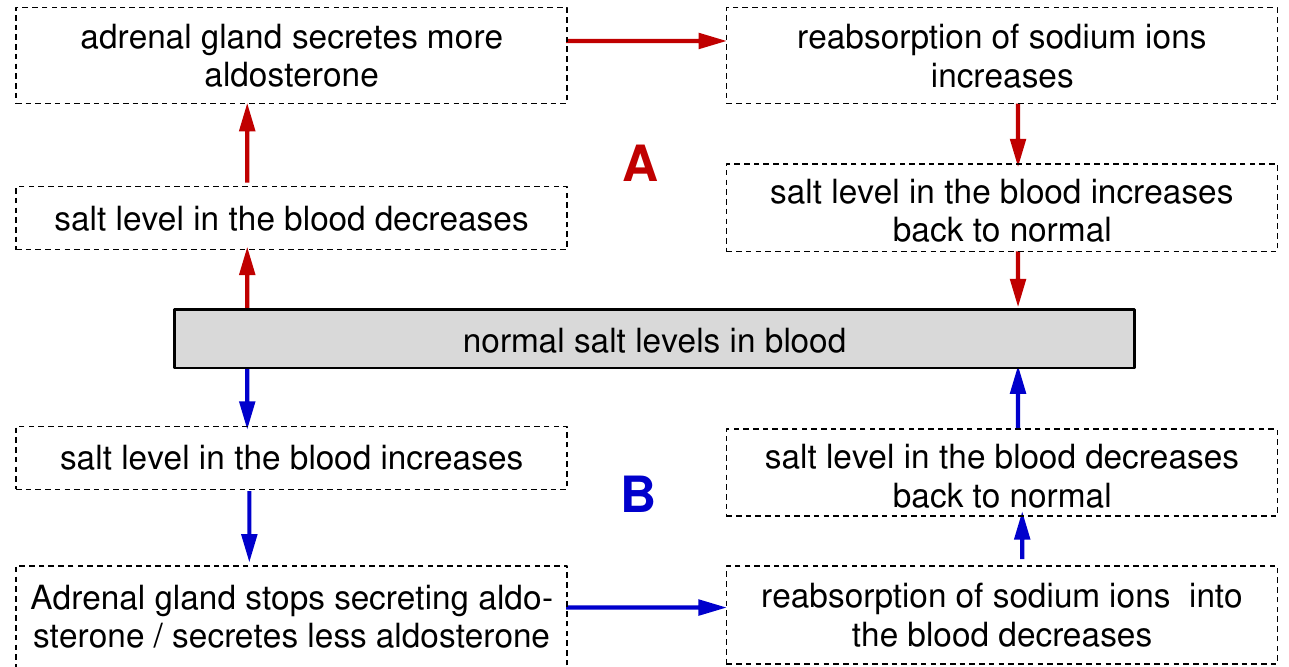
The diagram above shows how your body responds to both low and high salt levels through two different pathways (A and B).
Pathway A: when salt levels drop below normal
When your blood salt concentration becomes too low, your body responds through this sequence:
Example
Worked Example: Low Salt Response Pathway
Step 1: Detection Receptor cells in your kidneys detect the decreased sodium ion levels in the blood
Step 2: Hormone release The adrenal gland receives signals and secretes more aldosterone
Step 3: Correction Aldosterone stimulates increased reabsorption of sodium ions from the kidney filtrate back into the blood
Step 4: Result Less sodium is lost in urine, and blood salt levels increase back to normal
Pathway B: when salt levels rise above normal
When your blood salt concentration becomes too high, the opposite response occurs:
Example
Worked Example: High Salt Response Pathway
Step 1: Detection Receptor cells in your kidneys detect the increased presence of sodium ions in the blood
Step 2: Hormone reduction The adrenal gland stops releasing aldosterone (or secretes less)
Step 3: Correction Without aldosterone stimulation, sodium ions are not reabsorbed from the filtrate
Step 4: Result More sodium is excreted in urine, and blood salt levels decrease back to normal
Comparison of the two pathways
When salt levels are low:
- Problem: Low salt levels in blood and tissue fluids
- Detection: Kidney receptor cells sense decreased sodium ion levels
- Response: Adrenal gland produces the hormone aldosterone
- Action: Aldosterone stimulates sodium ion reabsorption from kidney filtrate
- Outcome: Less sodium lost in urine, salt levels return to normal
When salt levels are high:
- Problem: Increased salt levels in blood and tissue fluids
- Detection: Kidney receptor cells detect excess sodium ions
- Response: Adrenal gland stops releasing aldosterone
- Action: Without aldosterone, sodium ions are not reabsorbed
- Outcome: More sodium excreted in urine, salt levels return to normal
Why this system is important
This negative feedback system ensures that your body maintains optimal function through several key mechanisms:
- Your cells maintain proper function by having the right salt concentration
- Water balance is maintained (since salt concentration affects water movement)
- Blood pressure remains stable (salt affects blood volume)
- Your body can adapt to changes in salt intake from food
Note
The relationship between salt concentration and water balance is crucial - where sodium goes, water follows. This is why salt regulation directly impacts blood volume and pressure.
Common exam misconceptions
Important
Watch out for these common mistakes:
- Don't confuse salt regulation with water regulation - they're related but separate processes
- Remember that aldosterone increases sodium reabsorption, not excretion
- The adrenal gland produces aldosterone, not the kidney (though the kidney detects the changes)
- High salt levels lead to decreased aldosterone, not increased aldosterone
Exam tips for NSC students
Summary
Key Points to Remember for Exams:
- Always mention that this is a negative feedback system
- Name the specific hormone (aldosterone) and gland (adrenal gland)
- Explain both pathways (low salt and high salt scenarios)
- Include the role of receptor cells in the kidneys
- State that the end result is always homeostasis - return to normal levels
Remember!
Summary
Essential Takeaways:
-
Negative feedback in salt concentration regulation involves the detection of changes in sodium levels by kidney receptor cells, followed by appropriate responses to restore normal levels
-
Aldosterone from the adrenal glands is the key hormone that controls sodium reabsorption - more aldosterone means more sodium is kept in the body, less aldosterone means more sodium is lost in urine
-
The system works in two opposite directions: when salt is low, aldosterone increases sodium reabsorption; when salt is high, aldosterone decreases and more sodium is excreted
-
Homeostasis is always the goal - both pathways ultimately return salt concentration to normal levels in blood and tissue fluids
-
This regulation system helps maintain proper osmotic pressure and supports normal cellular function throughout the body