Naming Hydrocarbons (Grade 12 NSC Matric Physical Sciences): Revision Notes
📚Revision Notes
Naming Hydrocarbons
Introduction to hydrocarbon naming
Hydrocarbons are organic compounds made up entirely of carbon and hydrogen atoms. The IUPAC (International Union of Pure and Applied Chemistry) system provides a systematic way to name these compounds based on their structure and functional groups.
There are three main types of hydrocarbons you need to know:
- Alkanes: contain only single bonds between carbon atoms
- Alkenes: contain at least one double bond between carbon atoms
- Alkynes: contain at least one triple bond between carbon atoms
Note
The key to successful naming is following a systematic 5-step process that works for all hydrocarbon types. This consistent approach will help you tackle any hydrocarbon naming problem with confidence.
Naming alkanes
Alkanes are saturated hydrocarbons containing only single covalent bonds between carbon atoms. They have the general formula and always end with the suffix -ane.
Step-by-step naming process for alkanes
- Identify the functional group: Alkanes contain only single bonds
- Find the longest carbon chain: Count the maximum number of carbon atoms in a continuous chain
- Number the carbon atoms: Number from one end to give branches the lowest possible numbers
- Identify and name any branches: Name substituent groups and note their positions
- Combine the name elements: Put together in the order: branches (alphabetically) + main chain name
Example
Worked Example: Simple Alkane
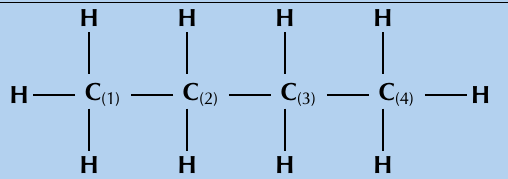
Let's name this compound:
Solution:
- Functional group: Single bonds only - this is an alkane (suffix -ane)
- Longest chain: Four carbon atoms - prefix "but-"
- Numbering: Carbons numbered 1, 2, 3, 4
- Branches: No branches present
- Final name: butane
Example
Worked Example: Branched Alkane
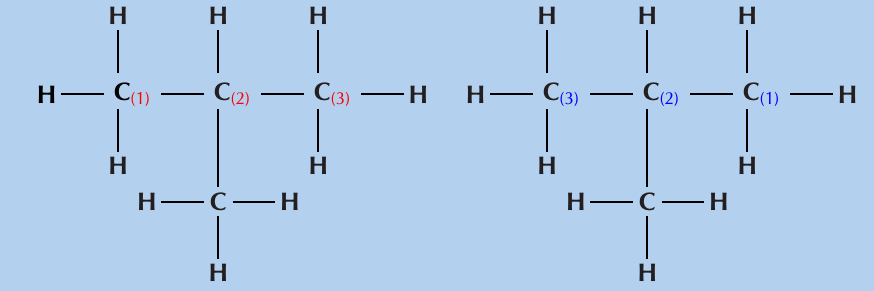
Now let's look at a more complex structure:
Solution:
- Functional group: Single bonds only - this is an alkane (suffix -ane)
- Longest chain: Three carbon atoms in the main chain - prefix "prop-"
- Numbering: The chain can be numbered from either end, but we choose the direction that gives the branch the lowest number
- Branches: There is a methyl group (CH₃) attached to carbon 2
- Final name: 2-methylpropane
Key point: The methyl group gets the suffix "-yl" because it's a branch, not part of the main chain.
Example
Worked Example: Multiple Branches
For compounds with multiple branches:
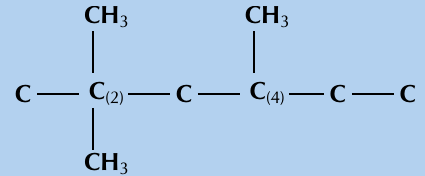
When naming compounds like 2,2,4-trimethylhexane:
- "hex" indicates 6 carbons in the longest chain
- "trimethyl" means three methyl branches
- "2,2,4" shows two methyl groups on carbon 2 and one on carbon 4
- Identical branches are grouped together with prefixes (di-, tri-, tetra-)
Naming alkenes
Alkenes are unsaturated hydrocarbons containing at least one carbon-carbon double bond. They have the general formula and end with the suffix -ene.
Key rules for alkenes
The main difference from alkanes is that the longest chain must contain the double bond, and the double bond gets priority in numbering.
Example
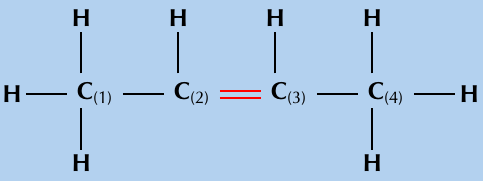
Worked Example: Simple Alkene
Solution:
- Functional group: Contains a double bond - this is an alkene (suffix -ene)
- Longest chain: Four carbons containing the double bond - prefix "but-"
- Numbering: Number to give the double bond the lowest possible number
- Branches: No branches
- Final name: but-2-ene or 2-butene
The number "2" indicates that the double bond starts at carbon 2.
Example
Worked Example: Branched Alkene
For more complex alkenes with branches:
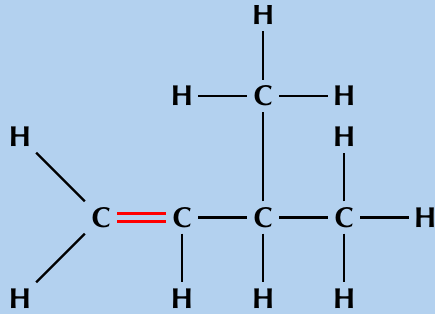
When the compound is 3-methylbut-1-ene:
- "but" indicates 4 carbons in the longest chain containing the double bond
- "1-ene" means the double bond starts at carbon 1
- "3-methyl" indicates a methyl branch on carbon 3
Important
Exam tip: Always ensure the longest chain contains the functional group (double bond for alkenes).
Naming alkynes
Alkynes are unsaturated hydrocarbons containing at least one carbon-carbon triple bond. They have the general formula and end with the suffix -yne.
Key rules for alkynes
Similar to alkenes, the longest chain must contain the triple bond, and the triple bond gets the lowest number.

Note
This diagram shows the bonding differences: ethane (single bonds), ethene (double bond), and ethyne (triple bond).
Example
Worked Example: Simple Alkyne
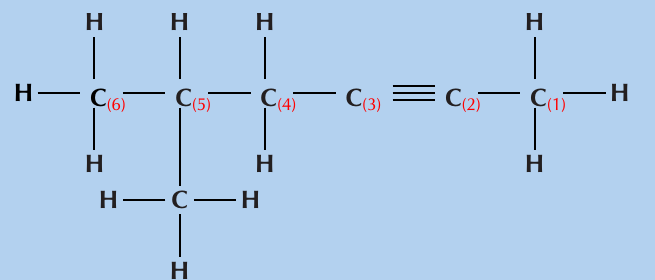
Solution:
- Functional group: Contains a triple bond - this is an alkyne (suffix -yne)
- Longest chain: Six carbons containing the triple bond - prefix "hex-"
- Numbering: Number to give the triple bond position 2
- Branches: Methyl group on carbon 5
- Final name: 5-methylhex-2-yne
Example
Worked Example: Multiple Triple Bonds

For compounds with multiple triple bonds like hept-1,5-diyne:
- "hept" indicates 7 carbons
- "1,5-diyne" shows triple bonds at positions 1 and 5
- "di-" prefix indicates two triple bonds
Special naming considerations
Halogen substituents
When hydrocarbons contain halogen atoms as substituents, use these prefixes:
Note
Halogen Naming Reference:
- Fluorine → fluoro
- Chlorine → chloro
- Bromine → bromo
- Iodine → iodo
Halogens are named alphabetically with other substituents and numbered according to their position on the carbon chain.
Key naming rules and exam tips
Essential rules to remember:
-
Functional group priority: The longest chain must always contain the functional group (double or triple bond)
-
Lowest numbering: Always number to give the functional group the lowest possible position number
-
Alphabetical ordering: List substituents in alphabetical order (ignoring prefixes like di-, tri-)
-
Identical substituents: Use prefixes di-, tri-, tetra- for multiple identical groups
-
Continuous chain: The longest chain doesn't have to be drawn in a straight line - follow the carbon connections
Important
Common exam mistakes to avoid:
- Forgetting to include the functional group in the longest chain
- Numbering from the wrong end of the chain
- Not using alphabetical order for substituents
- Confusing the suffixes (-ane, -ene, -yne)
Note
Problem-solving approach:
Always use the same systematic method:
- Identify the functional group first
- Find the longest chain containing it
- Number to give lowest numbers to functional groups
- Name all branches and their positions
- Combine everything in the correct order
Summary
Key Points to Remember:
- Alkanes (single bonds) end in -ane and follow the formula
- Alkenes (double bonds) end in -ene and follow the formula
- Alkynes (triple bonds) end in -yne and follow the formula
- The longest carbon chain must contain the functional group (double or triple bond)
- Always number to give functional groups the lowest possible numbers
- Substituents are listed alphabetically with their position numbers