Mechanism of Reaction and Catalysis (Grade 12 NSC Matric Physical Sciences): Revision Notes
📚Revision Notes
Mechanism of Reaction and Catalysis
What causes chemical reactions to occur?
Chemical reactions happen when particles collide with each other. However, not all collisions between reactant particles lead to successful reactions. This is explained by collision theory, which states that for a collision to result in a chemical reaction, two conditions must be met:
- The particles must collide with sufficient energy to break existing bonds
- The particles must have the correct orientation during collision
Note
This explains why only a small fraction of particle collisions actually produce chemical reactions, even though particles are constantly moving and colliding in a reaction mixture. Think of it like trying to unlock a door - you need both the right key (correct orientation) and enough force to turn it (sufficient energy).
Activation energy
Activation energy is the minimum amount of energy that reactant particles must possess for a chemical reaction to take place.
Important
Definition: The minimum energy required for a chemical reaction to proceed.
Even at a fixed temperature, particles in a reaction mixture have different amounts of kinetic energy. Some particles move faster than others, meaning only some will have enough energy to overcome the activation energy barrier. The particles that do have sufficient energy can participate in successful collisions that lead to chemical reactions.
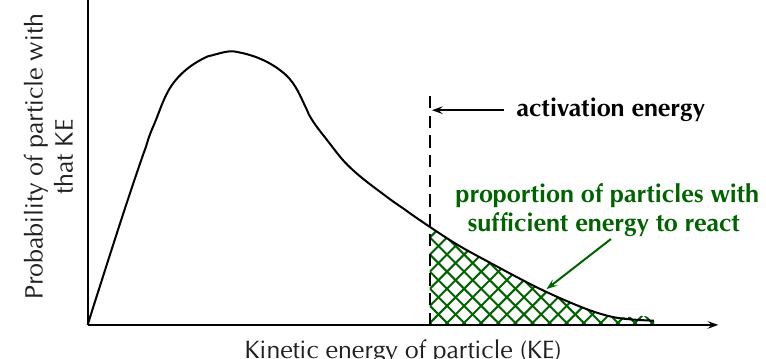
The graph above shows how particle energies are distributed at a constant temperature. The shaded area represents the proportion of particles that have enough kinetic energy to react.
Effect of temperature on reaction rates
When you increase the temperature of a reaction mixture, you increase the average kinetic energy of all the particles. This has two important effects:
- More particles now have kinetic energy greater than the activation energy
- Particles move faster, increasing the frequency of collisions
Note
The relationship between temperature and reaction rate is why we often heat reaction mixtures to make them go faster - more particles have enough energy to react successfully.
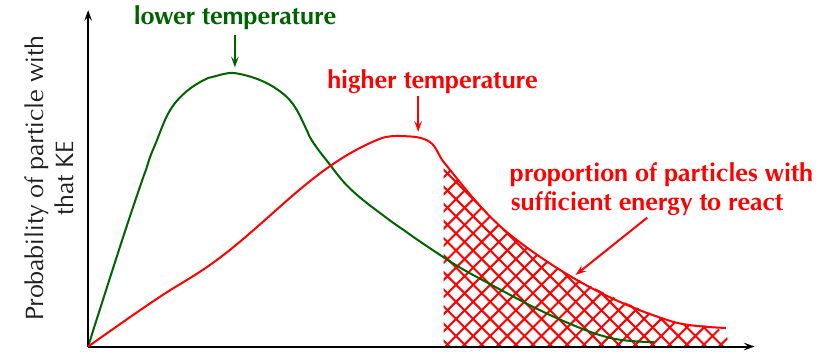
The diagram above compares particle energy distributions at low temperature (green curve) and high temperature (red curve). Notice how the higher temperature curve is shifted to the right and flattened, showing that more particles have high kinetic energy.
Energy profile diagrams
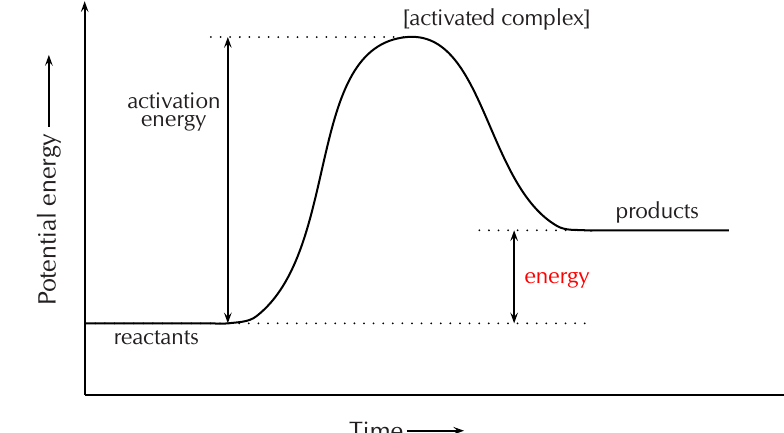
Energy profile diagrams (also called reaction coordinate diagrams) show how the potential energy changes as reactants are converted to products. These diagrams help us visualise the energy pathway of a reaction.
Endothermic reactions
In an endothermic reaction, energy is absorbed from the surroundings:
Example
Energy Change in Endothermic Reactions:
The diagram shows that products have higher energy than reactants, meaning energy must be supplied for the reaction to occur.
Exothermic reactions
In an exothermic reaction, energy is released to the surroundings:
Example
Energy Change in Exothermic Reactions:
For exothermic reactions, the products have lower energy than the reactants, and the excess energy is released during the reaction.
How catalysts work
A catalyst is a substance that increases the rate of a chemical reaction without being permanently consumed in the process.
Important
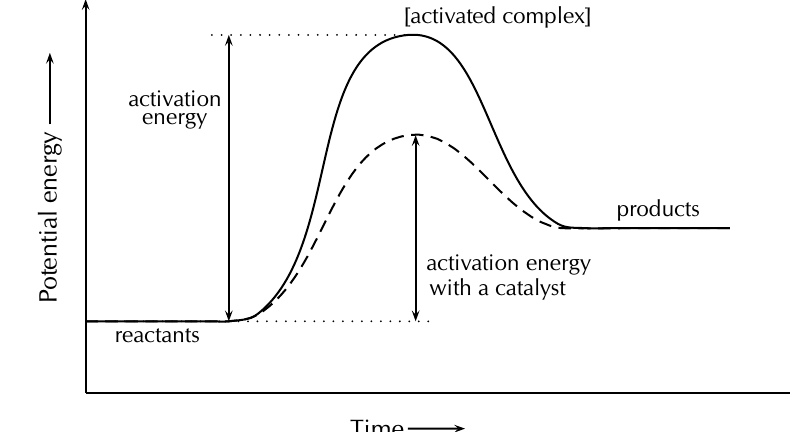
Definition: A catalyst speeds up a chemical reaction, without being consumed by the reaction. It increases the reaction rate by lowering the activation energy for a reaction.
Catalysts work in two main ways:
- Orienting reactant particles so that successful collisions are more likely to occur
- Reacting with reactants to form an intermediate compound that requires lower energy to form the final products
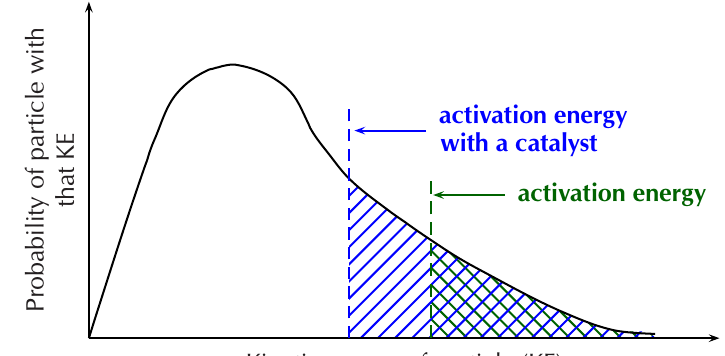
The diagram above shows how a catalyst increases the proportion of particles with sufficient energy to react by lowering the activation energy barrier.
Catalyst mechanisms and alternative pathways
Catalysts provide an alternative reaction pathway with lower activation energy. This alternative route involves the formation of intermediate compounds.
Example
Worked Example: Catalysed Reaction Mechanism
Here's how a typical catalysed reaction works:
Step 1: (catalyst C reacts with reactant A)
Step 2: (second reactant B joins the intermediate)
Step 3: (catalyst is released, product D is formed)
Overall reaction:
Notice that the catalyst (C) appears on both sides of the overall equation - it is regenerated unchanged at the end of the reaction.
Without a catalyst, the reaction would be:
Examples of catalysts
- Metals such as platinum, copper and iron act as catalysts in industrial processes
- Enzymes in our bodies are biological catalysts that speed up biochemical reactions
- The intermediate compound formed during catalysis is sometimes called the activated complex
Note
Catalysts are like shortcuts in a mountain pass - they provide an easier route to get from one side to the other, but they don't change your starting point or destination.
Summary
Key Points to Remember:
-
Collision theory: Only particle collisions with sufficient energy and correct orientation result in chemical reactions
-
Activation energy: The minimum energy barrier that must be overcome for a reaction to proceed - higher activation energy means slower reaction rates
-
Temperature effect: Increasing temperature increases the proportion of particles with enough energy to react, making reactions faster
-
Catalyst function: Catalysts lower activation energy by providing alternative reaction pathways, but are not consumed in the overall reaction
-
Energy diagrams: Show the energy pathway from reactants to products via the activated complex - the peak represents the activation energy barrier