Electrodynamics (Grade 12 NSC Matric Physical Sciences): Revision Notes
📚Revision Notes
Electrical Machines – Generators and Motors
Introduction to electromagnetic induction
When you move a conductor through a magnetic field, or when you change the magnetic field around a conductor, an electric current is generated in the conductor. This fundamental principle of electromagnetic induction forms the basis of how generators and motors work in our everyday technology.
The amount of current produced depends on several key factors:
- The speed at which the conductor moves through the changing magnetic field
- The number of coils that make up the conductor
- The position of the conductor relative to the magnetic field lines
Note
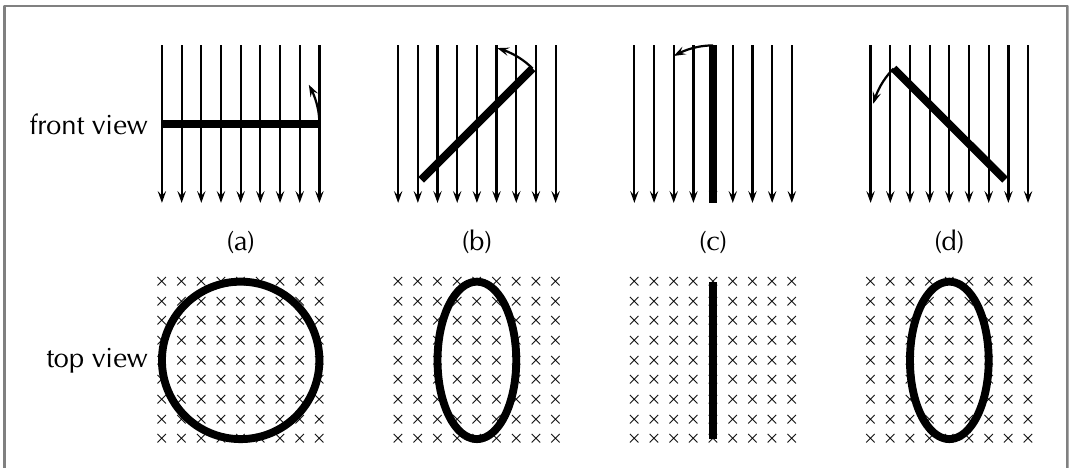
The relationship between conductor orientation and magnetic field strength is crucial. When a conductor is positioned perpendicular to magnetic field lines, maximum current is induced. As the conductor rotates and becomes parallel to the field lines, the induced current approaches zero.
Faraday's law
The principle behind electromagnetic induction is described by Faraday's Law, which you need to understand thoroughly for your NSC exam.
Definition: Faraday's Law states that the EMF (electromotive force) induced around a single loop of conductor is proportional to the rate of change of magnetic flux through the area of the loop.
The mathematical expression for Faraday's Law is:
Where:
- ε (epsilon) = induced EMF
- N = number of turns in the coil
- Δφ (delta phi) = change in magnetic flux
- Δt (delta t) = change in time
- φ = B · A cos θ (where B is magnetic field strength, A is area, and θ is the angle)
Important
This law explains how the orientation of a conductor affects the magnetic flux passing through it. As a conductor rotates in a magnetic field, the flux changes continuously, which creates the varying EMF and current patterns we see in electrical machines.
Electrical generators
What is a generator?
Definition: A generator is a device that converts mechanical energy into electrical energy using electromagnetic induction principles.
Generators work by rotating conductors (coils of wire) in magnetic fields. This rotation causes continuous changes in magnetic flux through the coils, which induces EMF according to Faraday's Law. The mechanical energy required to rotate the coils can come from various sources like steam turbines, water flow, or wind.
AC generators
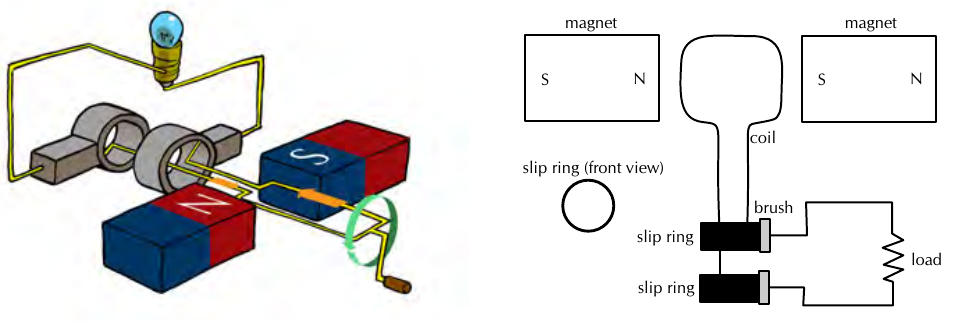
An AC generator (also called an alternator) produces alternating current that regularly changes direction. The basic components include:
- Coils of wire that rotate within a magnetic field
- Permanent magnets that provide the magnetic field
- Slip rings that maintain electrical contact with the rotating coils
- Brushes that transfer current from the slip rings to the external circuit
Note
The key to understanding AC generators is recognising how the current direction changes. As one side of the coil moves towards the north pole of the magnet, current flows in one direction. When the coil completes half a rotation, that same side now moves towards the south pole, causing current to flow in the opposite direction.
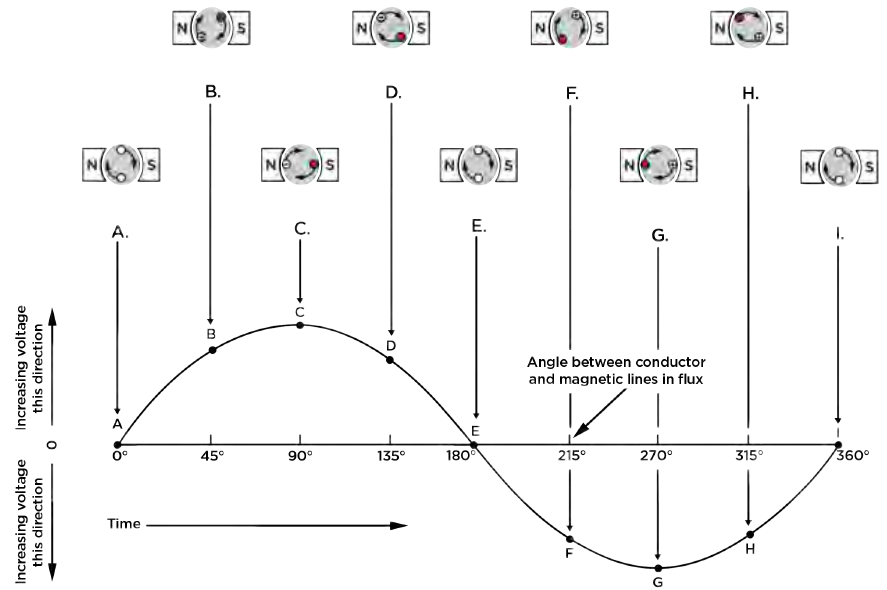
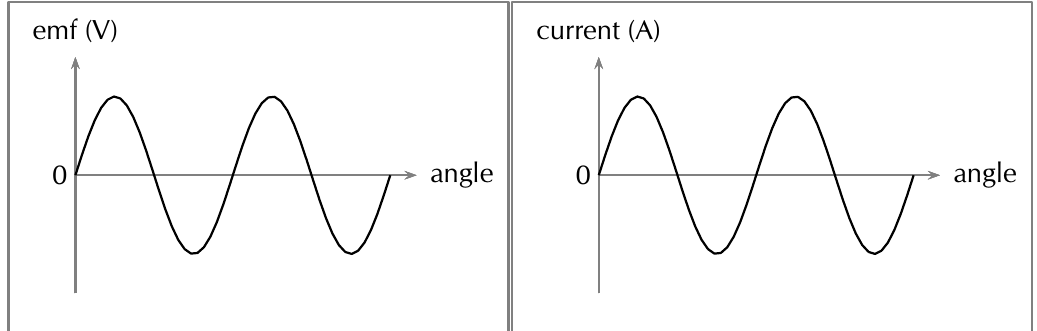
This creates the characteristic alternating current pattern where the current oscillates between positive and negative values in a smooth, sinusoidal wave. The frequency of this alternation depends on the rotation speed of the generator.
DC generators
A DC generator produces direct current that flows in only one direction through the external circuit. While the current in the rotating coil itself still alternates (just like in an AC generator), a special component called a split-ring commutator ensures the external current remains unidirectional.
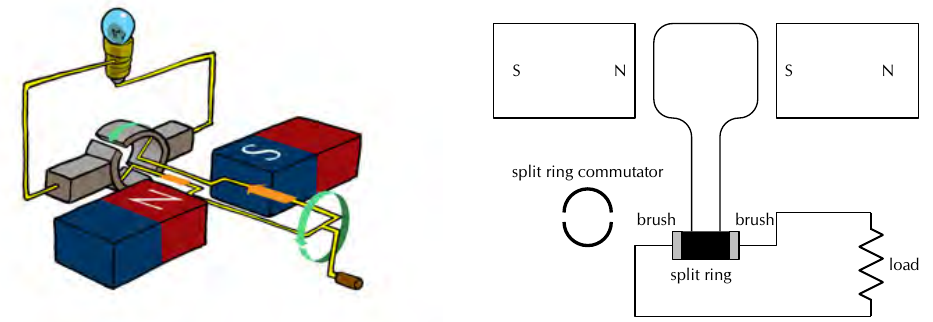
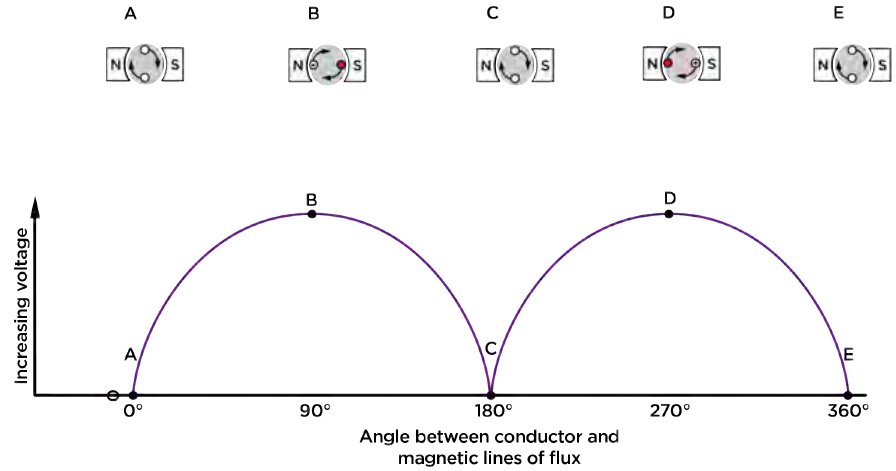
The commutator consists of a ring split into two segments. As the coil rotates, the commutator segments switch which brush they contact, effectively reversing the connections every half turn. This switching action means that even though the coil current alternates, the current flowing through the external circuit always moves in the same direction.
Note
The resulting DC output isn't perfectly smooth - it varies in magnitude but never changes direction, creating a pulsating direct current pattern.
AC versus DC generators
The main differences between AC and DC generators are:
AC Generators:
- Use slip rings for electrical contact
- Produce smooth alternating current
- Simpler construction with fewer moving parts
- No sparking issues at high speeds
- More efficient for long-distance power transmission
DC Generators:
- Use split-ring commutators for electrical contact
- Produce pulsating direct current
- More complex construction due to commutator system
- Can experience sparking at high speeds, especially in hazardous environments
- Better for applications requiring direct current
Electric motors
What is an electric motor?
Definition: An electric motor is a device that converts electrical energy into mechanical energy using electromagnetic force principles.
Motors work on the opposite principle to generators. Instead of moving a conductor through a magnetic field to generate electricity, motors use electricity flowing through conductors in magnetic fields to create motion.
The Lorentz force
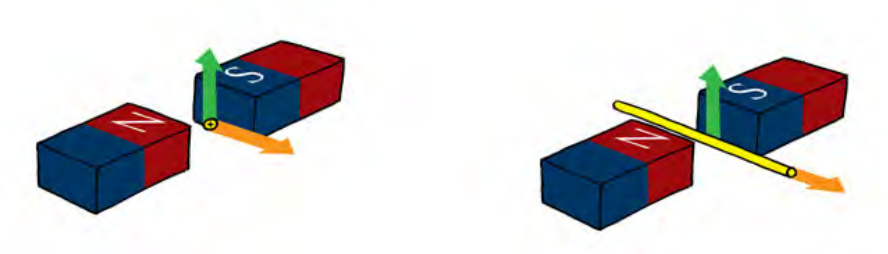
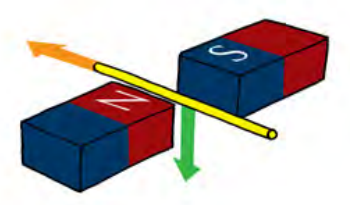
The fundamental principle behind electric motor operation is the Lorentz force. When a charged particle moves through a magnetic field, it experiences a force perpendicular to both its motion and the magnetic field direction.
Definition: The Lorentz force is the force experienced by a moving charged particle in an electric and magnetic field.
For the magnetic component of this force:
Where:
- F = force (in newtons, N)
- q = electric charge (in coulombs, C)
- v = velocity of the charged particle (in m·s⁻¹)
- B = magnetic field strength (in teslas, T)
How motors create rotation
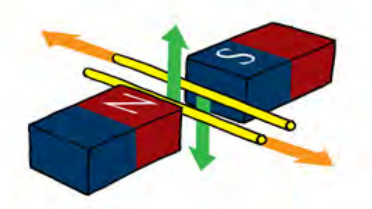
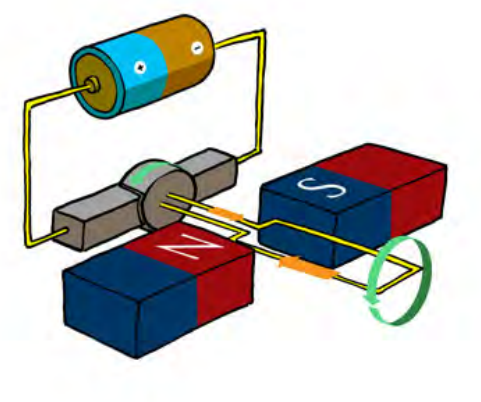
When electric current flows through a conductor placed in a magnetic field, the moving charges (current) experience the Lorentz force. This force acts on the conductor itself, causing it to move.
Note
In a motor, conductors are arranged in a loop or coil. When current flows through opposite sides of this loop in a magnetic field, the Lorentz forces on each side act in opposite directions. This creates a torque (turning force) that causes the coil to rotate around a central axis.
Right-hand rule
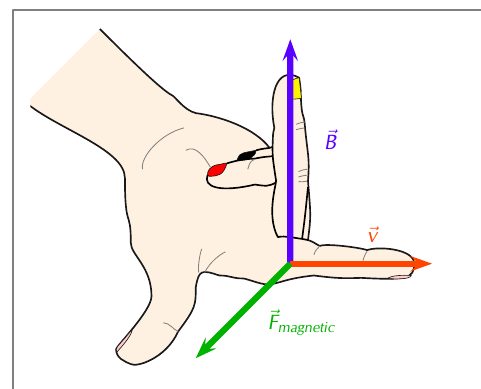
To determine the direction of the magnetic force, use the right-hand rule:
- Point your first finger in the direction of the magnetic field (B)
- Point your second finger in the direction of current flow (v)
- Your thumb points in the direction of the magnetic force (F)
Important
This rule helps you predict which way a current-carrying conductor will move in a magnetic field, which is essential for understanding motor operation.
AC versus DC motors
AC Motors:
- Use slip rings (similar to AC generators)
- Depend on alternating current to reverse magnetic fields
- Generally more efficient and require less maintenance
- Widely used in household appliances
DC Motors:
- Use split-ring commutators to reverse current direction
- Require brushes that make and break contact every half rotation
- Provide better speed control and high starting torque
- Common in automotive applications (starter motors)
The choice between AC and DC motors depends on the specific application requirements, with each type offering distinct advantages.
Real-life applications
Automotive applications
Alternators: Every car contains an AC generator called an alternator. When the engine runs, it mechanically rotates the alternator, which generates alternating current to charge the car's battery and power the electrical systems while driving.
Starter motors: Cars also use powerful DC electric motors as starter motors. These motors convert electrical energy from the battery into mechanical energy to rotate the engine crankshaft, allowing the engine to start. Starter motors require very high current to generate enough torque to overcome engine compression.
Large-scale electricity generation
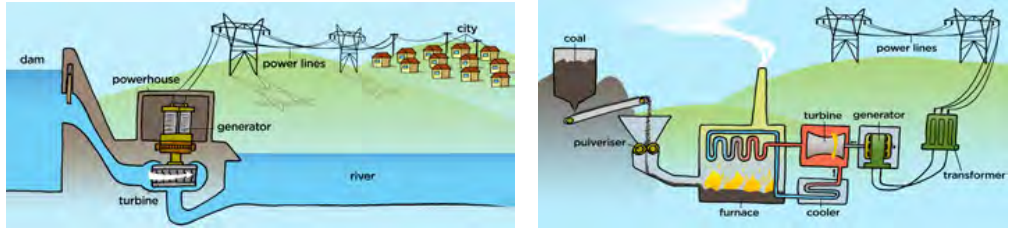
Power stations use massive AC generators to produce electricity for distribution to homes, offices, and factories. These generators are rotated by various energy sources:
- Coal-fired power plants burn coal to create steam that drives turbines
- Hydroelectric plants use flowing water to rotate turbines
- Nuclear power plants use nuclear reactions to generate steam for turbines
- Wind farms use wind energy to directly rotate generator turbines
Note
The electricity generated at power stations typically starts at low voltage but high current. Transformers convert this to high voltage, low current for efficient transmission over long distances through national power grids.
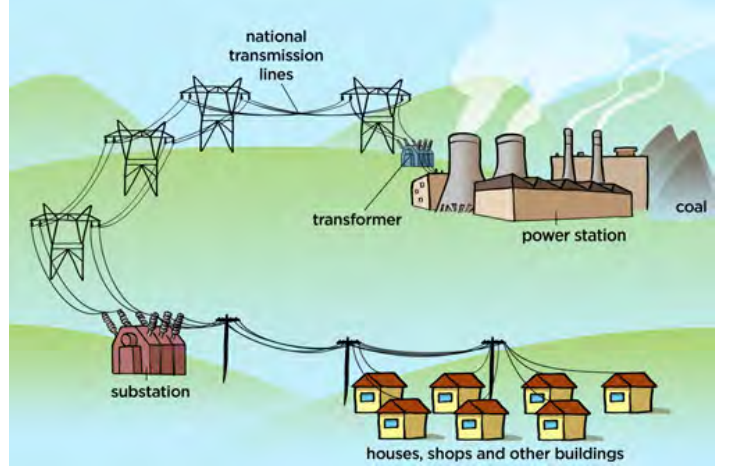
Near consumption areas, transformers reduce the voltage back to safe levels (240V in South Africa) for use in homes and businesses.
Example
Worked Example 1: Calculating induced EMF
Question: A coil with 200 turns rotates in a magnetic field of 0.05 T. If the magnetic flux through the coil changes from maximum to zero in 0.01 seconds, calculate the induced EMF.
Solution: Given:
- N = 200 turns
- B = 0.05 T
- Δt = 0.01 s
- Δφ = change from maximum flux to zero
Step 1: Calculate the change in flux When flux changes from maximum (B·A) to zero: Δφ = 0 - B·A = -B·A
Step 2: Apply Faraday's Law ε = -N × (Δφ/Δt) ε = -200 × (-B·A/0.01) ε = 200 × B·A/0.01
The exact EMF value depends on the coil area, but the principle shows how rapid flux changes create large induced EMFs.
Example
Worked Example 2: Lorentz force calculation
Question: A charged particle with charge 2 × 10⁻⁶ C moves at 300 m/s perpendicular to a magnetic field of 0.8 T. Calculate the magnetic force on the particle.
Solution: Given:
- q = 2 × 10⁻⁶ C
- v = 300 m/s
- B = 0.8 T
Step 1: Apply the Lorentz force formula F = qvB
Step 2: Substitute values F = (2 × 10⁻⁶) × 300 × 0.8 F = 4.8 × 10⁻⁴ N
The magnetic force on the particle is 4.8 × 10⁻⁴ N.
Example
Worked Example 3: Generator frequency
Question: An AC generator rotates at 3000 revolutions per minute. What is the frequency of the AC current produced?
Solution: Given:
- Rotation speed = 3000 rev/min
Step 1: Convert to revolutions per second 3000 rev/min ÷ 60 s/min = 50 rev/s
Step 2: Determine frequency For a simple AC generator, frequency equals rotation frequency Frequency = 50 Hz
This matches the standard AC frequency used in South Africa's power grid.
Summary
Key Points to Remember:
-
Generators convert mechanical energy to electrical energy using Faraday's Law of electromagnetic induction
-
Motors convert electrical energy to mechanical energy using the Lorentz force on current-carrying conductors in magnetic fields
-
AC generators use slip rings to produce alternating current, while DC generators use commutators to produce direct current
-
The right-hand rule helps determine the direction of magnetic forces in motors: first finger = magnetic field, second finger = current, thumb = force direction
-
Real-world applications include car alternators and starter motors, as well as massive generators in power stations that supply electricity to entire communities