Newton’s Second Law Revisited (Grade 12 NSC Matric Physical Sciences): Revision Notes
📚Revision Notes
Newton's Second Law Revisited
Understanding the connection between force and momentum
Previously, you studied situations where an object's momentum changed, but you didn't examine what actually caused these changes. Now we can connect Newton's laws of motion to momentum changes, building on your Grade 11 knowledge of forces.
In Grade 11, you learned that an object continues in its state of motion unless acted upon by a force. This means that without a force acting on an object, its momentum will not change.
Note
This connection between force and momentum change is fundamental to understanding how objects interact with each other and their environment. It bridges the gap between what you learned about forces in Grade 11 and the momentum concepts you're studying now.
Newton's Second Law definition
Important
Newton's Second Law of Motion (N2): The net or resultant force acting on an object is equal to the rate of change of momentum.
Mathematically, this can be expressed as:
This is the most general form of Newton's Second Law, which accounts for both changing mass and velocity situations.
Special case: constant mass
When an object's mass remains constant (which applies to most everyday situations), Newton's Second Law becomes:
We can show the relationship between these forms:
This demonstrates that a net force causes an object to change both its motion and its momentum.
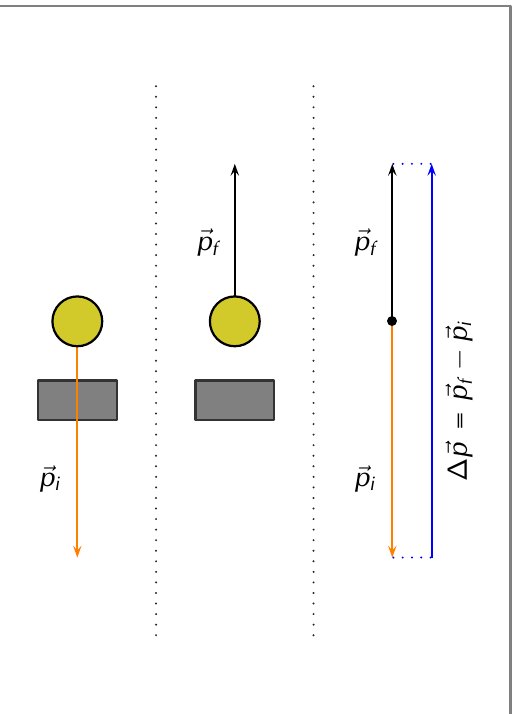
The vector nature of momentum
Remember that both momentum and velocity are vector quantities, which means direction is crucial. You must choose a positive direction when solving problems and stick to it throughout your calculations.
Note
The vector nature of momentum is one of the most important aspects to remember. Many students make errors by forgetting to consider direction properly. Always establish your coordinate system at the beginning of each problem and maintain consistency throughout your solution.
Calculating change in momentum
The change in momentum is calculated using:
Where:
- = final momentum
- = initial momentum
- = mass (constant)
- = final velocity
- = initial velocity
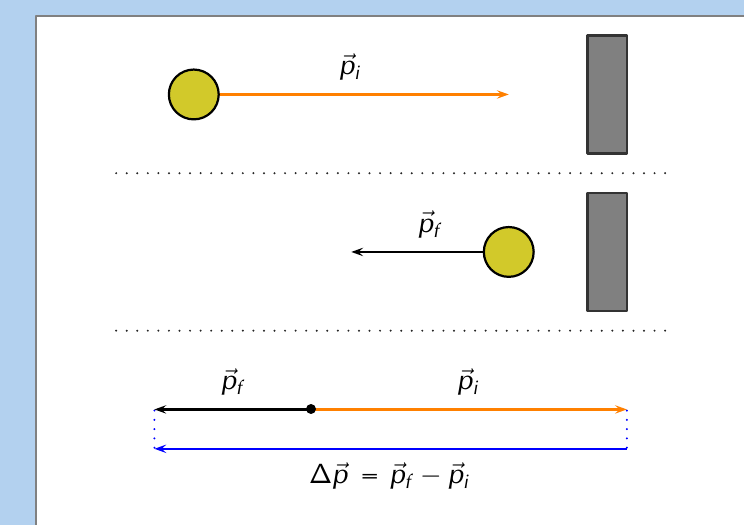
Example
Worked Example 1: Tennis ball collision with wall
Question: A tennis ball of mass 58 g strikes a wall perpendicularly with a velocity of 10 m·s⁻¹. It rebounds at a velocity of 8 m·s⁻¹. Calculate the change in momentum of the tennis ball caused by the wall.
Solution:
Step 1: Identify the information given
- Ball's mass = 58 g = 0.058 kg
- Initial velocity = 10 m·s⁻¹ towards the wall
- Final velocity = 8 m·s⁻¹ away from the wall
Step 2: Choose a frame of reference Let's choose towards the wall as the positive direction.
Step 3: Do the calculation kg·m·s⁻¹ away from the wall
Step 4: Quote the final answer The change in momentum is 1.04 kg·m·s⁻¹ away from the wall.
Example
Worked Example 2: Rubber ball bouncing
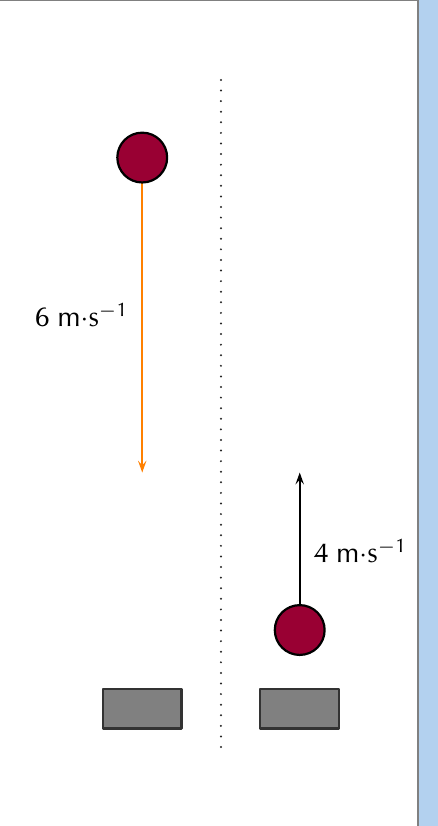
Question: A rubber ball of mass 0.8 kg is dropped and strikes the floor with an initial velocity of 6 m·s⁻¹. It bounces back with a final velocity of 4 m·s⁻¹. Calculate the change in momentum of the rubber ball caused by the floor.
Solution:
Step 1: Identify the information given
- Ball's mass = 0.8 kg
- Initial velocity = 6 m·s⁻¹ downwards
- Final velocity = 4 m·s⁻¹ upwards
Step 2: Choose frame of reference Let's choose down as the positive direction.
Step 3: Do the calculation kg·m·s⁻¹ upwards
Step 4: Quote the final answer The change in momentum is 8.0 kg·m·s⁻¹ upwards.
Example
Worked Example 3: Squash ball collision
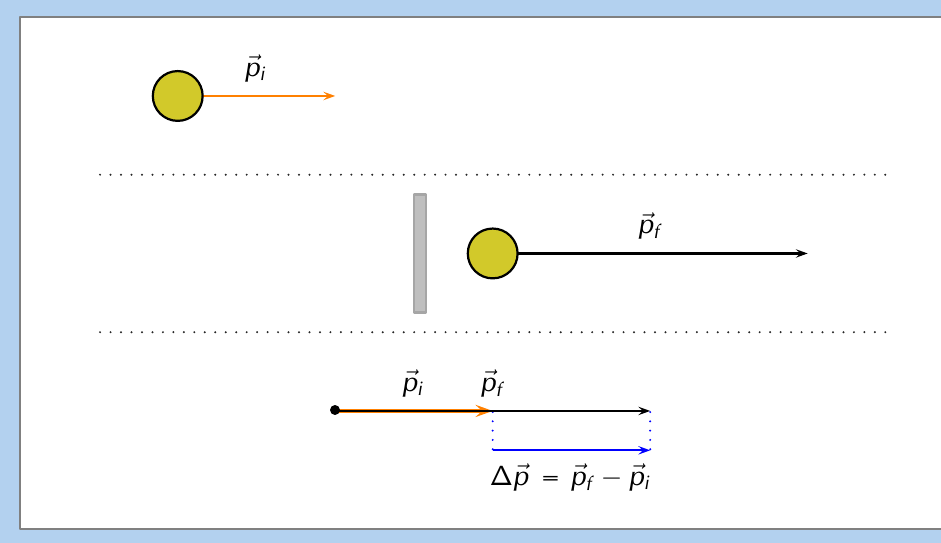
Question: A regulation squash ball weighs 24 g. In a squash match, a ball bounces off the back wall in the direction of the front wall at 1 m·s⁻¹ before a player hits it with a racquet. After being struck towards the front wall, the ball is moving at 20 m·s⁻¹. What is the change in momentum?
Solution:
Step 1: Identify the information given
- Ball's mass = 24 g = 0.024 kg
- Initial velocity = 1 m·s⁻¹ towards the front wall
- Final velocity = 20 m·s⁻¹ towards the front wall
Step 2: Choose a frame of reference Let's choose towards the front wall as the positive direction.
Step 3: Do the calculation kg·m·s⁻¹ towards the front wall
Step 4: Quote the final answer The change in momentum is 0.46 kg·m·s⁻¹ towards the front wall.
Problem-solving approach
When solving momentum problems, always follow these steps:
Note
Systematic Problem-Solving Steps:
- Identify the information given and convert to SI units
- Choose a frame of reference (pick positive direction)
- Do the calculation using appropriate formulas
- Quote the final answer with correct units and direction
Following this systematic approach will help you avoid common mistakes and ensure you get full marks in examinations.
Exam tips
Important
Critical Exam Success Tips:
- Always remember that momentum is a vector quantity - direction matters
- Choose your positive direction at the start and be consistent
- Pay attention to signs in your calculations
- Include both magnitude and direction in your final answer
- Convert all masses to kilogrammes and velocities to m·s⁻¹
Many students lose marks by forgetting the vector nature of momentum or by being inconsistent with their chosen reference frame.
Summary
Key Points to Remember:
- Newton's Second Law connects net force to the rate of change of momentum:
- For constant mass:
- Momentum is a vector quantity - always consider direction when solving problems
- Change in momentum:
- Follow the systematic four-step approach for all momentum problems