Mutagens (HSC SSCE Biology): Revision Notes
📚Revision Notes
Mutagens
Introduction to mutagens
A mutagen is an environmental agent that can alter DNA and cause mutations. Mutations are changes to the genetic material of cells, specifically alterations in the sequence of nucleotides in DNA. These changes can arise spontaneously during DNA replication, or they can be induced by exposure to environmental factors such as UV light, cigarette smoke, or other harmful substances.
The process of inducing a mutation through external agents is called mutagenesis, and the mutations that result are termed induced mutations. Understanding mutagens is crucial because many of them are carcinogenic (cancer-causing).
Note
The connection between mutagens and cancer exists because mutations can occur in genes that regulate the cell cycle or control cell division, potentially leading to uncontrolled cell growth and tumour formation.
Historical context
The harmful effects of mutagens were discovered over a century ago through tragic circumstances. During the late 1800s and early 1900s, scientists studying radiation were unaware of its dangers. Marie Curie, who worked extensively with ionising radiation throughout her career, died in 1934 from leukaemia caused by prolonged exposure to radioactive materials. Similarly, Rosalind Franklin, who used X-rays in her crystallography studies, died of ovarian cancer in 1958.
The link between radiation exposure and increased cancer rates became clearer after the 1945 bombing of Hiroshima, where survivors suffered physical mutations from radioactive fallout. This connection was further confirmed by victims of the 1986 Chernobyl nuclear meltdown, who showed immediate DNA damage that was subsequently passed to their descendants.
Important
By the 1970s, scientists understood that not only radiation but also certain chemicals and even some viruses could alter DNA structure and lead to cancer.
Categories of mutagens
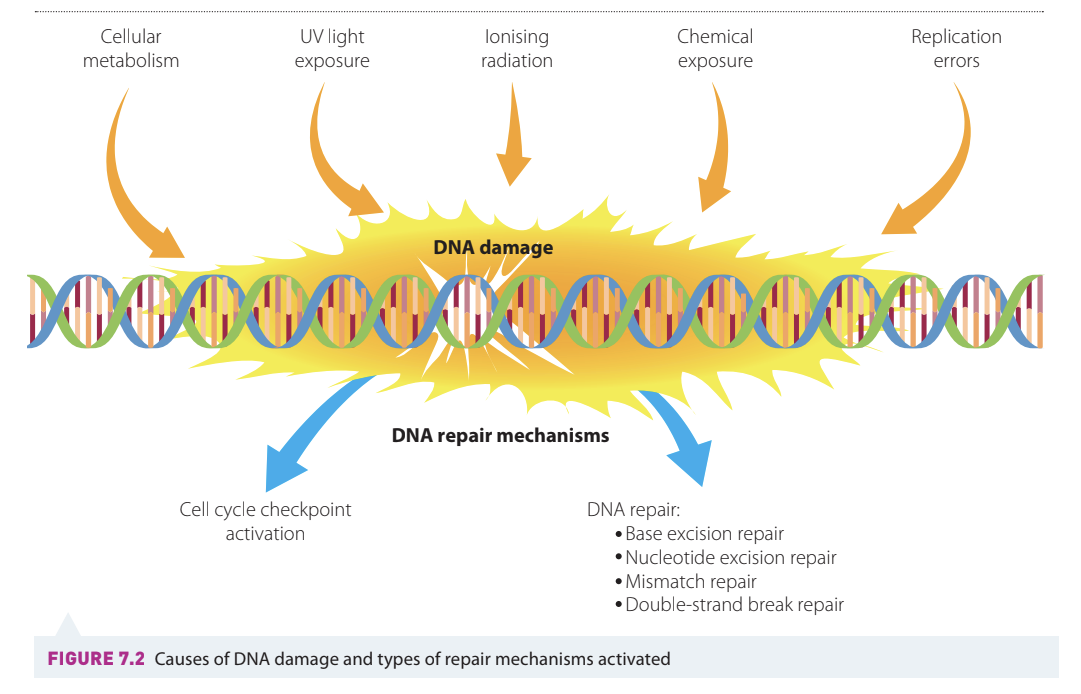
Environmental agents that maintain DNA integrity are essential for proper cell functioning. Mutagens can be grouped into three main categories based on their source: chemical mutagens, naturally occurring mutagens, and physical mutagens. Each type affects DNA in different ways.
Chemical mutagens
Chemical mutagens are substances that cause mutations when cells are exposed to them at high frequencies or for prolonged periods. Many everyday chemicals have been found to have mutagenic properties over time, and regulations now limit or ban their use.
Examples of chemical mutagens include:
- Ingested chemicals such as alcohol, tar in tobacco smoke, certain medications, and chemicals in food (especially charred and fatty foods, food additives, and preservatives like nitrites)
- Environmental irritants and poisons including organic solvents (such as benzene), cleaning products, asbestos, coal tars, pesticides, and some hair dyes
How chemical mutagens work:
Note
Chemical mutagens are often structurally similar to the normal bases found in DNA (purines and pyrimidines). Because of this similarity, they can be mistakenly incorporated into DNA during replication. This leads to incorrect nucleotides being inserted opposite them during replication, a process called mispairing. The result is often a non-functional protein product.
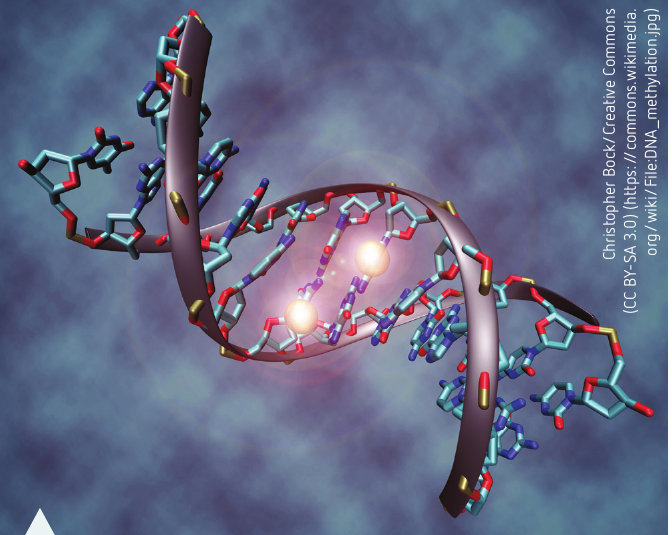
Common types of chemical mutagens include:
- Alkylating agents: Add chemical groups to DNA bases
- De-aminating agents: Remove amino groups from bases
- Intercalating agents: Insert themselves between DNA bases, disrupting the DNA structure
Naturally occurring mutagens
Some mutations previously thought to arise spontaneously may actually result from exposure to mutagens that occur naturally in the environment. Naturally occurring mutagens are present at normal levels within natural environments and may cause mutations, with the likelihood increasing with greater frequency and duration of exposure.
These mutagens can be divided into two groups: biological mutagens and non-biological naturally occurring mutagens.
Non-biological naturally occurring mutagens:
These include metals such as mercury and cadmium that occur naturally in soil and the environment.
Biological mutagens:
These include viruses, bacteria, fungi, and their metabolic products. They are often discovered when sudden outbreaks of particular cancers occur in organisms living in specific areas or consuming particular foods.
Examples and their actions:
- End-products of metabolism: One important example is nitrosamine, which forms in the stomach when certain foods are eaten together. For instance, when ingredients containing nitrous acid or nitrites (found in some processed and smoked meats) are consumed with amines (naturally present in meat and fish), they can combine to form carcinogenic nitrosamines. This process is accelerated when these foods are cooked at high temperatures using methods like frying or grilling.
- Transposons: These are sections of DNA that can spontaneously fragment and relocate or multiply within the genome. When these mobile genetic elements insert into chromosomal DNA, they disrupt normal DNA functioning.
- Microbes: Various viruses (such as hepatitis B virus, HIV, Epstein-Barr virus, and Rubella virus) and bacteria (such as Helicobacter pylori) can act as mutagens by directly altering genetic material in cells.
Effects of biological mutagens:
Note
Mutagenic microbes can damage DNA through several mechanisms:
-
They may insert their own genetic sequences into host DNA, changing gene function and potentially triggering cancers (similar to how transposons work)
-
Some bacteria and their products cause inflammation, during which free radicals (reactive oxygen species) are produced. These free radicals cause DNA damage and reduce the efficiency of DNA repair systems, increasing mutation rates. This can lead to oxidative stress, where the immune system's function is impaired and cannot effectively fight viral infections.
-
Some microbial products are unstable at cellular pH and decompose to form intermediates that bind to and alter cellular DNA.
Physical mutagens
Physical mutagens include heat and various forms of radiation. Direct heat often works in combination with chemical and naturally occurring mutagens to increase their mutagenic effects.
Understanding radiation:
Radiation is the transfer of energy through space from a source. Not all radiation is harmful to health. The dangerous type is called ionising radiation, which has enough energy to break chemical bonds in molecules, including DNA.
Electromagnetic radiation
Electromagnetic radiation from the sun is a form of energy that surrounds us, including radio waves, microwaves, and gamma rays. This energy travels in waves or particles across a range of wavelengths and frequencies. The complete range of wavelengths is known as the electromagnetic (EM) spectrum.
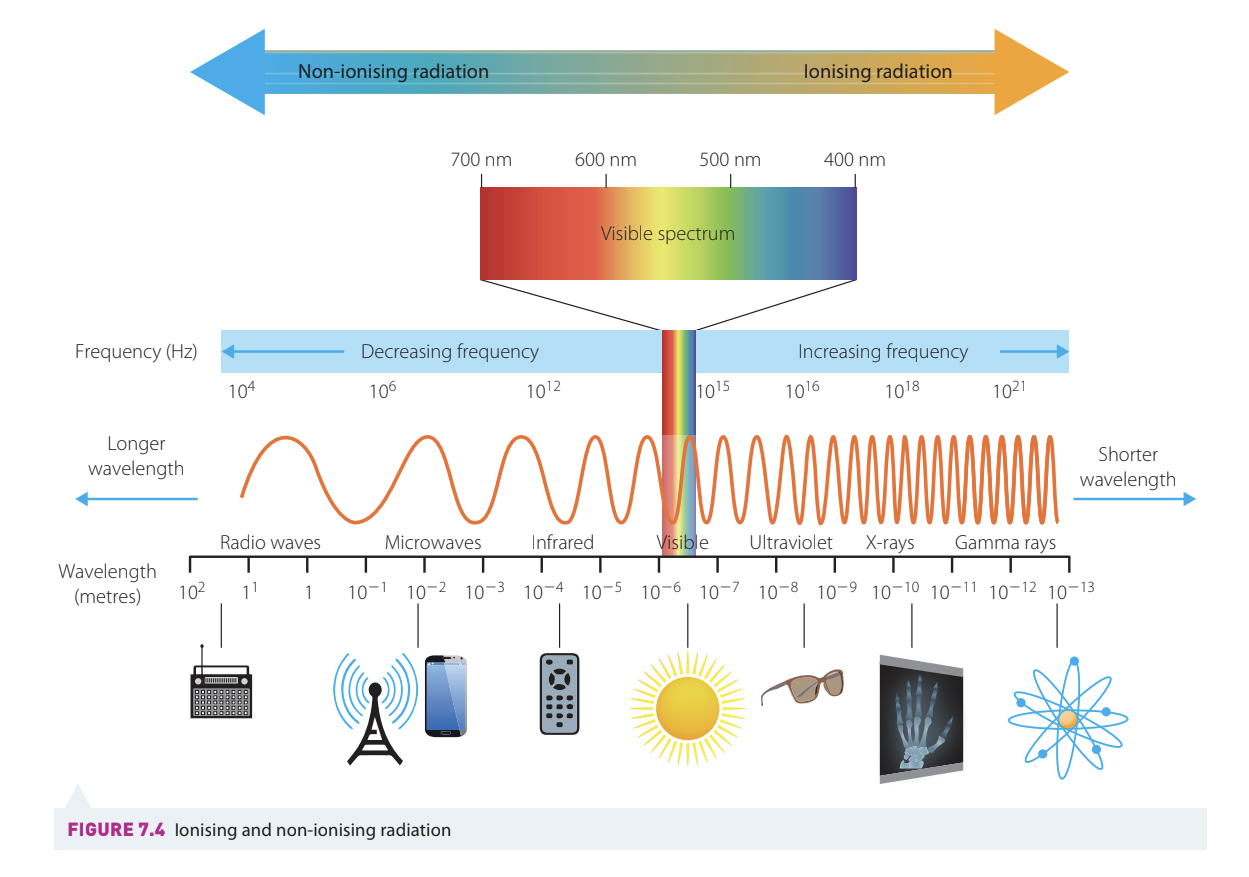
The EM spectrum consists of seven regions, in order of decreasing wavelength (and increasing energy and frequency):
- Radio waves
- Microwaves
- Infrared (IR)
- Visible light
- Ultraviolet (UV)
- X-rays
- Gamma rays
Ionising versus non-ionising radiation:
Important
Ionising radiation includes the shorter wavelengths of UV radiation, X-rays, and gamma rays. The shorter wavelength and high energy of ionising radiation make it dangerous because it can remove electrons from atoms, causing cellular damage.
In contrast, radio waves and infrared radiation are long-wavelength, low-energy forms that are not harmful. Ultraviolet radiation is somewhat harmful, whilst gamma radiation is extremely harmful even in small doses.
Ultraviolet (UV) radiation
UV radiation can be divided into three types:
- UVA (near-ultraviolet, 315-400 nm): This is non-ionising radiation. Whilst the DNA damage it causes may be related to ageing, its mutagenic and carcinogenic effects are still uncertain. Artificial UV lights in tanning salons use UVA, and prolonged exposure poses health risks. For this reason, commercial tanning salons are banned in Australia.
- UVB (middle UV, 280-315 nm) and UVC (far UV, 180-280 nm): These have shorter wavelengths and are forms of ionising radiation with high energy. The chemical damage they cause to DNA by breaking bonds is known to be mutagenic and carcinogenic.
How UV radiation damages DNA:
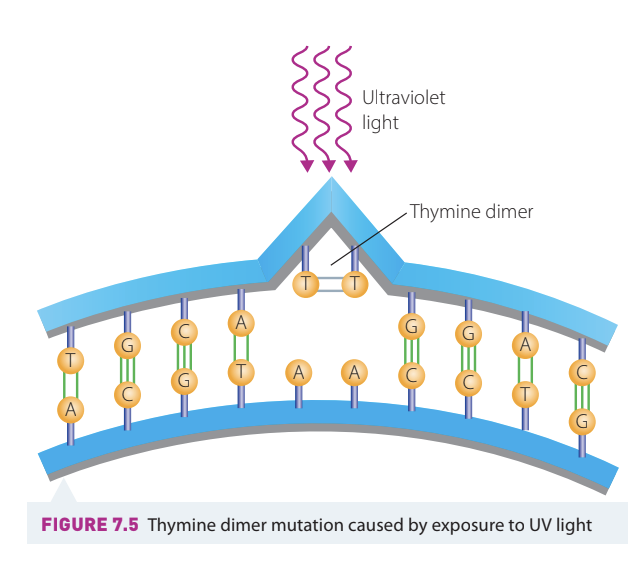
Naturally occurring UV radiation from sunlight has been shown to contribute to skin cancer. The most common effect of UV radiation on DNA is the production of pyrimidine dimers (also called cross-linked nucleotides). This occurs when an adjacent pair of bases (either two thymine or two cytosine bases) on the same DNA strand become attached to each other.
Example
How Pyrimidine Dimers Form and Affect DNA:
When UV radiation strikes DNA, it causes two adjacent pyrimidine bases (thymine or cytosine) to bond together, creating a dimer.
Effect on DNA function:
- The affected bases cannot pair with bases on the complementary strand
- DNA replication and transcription end prematurely
- This disruption affects both the cell cycle and the production of gene products
Other forms of ionising radiation
Ionising radiation is high-energy radiation capable of removing electrons from atoms or molecules, converting them into ions (charged particles). These high-energy electrons can then damage DNA.
Sources of ionising radiation:
- Natural sources: Cosmic rays from the sun and outer space, radioactive elements in soil, the atmosphere, stone, and wood
- Artificial sources: Radioactive materials from nuclear reactions that emit alpha, beta, and gamma rays. This includes radiation from atomic bombs, nuclear accidents (such as Chernobyl in 1986), nuclear testing, power plants, and medical applications (such as X-rays and gamma radiation)
Important
All forms of mutagenic ionising radiation can harm human health, even in small doses.
How ionising radiation damages DNA:
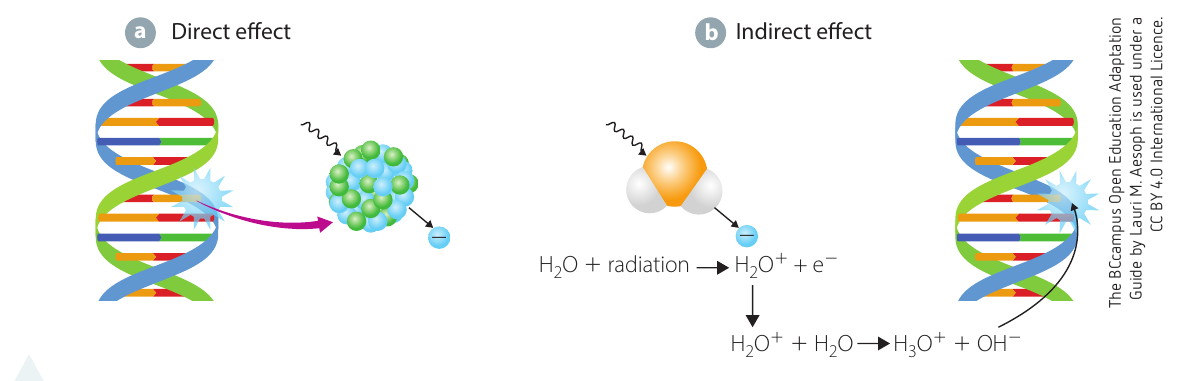
When high-energy electrons pass through cells, they interact with water molecules, producing particles called free radicals. These are highly reactive and can affect proteins, lipids in cell membranes, and DNA.
The damage to DNA includes:
- Breaks in one or both strands of the DNA double helix
- Deletions of genetic material
- Partial chromosome loss
- Rearrangements of DNA sequences
- Cross-linking of DNA strands
Note
These changes interfere with cell division, gene product formation, and cellular metabolism, potentially leading to cell death or cancer if the damage is not repaired.
DNA repair mechanisms
Because maintaining accurate DNA replication is crucial for cell survival, cells have evolved DNA repair mechanisms. Enzymes involved in replication also play important roles in removing damaged sections of DNA and repairing it.
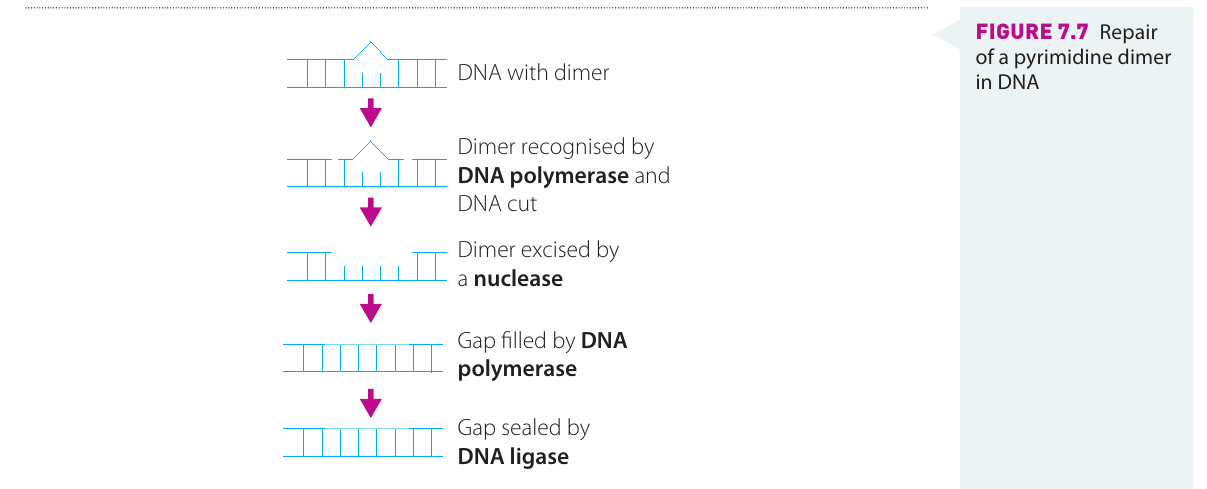
Key repair mechanisms include:
- Base excision repair: A damaged or incorrectly paired base is removed from its sugar linkage by a nuclease enzyme and replaced with the correct base. An example is the removal of a pyrimidine dimer caused by UV radiation.
- Mismatch repair: After DNA replication is complete, the enzyme DNA polymerase performs a 'spell check' to verify the accuracy of replication and correct any errors.
Note
These repair mechanisms work continuously to maintain the integrity of genetic information, preventing mutations from becoming permanent changes in the DNA sequence.
Regulation and protection
Today, there is strict regulation of the amounts of mutagens that may be present in products or to which people can be exposed. Some chemicals are completely banned, whilst others may only be added in very small amounts. Radiation exposure doses are also carefully regulated to minimise health risks.
Summary
Key Points to Remember:
-
Mutagens are environmental agents that can alter DNA and cause mutations, which may arise spontaneously or be induced by external factors.
-
Three main categories of mutagens exist: chemical mutagens (like tobacco tar and benzene), naturally occurring mutagens (including biological agents like viruses and non-biological elements like mercury), and physical mutagens (primarily various forms of radiation).
-
UV radiation creates pyrimidine dimers where adjacent DNA bases become cross-linked, preventing normal replication and transcription.
-
Ionising radiation produces free radicals that cause DNA strand breaks, deletions, and rearrangements, interfering with cell division and gene function.
-
DNA repair mechanisms are essential for maintaining genetic integrity, including base excision repair and mismatch repair systems that correct DNA damage.