Alkanes (HSC SSCE Chemistry): Revision Notes
📚Revision Notes
Alkanes
Introduction to alkanes
Alkanes are a crucial family of hydrocarbons that play a vital role in our daily lives. These compounds provide the energy we use every day - they power our vehicles, heat our water, warm our homes, and help us cook our food. Beyond their use as fuels, alkanes also serve as essential raw materials for manufacturing plastics and many other substances.
Alkanes are saturated compounds, which means they contain only single carbon-carbon bonds and no multiple bonds. This saturation makes them relatively stable and gives them distinct properties.
Note
The term "saturated" refers to the fact that each carbon atom is bonded to the maximum possible number of hydrogen atoms. This is because all bonds are single bonds - there are no double or triple bonds that would reduce the number of hydrogens.
The first alkanes
The simplest member of the alkane family is methane (). This is followed by ethane (), propane (), and butane ().
Note
Different Ways to Represent Molecules
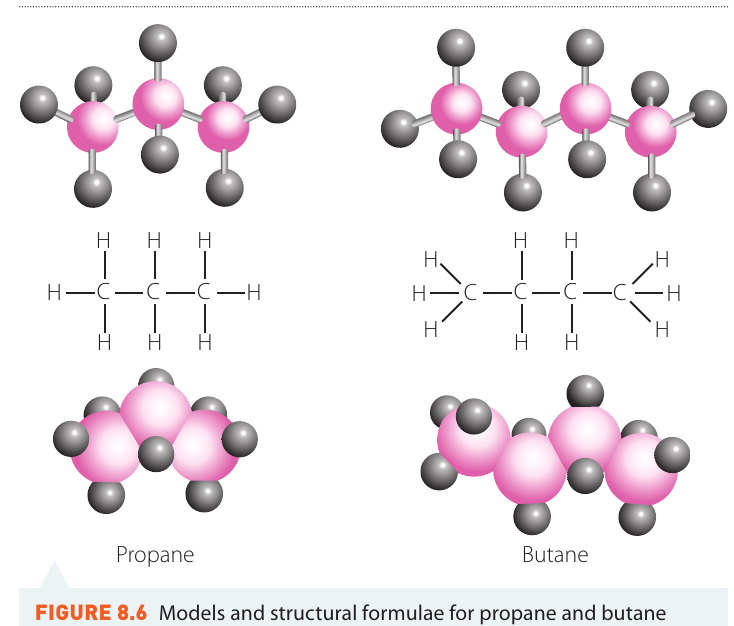
The diagram above shows three different representations of propane and butane:
- Ball-and-stick models showing atoms (pink spheres for carbon, gray for hydrogen) connected by bonds
- Structural formulae displaying all carbon and hydrogen atoms with their bonds
- Space-filling models showing the actual shape and size of the molecules
Each representation provides different insights into the molecule's structure and properties.
Straight-chain alkanes
The first ten members of the alkane family are listed in the table below. These are called straight-chain alkanes because all carbon atoms are connected in one continuous chain.
| Name | Formula |
|---|---|
| Methane | |
| Ethane | |
| Propane | |
| Butane | |
| Pentane | |
| Hexane | |
| Heptane | |
| Octane | |
| Nonane | |
| Decane |
Important
Despite being called "straight-chain", these molecules aren't actually straight lines. The carbon bonds arrange themselves in a zigzag pattern due to the tetrahedral geometry around each carbon atom. This is a common misconception - the "straight" refers to the connectivity of atoms, not their spatial arrangement.
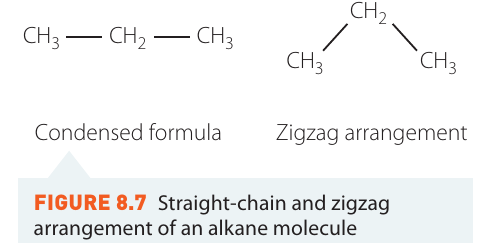
The figure above shows the same alkane molecule represented in two ways: condensed formula on the left and the more realistic zigzag arrangement on the right.
Homologous series
Alkanes belong to a homologous series - a group of compounds that share the same general formula. Each successive member of the series is formed by adding one carbon atom and three hydrogen atoms. This follows a predictable pattern, giving us the general molecular formula:
where is a whole number representing the number of carbon atoms.
Example
Worked Example: Using the General Formula
For propane, we know it has 3 carbon atoms, so .
Substituting into the general formula:
Therefore, the molecular formula for propane is .
Straight-chain versus branched alkanes
Not all alkane molecules have their carbon atoms in one continuous chain. Many alkanes contain branched chains, where carbon atoms branch off from the main chain.
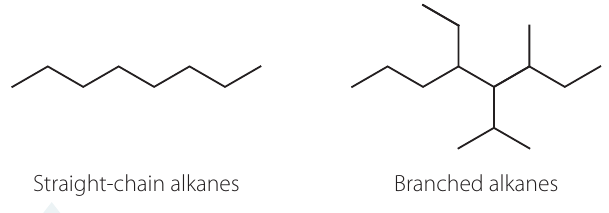
The skeletal structures above show the difference between straight-chain alkanes (left) and branched alkanes (right). This structural difference affects how we name these compounds.
Naming alkanes
The naming of hydrocarbons follows rules set by IUPAC (International Union of Pure and Applied Chemistry). These rules ensure that every organic compound has one universally accepted name, regardless of language or country.
Understanding alkane names
An alkane's name consists of two parts:
- Stem - indicates the length of the carbon chain
- Ending - identifies the hydrocarbon family (always -ane for alkanes)
Carbon chain stems
The stems for the first ten members are:
| Number of carbons | Stem | Number of carbons | Stem |
|---|---|---|---|
| 1 | meth- | 6 | hex- |
| 2 | eth- | 7 | hept- |
| 3 | prop- | 8 | oct- |
| 4 | but- | 9 | non- |
| 5 | pent- | 10 | dec- |
Note
Memory Tip
Learn these stems in order - they're essential for naming any organic compound! A helpful mnemonic: "My Elephant Proudly Bows Patiently Helping Every Organic Nomenclature Develop"
Rules for naming branched alkanes
Follow these six steps to name branched alkanes correctly:
Step 1: Identify the hydrocarbon family
- All alkanes end in -ane
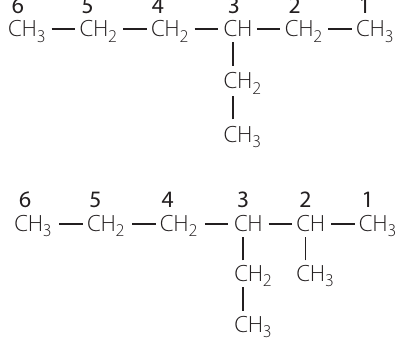
Step 2: Find the longest continuous carbon chain
- This is the main chain or parent structure
- It may not be drawn in a straight line
- The name comes from the number of carbons in this chain
- Example: If the longest chain has 6 carbons, the parent structure is hexane
Step 3: Identify substituents
- Substituents are atoms or groups attached to the main chain, forming 'branches'
- Carbon group substituents are called alkyl groups
- Alkyl groups are named according to their carbon atoms with the ending -yl
- Examples: — is methyl, — is ethyl
Step 4: Number the main chain
- Number the carbons so that branches have the lowest possible numbers
- The position of each substituent is shown by the number of the carbon it's attached to
- Numbers are separated from words by hyphens
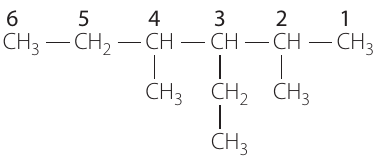
Step 5: List substituents alphabetically
- When multiple substituents exist, list them in alphabetical order
- Words and numbers are separated by hyphens
Step 6: Handle multiple identical substituents
- Use prefixes: di- (two), tri- (three), tetra- (four), penta- (five)
- Separate numbers with commas
- Important: Ignore these prefixes when arranging substituents alphabetically
Important
Common Mistake to Avoid
When alphabetizing substituents, remember to ignore prefixes like di-, tri-, tetra-, etc. For example, in "4-ethyl-2,3-dimethylhexane", ethyl comes before dimethyl because we ignore the "di-" prefix.
Worked example: naming an alkane
Example
Worked Example: Naming a Branched Alkane
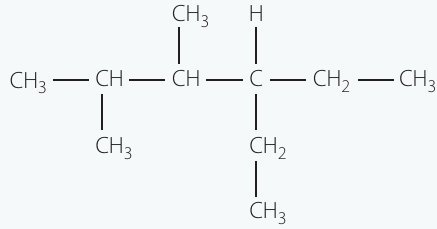
Let's name this compound step by step:
Step 1: Find the longest chain
- Count the carbons: 6 carbons in the longest continuous chain
- Base name: hexane
Step 2: Identify and number substituents
- One ethyl group at position 4: 4-ethyl
- Two methyl groups at positions 2 and 3: 2,3-dimethyl
Step 3: Arrange alphabetically
- "Ethyl" comes before "methyl" alphabetically
- Ignore the "di-" prefix when alphabetising
Step 4: Write the complete name
- Final answer: 4-ethyl-2,3-dimethylhexane
- Written as one word with hyphens separating numbers from words
Drawing alkanes from their names
To draw an alkane structure when given its systematic name, reverse the naming process by following these systematic steps:
Example
Worked Example: Drawing 2,2-dimethylbutane
Step 1: Draw the main carbon chain
- Use the base name to determine chain length
- "Butane" tells us we need 4 carbons in a chain
- Number the carbons starting from either end
     4    3    2    1
     C — C — C — C       (main chain)
Step 2: Identify and position substituents
- "2,2-dimethyl" tells us we have two methyl groups
- Both are attached to carbon 2
Step 3: Add the substituents
- Attach each methyl group to carbon 2
           C
           |
     C — C — C — C       (add substituents)
           |
           C
Step 4: Complete with hydrogen atoms
- Add hydrogen atoms to satisfy carbon's valency
- Check that each carbon has exactly four bonds
          CH₃
           |
    CH₃—CH₂—C —CH₃      (complete structure)
           |
          CH₃
Note
Key Points for Drawing Structures
- Always start by drawing the main carbon chain based on the parent name
- Use the numbers in the name to position substituents correctly
- Remember that each carbon must have exactly four bonds
- Double-check that you've added all substituents mentioned in the name
Remember!
Here are the essential concepts you need to master about alkanes:
Summary
Key Points to Remember
- Alkanes have the general formula , making them a homologous series
- Learn the carbon chain prefixes: meth- (1), eth- (2), prop- (3), but- (4), pent- (5), hex- (6), hept- (7), oct- (8), non- (9), dec- (10)
- Alkanes are saturated hydrocarbons containing only single carbon-carbon bonds
- When naming branched alkanes, always find the longest continuous carbon chain first - this becomes your parent structure
- Number the main chain to give substituents the lowest possible numbers, then list substituents alphabetically (ignoring prefixes like di-, tri-)