Circles and Translations (HSC SSCE Mathematics Advanced): Revision Notes
📚Revision Notes
Circles and Translations
Introduction
This topic explores how circles can be represented algebraically using equations, and how translations affect these equations. Understanding circle equations allows us to identify key features such as the centre, radius, domain, and range, and to sketch accurate graphs of circles on the coordinate plane.
After studying this content, you will be able to:
- Identify the centre and radius of a circle from its equation in standard form
- Determine the domain and range of a circle from its centre and radius
- Convert the equation of a circle from general form to standard form by completing the square
- Find the equation of a circle given its centre and radius
- Sketch the graph of a circle from its equation
Circle equations
Standard form at the origin
When a circle is centred at the origin, its equation in standard form is:
where is the radius of the circle, and .
Note
This equation represents all points that are exactly units away from the origin . The radius measures the distance from the centre to any point on the circle, which is why it must always be positive.
Translated circles in standard form
When a circle is translated (moved) from the origin, the equation changes to account for the new position. The equation of a circle translated horizontally by units and vertically by units is given in standard form as:
Understanding the parameters:
- represents the horizontal translation
- If , the circle moves right
- If , the circle moves left
- represents the vertical translation
- If , the circle moves up
- If , the circle moves down
- is the radius of the circle, where
Identifying the centre and radius:
From the standard form equation :
- The centre is located at
- The radius is
Important
When evaluating from , only the positive root is taken, since the radius represents a distance, and distance is always defined as a positive scalar quantity.
Domain and range of circles
Once you know the centre and radius of a circle, you can determine its domain and range:
Domain:
The domain represents the horizontal extent of the circle. It extends units left and right from the centre's x-coordinate.
Range:
The range represents the vertical extent of the circle. It extends units down and up from the centre's y-coordinate.
Note
Understanding Domain and Range:
Think of domain and range as the "shadow" the circle would cast on the x-axis and y-axis respectively. The domain tells you how far left and right the circle extends, while the range tells you how far up and down it extends.
General form
The general form of a circle's equation is:
where , , and are constants that define the circle's position and size.
Important
Critical Distinction:
The variables and in the general form equation are different constants from the and used to denote the centre in the standard form. The context will always make clear which definition is being used.
Converting from general form to standard form
To convert a circle equation from general form to standard form, you need to complete the square for both the and terms. Completing the square allows you to rewrite the equation so that the centre and radius become easily identifiable.
The process:
- Rearrange the equation so that terms and terms are grouped together
- Complete the square for the terms
- Complete the square for the terms
- Simplify to identify the standard form
Once in standard form, the centre is easily identified, and the radius can be calculated directly.
Note
Completing the Square Reminder:
To complete the square for a term like :
- Take half of the coefficient of (which is ):
- Square this value:
- Add this value inside the bracket and to the other side of the equation to maintain equality
Worked examples
Example
Worked Example 1: Analysing a circle from its standard form equation
Given: A circle has equation .
Part a: Determine the centre
Strategy:
Compare the given equation to the standard form to identify the values of and .
Solution:
This can be rewritten as:
Therefore, the centre is at (2, -1).
Part b: Determine the radius
Strategy:
Extract the value of from .
Solution:
, so .
The radius is 3 units.
Part c: Determine the domain and range
Strategy:
Use the formulas:
- Domain:
- Range:
Solution:
The domain is .
The range is .
Part d: Sketch the circle, labelling the centre and key points
Strategy:
Plot the centre, then plot points at the domain and range boundaries. These points lie at the ends of the horizontal and vertical diameters of the circle. Then draw the circle passing through these points.
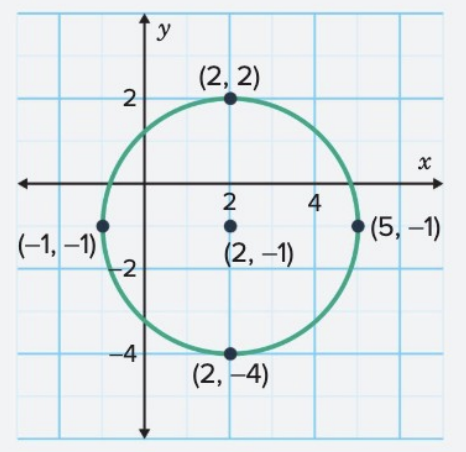
Solution:
The sketch shows a circle with:
- Centre at
- Radius 3
- Key points at (top), (right), (bottom), and (left)
Reflection:
The sketch confirms the centre at and radius 3, with translations right by 2 units and down by 1 unit from the origin.
Example
Worked Example 2: Converting from general form to standard form
Given: Convert to standard form.
Part a: Determine the standard form of the equation
Strategy:
Complete the square for both and terms to rewrite the equation in standard form.
Solution:
The standard form is .
Working explanation:
- First, we rearranged the equation to group and terms
- To complete the square for x: take half of the coefficient of (which is ), giving , then square it to get . Add this inside the bracket
- To complete the square for y: take half of the coefficient of (which is ), giving , then square it to get . Add this inside the bracket
- Add the same values () to the right side to maintain equality
- Factorise to get the standard form
Part b: Determine the centre
Strategy:
Identify and from the standard form .
Solution:
The centre is at (2, -3).
Part c: Determine the radius
Strategy:
Extract from .
Solution:
, so .
The radius is 4 units.
Part d: Sketch the circle, labelling the centre and key points
Strategy:
Plot the centre and points at the domain and range boundaries, then draw the circle.
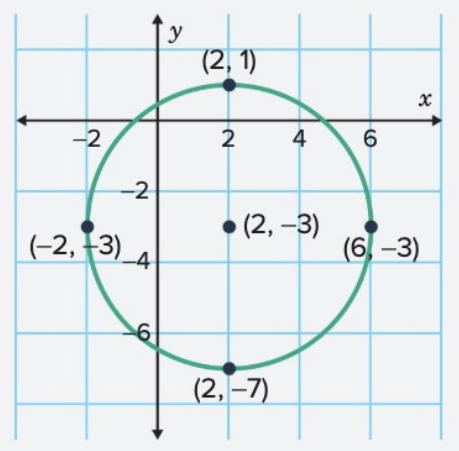
Solution:
The sketch shows a circle with:
- Centre at
- Radius 4
- Key points at (top), (right), (bottom), and (left)
Reflection:
The sketch verifies the centre and radius, aligning with the standard form obtained by completing the square.
Example
Worked Example 3: Finding the equation from centre and radius
Given: A circle has centre and radius 5.
Part a: Determine the equation of the circle
Strategy:
Use the standard form with , , and .
Solution:
The equation is .
Working explanation:
- We wrote the general formula for a circle in standard form
- We substituted the known values: , , and
- We evaluated
- We simplified the expression for to get
Part b: Sketch the circle, labelling the centre and key points
Strategy:
Plot the centre and the points at the boundaries of the circle, then draw the circle passing through these points.
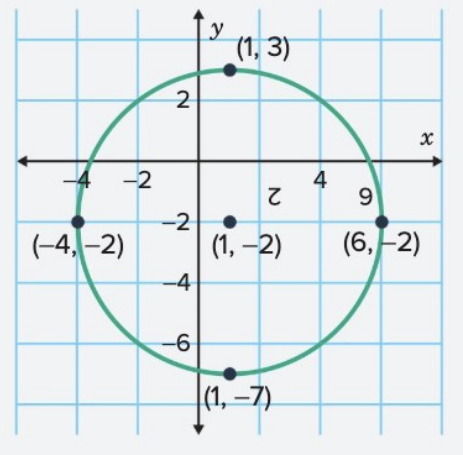
Solution:
The sketch shows a circle with:
- Centre at
- Radius 5
- Key points at (top), (right), (bottom), and (left)
Reflection:
The sketch confirms the equation and helps us visualise the circle's position and size.
Summary
Key Concepts Summary
A circle's equation in the form has:
- Centre at (a, b)
- Radius r (where )
To convert from general form to standard form:
- Complete the square for both and terms
- Rearrange to identify the centre and radius
The domain and range of a circle can be determined from its centre and radius:
- Domain:
- Range:
Summary
Remember!
- The standard form immediately reveals the centre and radius of a circle
- Pay careful attention to signs: means the centre has x-coordinate , while means the centre has y-coordinate
- The radius is always positive; when finding from , take only the positive square root
- To convert from general form to standard form, complete the square for both variables
- Domain and range can be found by adding and subtracting the radius from the centre coordinates: domain uses the x-coordinate, range uses the y-coordinate