Algebraic Techniques (HSC SSCE Mathematics Advanced): Revision Notes
📚Revision Notes
Completing the Square
Key idea
Completing the square is a technique that transforms a quadratic expression from its standard form into vertex form. This transformation reveals important features of the parabola and makes certain calculations much easier.
Standard form:
Vertex form:
The process involves creating a perfect square trinomial by strategically adding and subtracting the same value, keeping the expression mathematically equivalent to the original.
Note
The beauty of completing the square is that it allows you to "see" the key features of a parabola directly from its equation. Once in vertex form, the turning point and axis of symmetry become immediately apparent without any further calculation.
What vertex form tells you
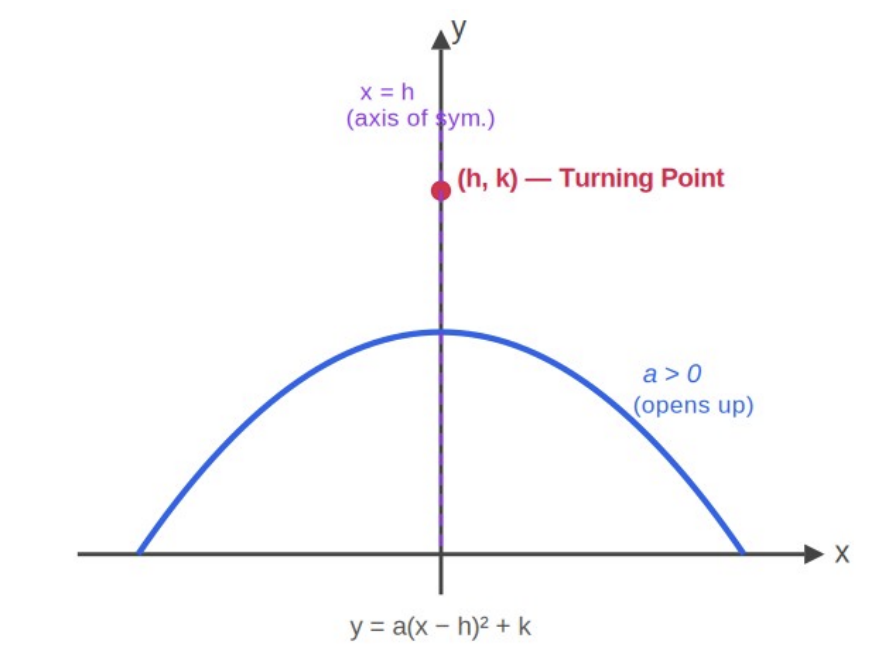
Once a quadratic is written in vertex form , you can immediately identify several key features of the parabola:
From the vertex form , you can determine:
- Turning point (vertex): The coordinates are
- Axis of symmetry: The vertical line
- Direction of opening: If , the parabola opens upward; if , it opens downward
Understanding the sign of h
A common source of confusion is reading the value of from the vertex form. Pay careful attention to the sign inside the brackets:
- means is positive
- means is negative
Important
Watch the sign! is actually , so , not . The sign inside the brackets is opposite to the value of .
Method when a = 1
When the coefficient of is , follow these five steps to complete the square:
| Step | What to do |
|---|---|
| 1 | Take the first two terms: |
| 2 | Halve the coefficient of , then square it: |
| 3 | Add and subtract after the first two terms |
| 4 | Factorise the first three terms into a perfect square |
| 5 | Simplify the remaining constant |
Note
The key step: Remember "halve, square, add-subtract". Step 2 is crucial — you must both halve the coefficient of x and then square the result before proceeding.
Worked example 1
Example
Worked Example: Completing the Square for
Step 1: Focus on the first two terms:
Step 2: Half of is , and
Step 3: Add and subtract :
Step 4: Factorise the first three terms:
Final answer:
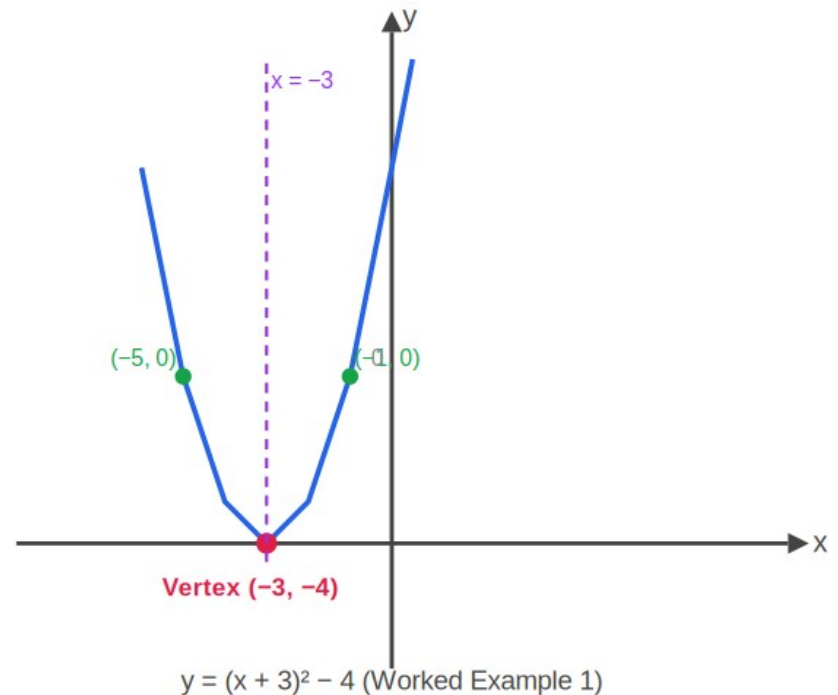
From this vertex form, we can see that the turning point is at and the axis of symmetry is .
Method when a ≠ 1
When the coefficient of is not equal to , you must factor out the value of a from the first two terms before completing the square.
Important
Critical step: Always factor out a from the first two terms before completing the square. This is the most common error students make with this method. Don't skip this step!
Worked example 2
Example
Worked Example: Completing the Square for
Step 1: Factor out from the terms:
Step 2: Half of is , and
Step 3: Add and subtract inside the brackets:
Step 4: Factorise the perfect square:
Step 5: Expand the brackets and simplify:
Final answer:
Worked example 3 — finding the turning point
Example
Worked Example: Finding the Turning Point of
Step 1: Half of is , and
Add and subtract :
Step 2: Read off and from the vertex form:
- (from )
- (the constant term)
Turning point:
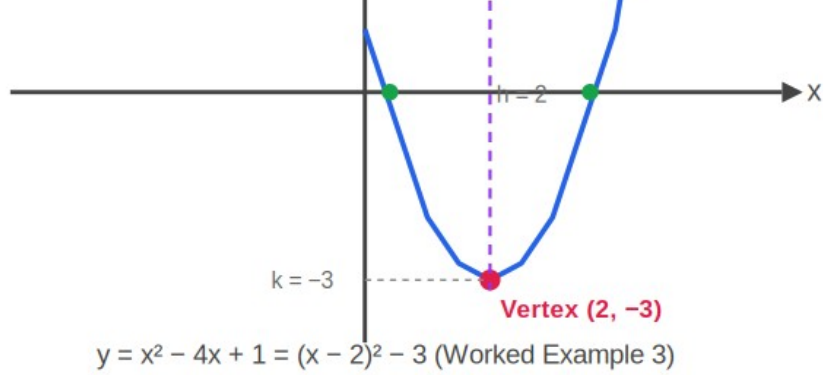
The graph shows the parabola with its vertex at and the axis of symmetry at .
Common mistakes
Important
Avoid These Common Errors:
- Forgetting to subtract what you added: You must maintain balance in the expression by subtracting the same value you add
- Not factoring out a when a ≠ 1: This is the most common error. Always factor out a from the first two terms before proceeding
- Sign errors when halving b: Take extra care when is negative. For example, half of is , not
- Misreading h from vertex form: Remember that gives , not . The sign inside the brackets is opposite to the value of h
Exam tips
When completing the square in an examination:
- Always write the formula explicitly: Show clearly in your working for full marks
- Show both the addition and subtraction: Write both and clearly in your working
- State the turning point as coordinates: Write it as an ordered pair
- For a ≠ 1 questions: Factor out a, complete the square, then expand a back through the expression
- Double-check the sign of h: Before writing your final answer, verify that you've read correctly from the vertex form
Note
Marking tip: Examiners look for clear, systematic working. Even if you make a small arithmetic error, you can still earn most of the marks if your method is correct and clearly shown.
Remember!
Summary
Key Points to Remember:
- Completing the square converts any quadratic into vertex form
- Vertex form directly reveals the turning point and axis of symmetry
- The key step is adding and subtracting to create a perfect square
- When , always factor out a first, then proceed with the standard method
- This technique underpins the derivation of the quadratic formula, making it an important foundational skill throughout the course