Composite Functions (HSC SSCE Mathematics Advanced): Revision Notes
📚Revision Notes
Composite Functions
What is a composite function?
A composite function is created when the output of one function becomes the input of a second function. This process is called function composition.
For example, the notation (read as "f of g of x") represents a composite function. In this case, the outputs from function are used as the inputs for function .
Note
Think of function composition like a production line: the output from one machine (function ) becomes the input for the next machine (function ). The final product depends on both machines working together in sequence.
The diagram below shows how composite functions work:
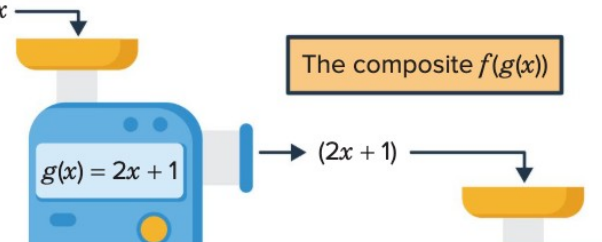
In this example, we start with an input . First, we apply function to get the result . Then, we take this result and use it as the input for function . The final output is .
Understanding the notation
For two functions and , there are two different ways to compose them:
- means we apply first, then apply to the result
- means we apply first, then apply to the result
Important
Work from the inside out!
For , the function is on the inside, so we apply it first. Then we apply the outer function to whatever produced. This is the key to understanding composite functions.
Order matters
Important
Different order, different answer!
An important property of composite functions is that the order of composition affects the result. In most cases, and will produce different functions. Changing the order changes the answer.
To form , we substitute into . The order matters because and may yield different results.
Evaluating composite functions
When evaluating composite functions, we use the substitution method: replace the variable in the outer function with the entire expression of the inner function.
Example
Worked Example 1: Forming a composite function
Question: Given and , determine .
Solution:
To find , we substitute into .
Steps:
- Write the function
- Substitute in place of
- Use the distributive property to expand
- Simplify by evaluating the arithmetic
Example
Worked Example 2: Evaluating at specific values
Question: If and , evaluate:
- a) and
- b)
- c)
- d) Determine if for all
Solution:
Part a) Substitute into both functions.
For :
For :
Therefore, and .
Part b) Use the result for from part (a) and substitute it into .
From part (a), .
Part c) Use the result for from part (a) and substitute it into .
From part (a), .
Part d) Compare the results from parts (b) and (c).
From part (b), .
From part (c), .
Since , we can conclude:
Since , it is not true that for all .
This demonstrates that the order of composition matters. Applying the functions in different orders produces different results.
Domain and range of composite functions
Understanding the domain and range of composite functions requires careful consideration of both functions involved.
Note
Domain flows through the chain
The domain of a composite function depends on:
- The domain of
- The values that produces, which must be valid inputs for
The range of is determined by the range of , but it is restricted by the output of .
For example, if has no restrictions but requires non-negative inputs, then the domain of is restricted to values of where .
Finding the domain of a composite function
To find the domain of , follow these steps:
- Determine the domain of
- Determine the range of
- Determine the domain of
- Restrict the range of to only those values that lie within the domain of
- Restrict the domain of to only those inputs that produce outputs in the restricted range from Step 4
This restricted domain of is the domain of .
Finding the range of a composite function
To find the range of , follow these steps:
- Find the range of
- Identify the values in the range of that are also in the domain of
- Evaluate using only the inputs for which lies in the set from Step 2
The resulting set of values is the range of .
Example
Worked Example 3: Domain and range with restrictions
Question: Given and , determine:
- a) The domain of
- b) The range of
Solution:
Part a) Find the domain of .
First, form the composite function .
For the domain, requires . Therefore, we need .
Set up the inequality:
The domain is [].
Part b) Find the range of .
For the range, produces non-negative values because the square root function outputs .
Since for , the range is [].
The square root function takes non-negative inputs and produces non-negative outputs. As increases from towards infinity, increases from 0 towards infinity, and therefore also increases from 0 towards infinity.
Example
Worked Example 4: Using graphs to find range
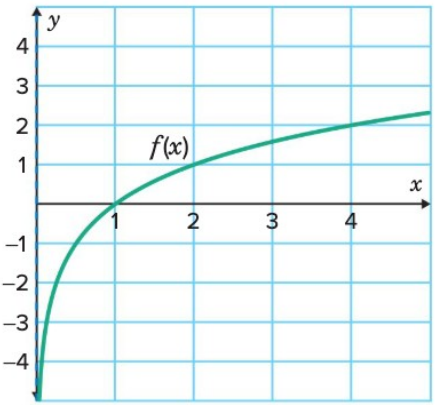
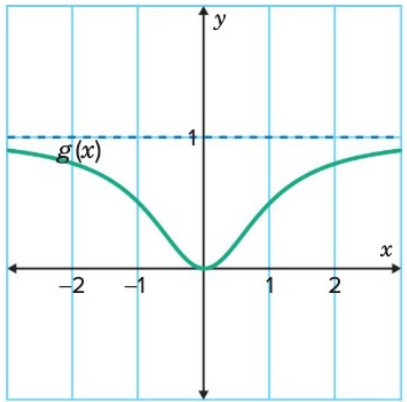
Question: The graphs of functions and are shown below. What is the range of the composite function ?
Solution:
We need to observe the range of from its graph, intersect it with the domain of , and determine the output values of over this interval using its graph.
Step 1: From the graph of , the function has a minimum at and approaches as increases or decreases without bound. This gives the range [].
Step 2: The graph of shows a vertical asymptote at , so its domain is . When we intersect the range of , which is , with the domain of , we get .
Step 3: On the graph of , for inputs , the output ranges from as approaches 0, to 0 as approaches 1, excluding 0.
The range of is .
Important
Common mistake to avoid:
A common error is including 0 in the range, but prevents this because never quite reaches 0 for inputs strictly less than 1. Always check the endpoint behavior carefully!
Summary
Key Points to Remember:
-
A composite function is formed by applying first, then to the result. Think of it as working from the inside out.
-
The order of composition matters. In general, . Changing the order produces a different function.
-
To find the domain of , ensure that produces valid inputs for . This means the output of must lie within the domain of .
-
The range of a composite function depends on the range of the outer function, but is restricted by what the inner function can produce.
-
When working with composite functions, always substitute carefully and simplify step by step to avoid errors.