Even and Odd Functions (HSC SSCE Mathematics Advanced): Revision Notes
📚Revision Notes
Even and Odd Functions
Introduction to function symmetry
Functions can be classified based on their symmetry properties. Understanding whether a function is even, odd, or neither helps us predict its behaviour and simplify calculations. These classifications are determined both by the visual appearance of the graph and by algebraic properties that can be tested mathematically.
Note
The concept of symmetry in functions provides powerful tools for analysis. By identifying a function's symmetry type, we can often predict behaviour across the entire domain by examining only half of it.
Even functions
Graphical definition
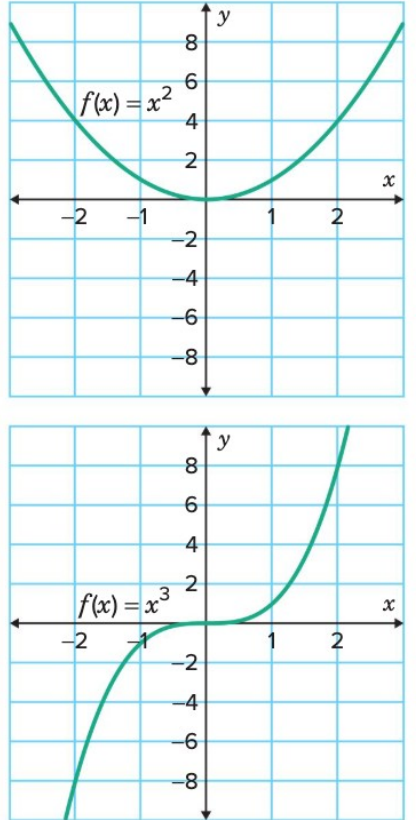
We classify a function as even when its graph displays reflective symmetry about the y-axis. This means if you were to fold the graph along the -axis, both halves would match perfectly. The graph looks identical before and after reflection across the -axis.
Note
Think of even functions as having "mirror symmetry" - the left side is a perfect mirror image of the right side, with the -axis acting as the mirror.
Algebraic definition
Mathematically, a function is even if it satisfies the condition:
This property must hold for all values of x in the function's domain. In practical terms, this means that when you substitute into the function, you get exactly the same result as when you use .
Visual example
The function is a classic example of an even function. Its graph is a parabola that is symmetric about the -axis. For any point on the graph, the point also lies on the graph. This reflects the algebraic property: if you substitute into the function, you get , which equals .
Odd functions
Graphical definition
A function is classified as odd when its graph remains unchanged under a rotation of 180° about the origin. This type of symmetry is also called point symmetry. If you rotate the entire graph halfway around the origin, it looks identical to the original.
Note
Odd functions have rotational symmetry - imagine spinning the graph 180° around the origin like turning a wheel halfway around. The graph should look exactly the same after the rotation.
Algebraic definition
Algebraically, a function is odd if it satisfies the condition:
This must be true for all values of in the domain. When you substitute into the function, the result is the negative (or opposite) of .
Visual example
The function demonstrates odd function behaviour. Its graph is unchanged after a rotation about the origin. For any point on the graph, the point also appears on the graph. Algebraically, this is shown by: .
Functions that are neither even nor odd
Many functions satisfy neither the even condition nor the odd condition. When you test a function by substituting and find that equals neither nor , the function is classified as neither even nor odd.
Important
This is perfectly normal - in fact, most functions fall into this category. Don't expect every function to be even or odd. For example, is neither even nor odd because it contains both even and odd power terms.
Testing functions algebraically
Strategy for classification
To determine whether a function is even, odd, or neither, follow this systematic approach:
Important
Classification Test Procedure:
Step 1: Substitute into the function to find
Step 2: Simplify the expression completely
Step 3: Compare your result with and
- If , the function is even
- If , the function is odd
- If neither condition is satisfied, the function is neither
Worked example 1: Testing a polynomial function
Example
Worked Example: Classifying a Polynomial Function
Let's determine whether is even, odd, or neither.
Strategy:
We'll substitute into the function. If the result equals , it's even. If the result equals , it's odd. Otherwise, it's neither.
Solution:
Write the original function:
Substitute :
Evaluate each term:
We can see that:
Therefore, the function is even.
Reflection:
Notice that this function contains only even powers of x (powers 4 and 2) and a constant term. This is a typical characteristic of even functions. When all terms have even powers, the function is usually even, which we've confirmed algebraically.
Worked example 2: Testing a reciprocal function
Example
Worked Example: Classifying a Reciprocal Function
Determine whether the function is even, odd, or neither.
Strategy:
We'll find and compare it with both and to classify the function.
Solution:
Write the original function:
Substitute :
Evaluate the power:
Simplify:
We can now substitute :
Therefore, the function is odd.
Worked example 3: Using symmetry to find coordinates
Example
Worked Example: Finding Symmetric Points
Given that is an even function, determine the coordinates of the point on the graph of that corresponds to under the symmetry property.
Strategy:
Since the function is even, it has the property . This means we need to find the symmetric point to , which is . Then we'll calculate to find the coordinates.
Solution:
For an even function, the point symmetric to is located at .
Calculate :
Write the function:
Substitute :
Evaluate the power:
Simplify:
The corresponding point is (-2, 1).
This makes sense because even functions are symmetric about the y-axis, so if there's a point at on the graph, there must also be a point at .
Real-world applications

Functions play an important role in engineering and design. In automotive engineering, mathematical functions help model how different components move and respond under various conditions. Engineers use functions to simulate aerodynamics, suspension systems, and steering performance before constructing physical prototypes.
Note
Understanding symmetry properties of functions can simplify these models and make calculations more efficient. For example, if a component's behavior is modeled by an even function, engineers only need to analyze half the domain to understand the complete system behavior.
Remember!
Summary
Key Points to Remember:
-
Even functions exhibit reflective symmetry about the y-axis and satisfy the algebraic property for all in the domain
-
Odd functions display 180° rotational symmetry about the origin and satisfy for all in the domain
-
To test a function, substitute -x and compare the result with and
-
Many functions are neither even nor odd - they don't satisfy either symmetry condition
-
Symmetry properties are useful for finding corresponding points on a graph and simplifying calculations