Further Domain and Range (HSC SSCE Mathematics Advanced): Revision Notes
📚Revision Notes
Further Domain and Range
Introduction
When working with functions and relations, we need precise ways to describe which input values are allowed and which output values are possible. This note explores how to express domain and range using three different methods: interval notation, inequalities, and worded descriptions. We'll also look at more complex relations where multiple intervals need to be combined.
Domain and range notations
Understanding domain and range is essential for working with functions and relations effectively.
Domain refers to the set of all possible input values (-values) for which a function or relation is defined. Think of it as answering the question: "What values can I put into this function?"
Range is the set of all possible output values (-values) that result from using the domain. This answers: "What values can I get out of this function?"
Different ways to express domain and range
There are three main methods for describing domains and ranges, and they all convey the same information in different forms:
Interval notation uses brackets and parentheses to show intervals on the number line:
- Square brackets indicate that an endpoint is included
- Parentheses indicate that an endpoint is excluded
- For example, if , then is an open interval (endpoints excluded) and is a closed interval (endpoints included)
Note
Think of it this way: Square brackets "shut the door" on the endpoint (including it), while parentheses are "open doors" (excluding it). This mental image can help you remember which notation includes or excludes endpoints.
Inequality notation uses symbols like , , , and to describe the set of values. For instance, is equivalent to , while corresponds to .
Worded descriptions provide a verbal explanation of the set. The inequality can be described as "all real numbers greater than or equal to 1 and less than or equal to 4."
Understanding the notation types
Let's see how these three methods work together with a specific example. Consider the interval from 1 to 4:
- Interval notation: represents all real numbers from 1 to 4, inclusive
- Inequality notation:
- Worded description: "all real numbers from 1 to 4, including both endpoints"
Now compare this with :
- Interval notation: excludes both endpoints
- Inequality notation:
- Worded description: "all real numbers between 1 and 4, excluding 1 and 4"
Important
The key difference is whether the boundary values themselves are included in the set. This distinction is crucial when working with domain and range problems, as including or excluding a single value can completely change the validity of a solution.
Converting between notation types
Being able to move fluently between different notations is an important skill. Let's work through some examples.
Example
Worked Example 1: Converting from interval notation
Problem: Express the domain in inequality notation and as a worded description.
Strategy: The -value beside the square bracket is included, so we use or . The -value beside the parenthesis is excluded, so we use or .
Solution - Inequality notation:
The -value beside the square bracket is , so the lower boundary is .
The -value beside the parenthesis is 5, so the upper boundary is .
Therefore, the inequality notation is .
Solution - Worded description:
Using the inequality symbols from part (a), we can express this as: "The domain of all real numbers greater than or equal to and less than 5."
Example
Worked Example 2: Converting from a worded description
Problem: The range of a relation is described as "All real numbers greater than or equal to but less than 8." Write this in inequality notation and interval notation.
Strategy: The range uses all real numbers, so we work with the variable . Then we apply the proper inequality symbols based on the description.
Solution - Inequality notation:
The first part "greater than or equal to " translates as , so the lower boundary is .
The second part "less than 8" translates as , which is the upper boundary.
Therefore, the inequality notation is .
Solution - Interval notation:
For or , we use square brackets. For or , we use parentheses.
Since we have at and at 8, the interval notation is .
Key points about notation
When expressing domains and ranges, remember:
- The domain relates to input values (-values)
- The range relates to output values (-values)
- Different notation methods express the same information in different forms
- Each method can be useful in different contexts
Domain and range of complex relations
Relations can be more complex than simple functions. Unlike functions, which pass the vertical line test and give only one output for each input, relations may produce multiple outputs for a single input value.
Finding domain and range from equations
When working with equations, we need to identify any restrictions on the variables:
For the domain: We look for all -values where the relation is defined. This means checking for restrictions such as:
- Division by zero (denominators cannot equal zero)
- Negative values under square roots (the expression under a square root must be non-negative for real numbers)
For the range: We can often find the range by rearranging the equation to make the subject, then applying similar restrictions to determine which -values are possible.
Important
Common Restrictions to Always Check:
When finding the domain of a relation, always look for these potential problems:
- Denominators that could equal zero (division by zero is undefined)
- Even roots of negative numbers (square roots, fourth roots, etc. must have non-negative arguments)
- Logarithms of non-positive numbers (if working with logarithmic functions)
Missing even one restriction can lead to an incorrect domain!
Using union notation
When the domain or range consists of two or more separate intervals, we use the union symbol (read as "union") to combine them into a single set.
Note
For example, if a relation is undefined at , the domain might be , which in interval notation is written as . This means "all real numbers except 2."
The union symbol essentially says: "Take all values from the first interval OR all values from the second interval."
Example
Worked Example 3: Rational function with restrictions
Problem: For the relation , determine the domain and range in interval notation.
Part (a): Finding the domain
Strategy: Identify restrictions on by determining where the denominator equals zero.
Solution:
The denominator is zero when or .
Therefore, the relation is undefined at these points.
Domain
This represents all real numbers except and .
Part (b): Finding the range
Strategy: Solve for in terms of to determine which -values are possible.
Solution:
Multiply both sides by :
Add 4 to both sides:
Take the square root of both sides:
For to be real, we need .
Since , we get or (when ).
Range
This represents all real numbers except those between and 0 (inclusive of ).
Verifying with a graph:
We can check our answer by graphing the function. The graph shows vertical asymptotes at and a horizontal asymptote at , confirming our calculated domain and range.
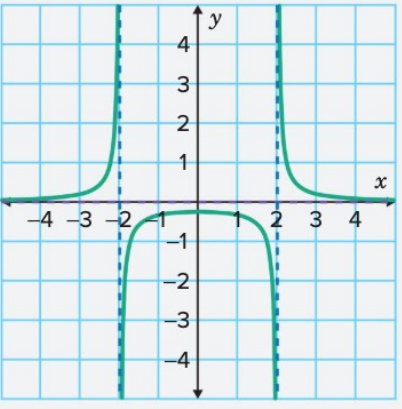
The graph clearly shows the function is undefined at and (vertical asymptotes), and the function never reaches (horizontal asymptote), supporting our algebraic findings.
Example
Worked Example 4: Implicit relation
Problem: For the relation , determine the domain and range in interval notation.
Part (a): Finding the domain
Strategy: Solve for in terms of to determine which -values are possible.
Solution:
Subtract from both sides:
Multiply both sides by 9:
Take the square root of both sides:
For to be real, we need .
This means , so .
Domain
Part (b): Finding the range
Strategy: Solve for in terms of to determine which -values are possible.
Solution:
Subtract from both sides:
Take the square root of both sides:
For to be real, we need .
This means , so .
Therefore, .
Range
Note
Understanding Implicit Relations:
The relation in Example 4 is actually an ellipse! When you have an equation where both and are present and cannot be easily solved for one variable, you're dealing with an implicit relation. These relations often require solving for each variable separately to find the domain and range.
Summary
Key Points to Remember:
- Domain is the set of all possible input values (-values) for which a function or relation is defined.
- Range is the set of all possible output values (-values) produced by the function or relation.
- Three notation methods can express the same set: interval notation, inequality notation, and worded descriptions.
- Square brackets include endpoints; parentheses exclude endpoints.
- Complex relations may require union notation to combine multiple intervals when there are gaps in the domain or range.
- Always check for restrictions like division by zero or negative values under square roots when finding domains and ranges from equations.