Absolute Value Functions (HSC SSCE Mathematics Advanced): Revision Notes
📚Revision Notes
Absolute Value Functions
What is an absolute value function?
An absolute value function is a special type of function with the general form:
where and are constants, and .
The absolute value operation ensures that the function's output is always non-negative. This creates a distinctive V-shaped graph that is easy to recognise and work with.
Note
The V-shape is a defining characteristic of absolute value functions. No matter what values you choose for and , the graph will always form this distinctive V pattern, opening upward from the vertex.
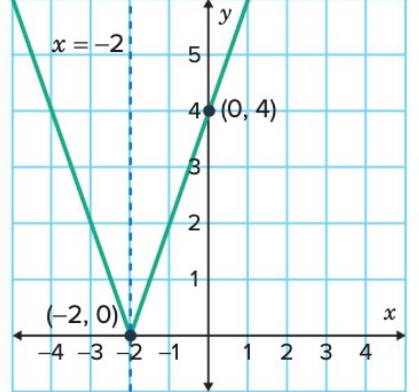
The key feature of an absolute value function is its vertex, which is the turning point where the two arms of the V meet. To find the vertex, we set the expression inside the absolute value equal to zero:
Solving for gives:
At this -value, the function output is zero, so the vertex is located at the point .
Key features of absolute value functions
Understanding the key features helps you sketch and analyse these functions effectively.
Domain: The domain of is all real numbers, . You can substitute any value of into the function.
Range: The range is . Since the absolute value always produces non-negative outputs, the graph never goes below the -axis.
Axis of symmetry: The graph has a vertical line of symmetry passing through the vertex at . Points on either side of this line are equidistant and have equal -values.
Shape: The graph forms a V-shape, with two straight arms meeting at the vertex.
Important
Critical Properties to Remember:
- The range is always - absolute value functions can never produce negative outputs
- The domain is always all real numbers - there are no restrictions on input values
- Every absolute value function has exactly one vertex where the two arms meet
How parameters affect the graph
The constants and in control different aspects of the graph's appearance and position.
The parameter
The parameter a controls how steep the sides of the V-shape are:
- The larger the absolute value of , the steeper the arms
- If , the graph is wider and less steep
- If , the graph is identical to but reflected across the -axis
- The notation reflects the entire graph across the -axis
Note
Understanding Parameter a:
Think of as controlling the "sharpness" of the V:
- Larger values create a narrow, sharp V
- Smaller values create a wide, gentle V
- The sign of affects the slope direction but not the upward opening
The parameter
The parameter b shifts the vertex horizontally:
- The vertex moves units along the -axis from the origin
- If in , the vertex shifts right
- If in , the vertex shifts left
The vertex position is always at , which you can verify by setting the expression inside the absolute value to zero.
Graphing absolute value functions
To sketch an absolute value function, follow these steps:
- Find the vertex by solving
- Plot the vertex point
- Choose several -values on either side of the vertex
- Calculate the corresponding -values
- Plot these points and connect them to form the V-shape
Example
Worked Example: Graphing
Let's graph the function systematically.
Step 1: Find the vertex
Set the expression inside the absolute value to zero:
The vertex is at .
Step 2: Create a table of values
Choose -values around :

Step 3: Plot the points and connect
Plot the points , , , , and . Connect them to form a V-shape.
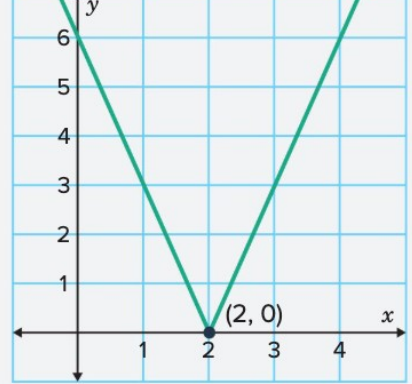
Key observations:
- The graph is symmetric about
- The domain is all real numbers
- The range is
- Points equidistant from the vertex have equal y-values, such as and
Solving absolute value equations
An absolute value equation has the form:
where is a non-negative constant. To solve these equations, we need to consider what values make the expression inside the absolute value equal to or .
Important
Number of Solutions - The "Two, One, or None" Rule:
The number of solutions depends entirely on the value of :
- If , there are two solutions
- If , there is one solution (at the vertex)
- If , there are no solutions (absolute values cannot be negative)
Algebraic method:
To solve algebraically:
- Consider two cases: and
- Solve each equation separately
- Check both solutions in the original equation
Graphical method:
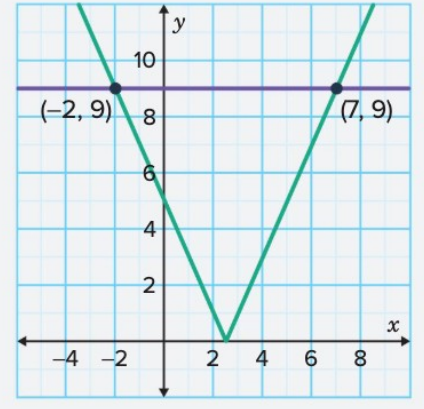
To solve graphically, find where the graph of intersects the horizontal line .
Example
Worked Example: Solving
Solve the equation algebraically.
Solution:
Since , we expect two solutions.
Case 1:
Case 2:
Check:
- For : ✓
- For : ✓
The solutions are and .
Example
Worked Example: Solving
Solve the equation .
Solution:
First, isolate the absolute value expression:
Now solve :
Case 1:
Case 2:
The solutions are and .
Verification:
- For : ✓
- For : ✓
Note
Common Mistake to Avoid:
When solving equations like , always isolate the absolute value expression first before splitting into two cases. Don't attempt to apply the two-case method while other terms are still present outside the absolute value.
Using technology to graph
Graphing calculators and software can help you visualise absolute value functions quickly.
Example
Worked Example: Graphing using technology
Steps:
- Enter into the graphing application
- Use the trace or minimum feature to locate the vertex
- Observe the symmetry about the vertical line through the vertex
Results:
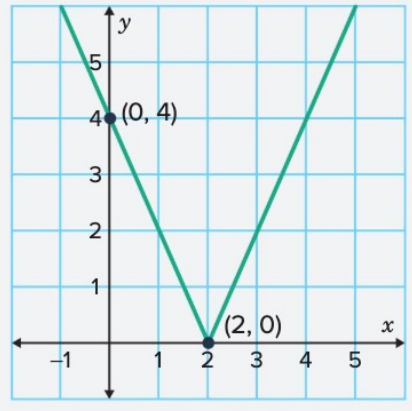
Key findings:
- Vertex: At (where ), the vertex is
- Symmetry: The graph is symmetric about
- Y-intercept: At , , giving the point
- X-intercept: The vertex is at , which is also the -intercept
Points like and are equidistant from and have equal -values, confirming the symmetry.
Real-world application
Absolute value functions can model situations involving deviation from a target value.
Example
Worked Example: Quality Control
A quality control process requires a product's weight to deviate by exactly 8 grams from a target weight of 120 grams. We can model this using an absolute value function and find the acceptable weights.
Model:
Let be the actual weight in grams. The deviation from the target is:
The acceptable weights satisfy .
Solution:
Case 1:
Case 2:
The acceptable weights are grams or grams.
This means products can weigh between 112 grams and 128 grams to be within the acceptable deviation of 8 grams from the 120-gram target.
Summary
Key Points to Remember:
- An absolute value function has the form , which always produces non-negative outputs and creates a V-shaped graph
- The vertex is located at , found by setting
- The domain is all real numbers (), and the range is
- The graph is symmetric about the vertical line
- To solve algebraically, consider both cases: and , then solve each equation separately
- The number of solutions depends on : if (two solutions), if (one solution), if (no solutions)