Direct Variation Models (HSC SSCE Mathematics Advanced): Revision Notes
📚Revision Notes
Direct Variation Models
Understanding direct variation
Direct variation describes a special type of proportional relationship between two quantities. When one quantity increases, the other increases by a proportional amount. Similarly, when one quantity decreases, the other decreases proportionally. This relationship is fundamental in modelling many real-world situations.
A direct variation is a proportional relationship where one quantity directly varies with respect to a change in another quantity. This means that if there is an increase (or decrease) in one quantity, the other quantity will experience a proportionate increase (or decrease).
Note
When quantities are directly related, they move in the same direction - both increasing together or both decreasing together. This proportional change is what makes direct variation such a powerful tool for modelling real-world situations.
The general formula
When a quantity varies directly with a quantity or a power of , we can model this relationship using the formula:
Where:
- is the constant of proportionality, where
- is the power of the relationship, where
- is the independent variable
- is the dependent variable
This formula allows us to express how the dependent variable changes in response to changes in the independent variable.
Important
The constant of proportionality must be non-zero (), and the power must be positive () for a valid direct variation relationship.
Direct linear variation
The simplest form of direct variation is direct linear variation, which takes the form where . Unless a different power or function is specified, assume direct variation refers to a linear relationship.
Graphical representation of direct variation
Let's consider a practical example. The distance (in metres) that a car travels at a constant speed of 20 m/s varies directly with time (in seconds). The model is , where and .
When , the graph is a straight line through the origin, showing that increases proportionally with .
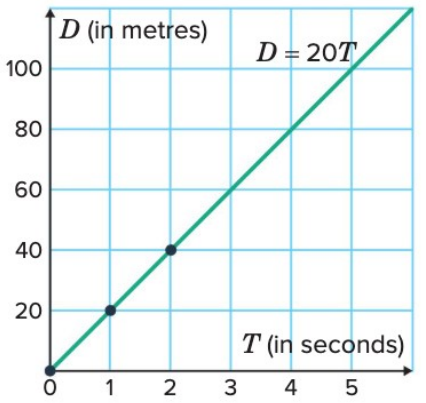
The graph illustrates direct variation, with distance increasing linearly with time. An important characteristic of all direct variation relationships is that they always pass through the origin . This makes sense because when the independent variable is zero, the dependent variable must also be zero.
Note
Key Graph Characteristic: All direct variation graphs pass through the origin because when , we have , regardless of the values of and .
Finding the constant of proportionality
To apply the direct variation model , we need to determine the constant using a known pair of values for and . Once we have found , we can use the model to calculate other values.
Simple example
For instance, if varies directly with (where ) and when , we can find as follows:
The model is y = 6x, which can now be used to find for other values of .
Worked example 1: Linear variation
Example
Worked Example: Machine Hire Cost
The cost (in dollars) of hiring a machine varies directly with the time (in days). If dollars for days:
Part a: Find the constant of linear proportionality, .
Strategy: Model the relationship as and substitute , to solve for .
Solution:
— Write the direct variation model
— Substitute and
— Divide both sides by 3
— Evaluate
The constant of proportionality is k = 50.
Part b: Find the cost for days.
Strategy: Use the model and substitute .
Solution:
— Write the model with
— Substitute
— Evaluate
The cost is $350.
Applications of direct variation
Direct variation models help us solve real-world problems where one quantity increases as another increases. This contrasts with inverse variation, where one quantity decreases as another increases. Let's explore applications involving different powers.
Worked example 2: Quadratic variation
Example
Worked Example: Area of a Circle
The area (in square metres) of a circle varies directly with the square of its radius (in metres). If square metres when metres:
Part a: Find the constant of proportionality .
Strategy: Model the relationship as and substitute , to solve for .
Solution:
— Write the model with
— Substitute and
— Evaluate
— Divide both sides by 4
— Evaluate
The constant of proportionality is k = 3.14, approximately .
Part b: Find the radius when square metres, rounded to two decimal places.
Strategy: Use and substitute to solve for .
Solution:
— Write the model with
— Substitute
— Divide both sides by 3.14
— Evaluate
— Take the positive square root
— Evaluate
The radius is 3 metres.
Checking our work: Using the exact value , the calculation yields , so metres, confirming the result.
Note
When working with quadratic variation (), the relationship involves the square of the independent variable. This is common in geometric formulas involving area, as seen with circles, squares, and other two-dimensional shapes.
Worked example 3: Cubic variation
Example
Worked Example: Volume of a Sphere
The volume (in cubic metres) of a sphere varies directly with the cube of its radius (in metres). If cubic metres when metres:
Part a: Find the constant of proportionality .
Strategy: Model the relationship as and substitute , to solve for .
Solution:
— Write the model with
— Substitute and
— Evaluate
— Divide both sides by 27
— Simplify
The constant of proportionality is k = .
Part b: Find the exact volume when metres.
Strategy: Use and substitute .
Solution:
— Write the model with
— Substitute
— Evaluate
— Simplify
The volume is cubic metres.
Checking our work: The volume formula for a sphere is , which matches our model, confirming the calculations.
Important
Understanding Different Powers:
- Linear variation () represents a constant rate of change
- Quadratic variation () commonly appears in area calculations
- Cubic variation () is found in volume calculations
The power determines how quickly the dependent variable changes as the independent variable increases.
Remember!
Summary
Key Points to Remember:
-
Direct variation occurs when both quantities increase or decrease together in a proportional relationship, modelled as where is the constant of proportionality and is the power.
-
Graphs of direct variation always pass through the origin , because when one variable is zero, the other must also be zero.
-
To solve problems, first find the constant by substituting known values into the model, then use the complete model to calculate unknown quantities.
-
Different powers represent different relationships: gives linear variation, gives quadratic variation (like area of circles), and gives cubic variation (like volume of spheres).
-
The constant of proportionality represents the rate at which the dependent variable changes relative to the independent variable raised to the power .