Introduction to Absolute Value Functions (HSC SSCE Mathematics Advanced): Revision Notes
📚Revision Notes
Introduction to Absolute Value Functions
What is absolute value?
Absolute value refers to the distance of a number from zero on a number line. It tells us the magnitude or size of a real number, without considering whether the number is positive or negative. This means the absolute value is always non-negative.
Note
Think of absolute value as answering the question: "How far is this number from zero?" The direction doesn't matter, only the distance.
For example:
- The absolute value of is (it's units from zero)
- The absolute value of is also (it's still units from zero)
- The absolute value of is (it's at zero)
The absolute value function
The absolute value function is written as:
where:
- is a real number input
- is the absolute value of , which is always non-negative
This function creates a relationship between all real numbers (inputs) and non-negative real numbers (outputs). Every real number is mapped to exactly one non-negative output value.
Note
The absolute value function is a many-to-one mapping: different inputs (like and ) can produce the same output (), but each input produces only one output.
Piecewise definition
The absolute value function can be expressed as a piecewise function, meaning it has different rules depending on the value of the input:
Important
Understanding this piecewise definition is crucial. The negative sign in doesn't make the result negative—it converts a negative input into a positive output. For example, when , the expression gives a positive result.
This definition tells us:
- When the input is zero or positive (), the absolute value equals the input itself
- When the input is negative (), the absolute value equals the opposite of the input (which makes it positive)
For instance:
- If , then (since , we use the first rule)
- If , then (since , we use the second rule)
Domain and range
The domain of the absolute value function is all real numbers:
This means we can input any real number into the function.
The range of the absolute value function is all non-negative real numbers:
This means the output will always be zero or positive, never negative.
Note
Notice the notation: parentheses indicate values not included (like infinity), while brackets indicate values that are included. The range includes but extends infinitely in the positive direction.
Graphical representation
The graph of creates a distinctive V-shaped curve with its vertex (turning point) located at the origin .
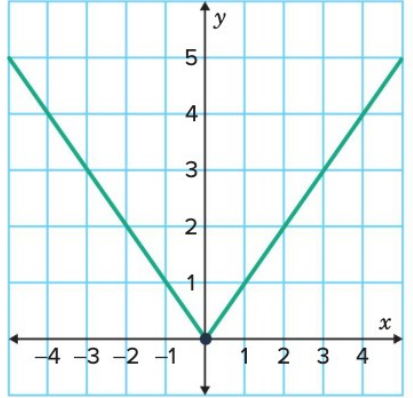
Key features of the graph:
- The graph is symmetric about the y-axis, which means it has even symmetry. If you fold the graph along the y-axis, both halves match perfectly
- For , the graph follows the line (ascending with slope )
- For , the graph follows the line (also ascending with slope , but reflected)
- The lowest point on the graph is , and the graph extends upward indefinitely in both directions
Note
The V-shape is a signature characteristic of absolute value functions. This distinctive shape makes them easy to recognize and helps visualize how the function treats positive and negative inputs differently while producing the same magnitude of output.
Using absolute value to model distance
Absolute value equations are particularly useful for representing distance problems. Since distance is always measured as a positive quantity, absolute value is the perfect tool.
Worked example: Writing distance equations
Example
Worked Example: Writing Distance Equations
Problem: Write an absolute equation to represent "All real numbers that are units from ."
Solution:
We need to express the distance from to as an absolute value equation. The distance from any number to is units, so:
The equation expresses this distance using absolute value.
Simplifying the signs inside the absolute value (a negative minus a negative becomes a positive):
This equation states that is units away from on the number line.
Worked example: Evaluating using the piecewise definition
Example
Worked Example: Evaluating Using the Piecewise Definition
Problem: Evaluate for and using the piecewise definition.
Solution:
For :
Since , we use the rule from the piecewise definition:
For :
Since , we use the rule from the piecewise definition:
Verification: We can confirm these answers make sense. Both and represent the correct distances from on a number line.
Worked example: Real-world application
Example
Worked Example: Real-World Application
Problem: A weather station measures temperatures with a target of and a range of acceptable error of . Write an absolute value equation for the acceptable temperatures .
Solution:
We need to represent the distance from the temperature to the target degrees as an absolute value equation.
The acceptable error is degrees in either direction, so the distance from to must be degrees:
This equation tells us that acceptable temperatures are exactly degrees Celsius away from the target of . This would give us temperatures of 17°C or 23°C.
Key concept: The absolute value function maps real numbers to non-negative outputs. It can be defined piecewise as when , or when .
Square root and absolute value relationship
There is an important mathematical identity connecting square roots and absolute values:
where is a real number input.
Important
Critical Identity: This identity is essential for simplifying algebraic expressions. Remember that squaring and then taking the square root doesn't simply return —it returns the absolute value of . This is a common source of errors in algebraic manipulations.
This identity works because both expressions always yield a non-negative result, which matches the absolute value's definition.
Let's verify this with some numerical examples:
- For : ✓
- For : ✓
- For : ✓
This relationship holds because the square root function returns the non-negative root, which aligns perfectly with how absolute value works. Squaring a number makes it positive (or zero), and then taking the square root gives us the non-negative value, which is exactly what absolute value does.
Worked example: Verifying and applying the identity
Example
Worked Example: Verifying and Applying the Identity
Problem: Verify for and use this result to evaluate .
Solution:
Verification for :
Substituting :
Evaluating each side:
✓
The equality holds, confirming the identity is correct for this value.
Evaluation of :
Using the identity :
Evaluating the absolute value:
Key concept: The identity holds because both expressions yield non-negative equal outputs. Use numerical substitutions to verify, and apply this identity to simplify expressions involving square roots of squared terms.
Remember!
Summary
Key Points to Remember:
-
Absolute value represents distance from zero on a number line, always resulting in a non-negative output
-
The function can be defined piecewise: when , and when
-
The graph of forms a V-shape with vertex at and is symmetric about the y-axis
-
Domain is all real numbers and range is all non-negative real numbers
-
The identity is extremely useful for simplifying expressions involving square roots of squared terms