Inverse Variation Models (HSC SSCE Mathematics Advanced): Revision Notes
📚Revision Notes
Inverse Variation Models
What is inverse variation?
In an inverse variation relationship, as one quantity becomes larger, the other becomes smaller. This is different from direct variation where both quantities change in the same direction. When we say that is inversely proportional to , we write the relationship as , where is a constant value that doesn't change. This constant is called the constant of proportionality or constant of variation.
Real-world examples of inverse variation include:
- The brightness of a light decreases as you move further from the light source
- The time needed to complete a task decreases as more workers are added to the job
- The speed required to travel a fixed distance decreases as more time is available
Note
The key feature of inverse variation is the opposite direction of change. Think of driving a fixed distance: if you increase your speed, the time decreases. If you decrease your speed, the time increases. This opposite relationship is what makes it "inverse."
The general form of inverse variation
The mathematical model for inverse variation, where decreases as increases, is:
Let's break down what each part means:
- is the dependent variable - this is the quantity that responds to changes in
- is the independent variable - this is the quantity we can control or measure, where
- is the non-zero constant of proportionality - this fixed value determines the strength of the relationship
- is the positive power of the inverse relationship - this determines how quickly decreases as increases
Example
Worked Example: Speed and Time Relationship
Consider the speed (in km/h) needed to travel a fixed distance of 1000 km. The speed varies inversely with time (in hours). This relationship is modelled as , where .
Since distance equals speed multiplied by time, we have:
Rearranging gives us:
Therefore, the constant of proportionality is .
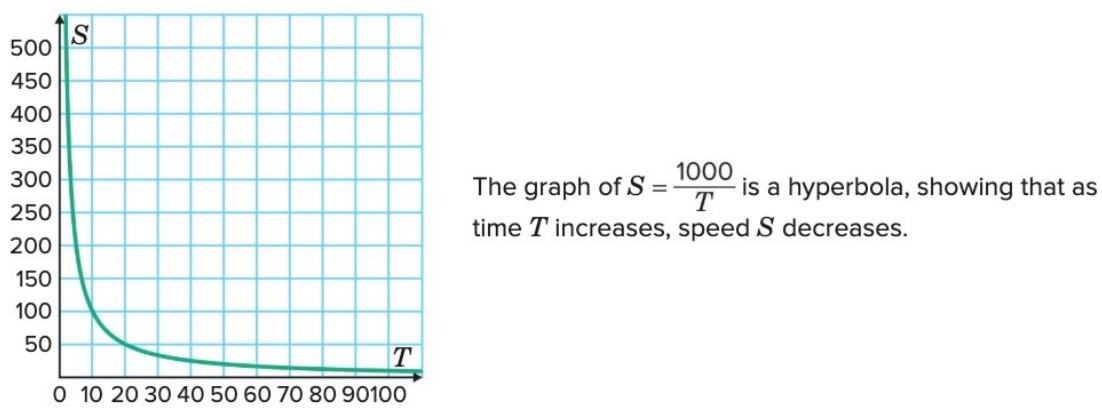
The graph shows a hyperbola, which is the characteristic shape of an inverse variation relationship. As time increases along the horizontal axis, speed decreases along the vertical axis. The curve gets closer and closer to both axes but never actually touches them.
Finding the constant of proportionality
To use an inverse variation model in practice, we need to determine the value of . This is done by substituting a known pair of values for and into the equation , then solving for .
Note
Method for Finding k:
- Write the inverse variation model with the correct power
- Substitute the known values of and
- Solve the resulting equation for
Once you know , you can use the complete model to find unknown values of either variable.
Worked example 1: Light intensity
The intensity of light (measured in lumens per square metre) varies inversely with the square of the distance (in metres) from the light source. When the distance is 2 metres, the intensity is 25 lumens per square metre.
Example
Worked Example: Light Intensity and Distance
Part a: Develop the inverse variation model
Since the intensity varies inversely with the square of the distance, we use the model:
Now substitute the known values and :
Therefore, the complete model is:
Part b: Find the distance when intensity is 4 lumens per square metre
Use the model and substitute :
Multiply both sides by :
Take the square root of both sides:
Since distance must be positive, metres. Answer: 5 metres
Important
Understanding the Rapid Decrease:
The intensity decreases rapidly as distance increases because the relationship involves the square of the distance. Doubling the distance means the intensity becomes one-quarter of what it was. This is why light sources appear much dimmer from far away.
Worked example 2: Project completion time
The time (in days) needed to complete a project varies inversely with the square of the number of workers . When there are 2 workers, the project takes 9 days.
Example
Worked Example: Workers and Project Time
Part a: Find the constant of proportionality
Since time varies inversely with the square of the number of workers, the model is:
Substitute the known values and :
Therefore, the constant of proportionality is . Answer: k = 36
Part b: How many workers are needed to complete the project in 4 days?
Use the model and substitute :
Multiply both sides by :
Take the square root of both sides:
Since the number of workers must be positive, workers are needed. Answer: 3 workers
Note
Practical Insight:
Adding more workers reduces the time needed, but not in a simple proportional way. Because the relationship is inverse squared, doubling the workers doesn't halve the time - it reduces it even more dramatically. This is an important consideration in project planning and resource allocation.
Distinguishing between direct and inverse variation
It's important to recognise the difference between these two types of relationships:
Important
Key Differences:
- Direct variation: As one variable increases, the other increases too. Model:
- Inverse variation: As one variable increases, the other decreases. Model:
When reading a problem, look for key phrases like "varies inversely with" or "decreases as [something] increases" to identify inverse variation.
Summary
Key Points to Remember:
- In inverse variation, as one quantity increases, the other decreases, following the model
- The constant never changes and is found by substituting a known pair of values into the equation
- The power determines how rapidly one variable responds to changes in the other - higher powers mean more dramatic changes
- Inverse variation graphs form hyperbolas that approach but never touch the axes
- Real-world applications include:
- Light intensity with distance
- Time with number of workers
- Speed with time for a fixed distance