Introduction to Rates of Change (HSC SSCE Mathematics Advanced): Revision Notes
📚Revision Notes
Instantaneous Speed and Tangents
Understanding instantaneous speed
Instantaneous speed measures how fast an object is moving at one specific moment in time, rather than over a period. This is different from average speed, which is calculated over an interval.
When we look at a distance-time graph, the instantaneous speed at any point corresponds to the gradient of the tangent to the curve at that point. The tangent represents the exact slope of the curve at a single instant.
Learning objectives:
- Relate the instantaneous speed of an object to the gradient of the tangent at a point on its distance-time graph
- Estimate the instantaneous speed by calculating average speed over a very small interval
- Estimate the instantaneous speed by drawing a tangent to the distance-time graph and calculating its gradient
Note
The key difference between instantaneous and average speed: instantaneous speed captures motion at a single moment, while average speed describes motion over a time interval. Think of instantaneous speed as your speedometer reading at one exact second, while average speed is your total distance divided by total time for a journey.
What is a tangent?
A tangent is a straight line that touches a curve at exactly one point. At this point of contact, the tangent has the same direction as the curve itself. Think of it as the best straight-line approximation to the curve at that specific point.
The tangent is fundamentally different from other lines that might intersect the curve. It captures the curve's behaviour at one precise location, making it perfect for describing instantaneous rates of change.
Note
Key property of tangents: A tangent line "just touches" the curve at exactly one point and has the same slope as the curve at that point. This single-point contact makes tangents ideal for measuring instantaneous rates of change.
Gradient of tangent as instantaneous speed
The instantaneous speed of an object at time is the rate of change of distance at that exact moment. On a distance-time graph, this rate of change is represented by the gradient of the tangent to the curve at time .
The tangent line touches the curve at a single point, representing the slope of the curve at that instant. This gradient tells us exactly how fast the object is moving at that particular moment.
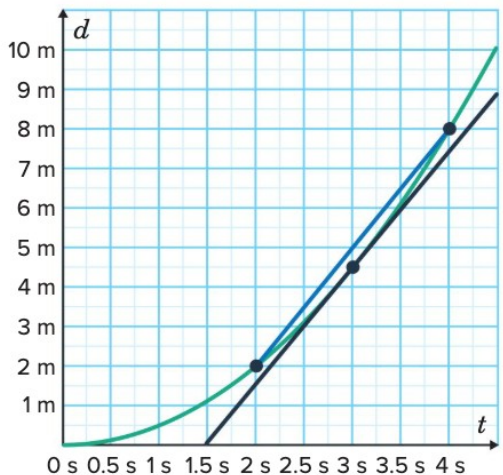
In the graph above, you can see the difference between:
- The secant line (the straight line from to ) which gives the average speed over that interval
- The tangent line (shown touching the curve at ) which gives the instantaneous speed at that specific moment
Note
Secant vs Tangent:
- A secant line connects two points on a curve and its gradient gives the average speed between those points
- A tangent line touches the curve at exactly one point and its gradient gives the instantaneous speed at that point
- As the two points on a secant get closer together, the secant approaches the tangent
For a distance function , the instantaneous speed at is the limit of the average speed as the time interval becomes smaller and smaller. As we shrink the interval, the secant line approaches the tangent line, and the average speed approaches the instantaneous speed.
Important
The fundamental concept: Instantaneous speed is what happens when we calculate average speed over an interval that shrinks to zero. Mathematically, this is the limit process that defines the tangent's gradient.
Estimating instantaneous speed from graphs
To estimate instantaneous speed from a distance-time graph, we draw a tangent at the desired time and calculate its gradient. The formula we use is:
where represents the change in distance and represents the change in time.
In practice, we approximate the tangent by drawing a line that closely follows the curve's slope at the point of interest. We then select two convenient points on this tangent line and calculate the gradient using .
Important
Critical principle: The smaller the interval we use, the more accurate our approximation will be. A tiny interval means the secant line is very close to the tangent line, giving us a better estimate of the instantaneous speed.
Worked example 1: Estimating speed using a small interval
Example
Worked Example: Using Small Intervals
Problem: A car's distance is modelled by , where is in metres and is in seconds. Estimate the instantaneous speed at .
Strategy: We estimate the instantaneous speed at by calculating the average speed over a small interval, such as .
Solution:
Write the equation:
Substitute :
Write the equation again:
Substitute :
Write the formula for approximating instantaneous speed:
Substitute and :
Substitute and :
Evaluate the subtraction:
Answer: The instantaneous speed at is approximately m/s.
Reflection: The small interval ensures the secant line closely approximates the tangent, providing a reasonable estimate. Using an even smaller interval would give an even better approximation.
Key insight: The instantaneous speed at time is the gradient of the tangent to the distance-time graph at that point, representing the exact speed at that moment.
Worked example 2: Drawing a tangent to estimate speed
Example
Worked Example: Graphical Method
Problem: The distance-time graph shows a vehicle's journey. Estimate the instantaneous speed at hours by drawing a tangent and calculating its gradient.
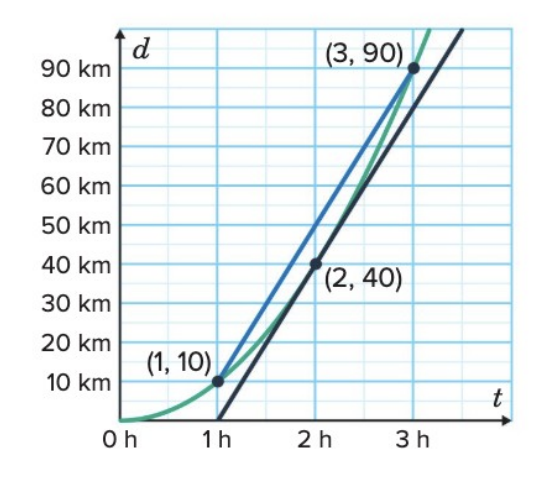
Strategy: We use the tangent line approximated by the secant from to passing through . We calculate the gradient using .
Solution:
Calculate change in distance:
Calculate change in time:
Write the formula:
Substitute the values:
Evaluate:
Answer: The instantaneous speed at is approximately km/h.
Reflection: The secant line from to approximates the tangent at . A smaller interval would refine the estimate further.
Key insight: Instantaneous speed can be estimated from a distance-time graph by calculating the gradient of a tangent at the given time, using points on an approximate tangent line.
Remember!
Summary
Key Points to Remember:
-
Instantaneous speed is the speed at one exact moment in time, represented by the gradient of the tangent to a distance-time graph at that point
-
A tangent is a straight line that touches a curve at exactly one point and has the same direction as the curve at that point
-
The formula for instantaneous speed is , where is the change in distance and is the change in time
-
To estimate instantaneous speed from a graph, draw a tangent at the desired time and calculate its gradient using two points on the tangent
-
Using smaller time intervals gives more accurate approximations of instantaneous speed