Instantaneous vs. Average Speed (HSC SSCE Mathematics Advanced): Revision Notes
📚Revision Notes
Instantaneous vs. Average Speed
What is average speed?
Average speed tells us how fast something travels over a period of time. It gives us an overall measure of motion by dividing the total distance travelled by the total time taken.
The formula for average speed over an interval is:
where represents distance and represents time.
This calculation gives us a single value that represents the average rate of motion across the entire time interval.
Note
Think of average speed as the overall pace of a journey. For example, if you drive 120 km in 2 hours, your average speed is 60 km/h, even though you might have driven faster or slower at different points during the trip.
What is instantaneous speed?
Instantaneous speed is quite different from average speed. It tells us the speed at a specific moment in time, rather than over a period of time. Think of it like looking at a speedometer in a car - it shows your speed at that exact instant.
Mathematically, instantaneous speed is represented by the gradient of the tangent line to the distance-time graph at a particular point. This represents the rate at which distance is changing at that exact moment.
Important
The key distinction: Average speed measures motion over an interval, while instantaneous speed captures the exact speed at a single moment. This difference is crucial for understanding variable motion and acceleration.
Comparing average and instantaneous speed
The key difference between these two concepts lies in what they measure:
- Average speed provides an overall measure of how fast something travels during a time interval
- Instantaneous speed captures the exact speed at a given moment, which is useful for analysing variable motion such as acceleration
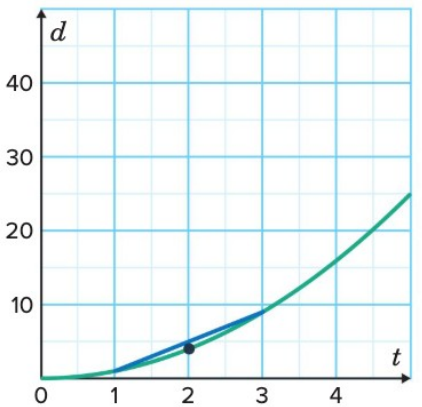
On a distance-time graph, these two types of speed are represented differently:
- Average speed is shown by the gradient of a secant line connecting two points on the curve
- Instantaneous speed is shown by the gradient of a tangent line touching the curve at a single point
Note
Understanding the Graph
In the graph above, the secant line from to represents average speed over that interval, while the gradient at the point where represents the instantaneous speed at that moment.
Notice how the tangent line only touches the curve at one point, while the secant line cuts through it at two points. This visual difference mirrors the conceptual difference between the two types of speed.
Worked example: Comparing speeds
Let's look at a practical example to understand how these concepts work together.
Example
Worked Example: Cyclist Motion Analysis
Question: A cyclist's distance is modelled by , where is in metres and is in seconds. Compare the average speed from to with an approximation of the instantaneous speed at using the interval .
Part 1: Calculating average speed
First, we'll find the average speed from to .
Write the equation:
Substitute :
Write the equation again:
Substitute :
Write the formula for average speed:
Substitute and :
Substitute the values and :
Evaluate the subtraction:
Evaluate:
The average speed is 13 m/s.
Part 2: Approximating instantaneous speed
Now we'll approximate the instantaneous speed at using the interval .
Write the equation:
Substitute :
Write the equation again:
Substitute :
Write the formula for approximate instantaneous speed:
Substitute and :
Substitute and :
Evaluate the subtraction:
Evaluate:
The approximate instantaneous speed at t = 2 is 15.25 m/s.
Interpretation:
The average speed (13 m/s) is lower than the instantaneous speed (15.25 m/s), indicating the cyclist is accelerating. This makes sense because is a non-linear function showing increasing speed over time.
Approximating instantaneous speed
Since calculating the exact instantaneous speed requires calculus techniques you'll learn later, we can approximate it using a clever method.
The instantaneous speed at time can be approximated by calculating the average speed over a very small interval. Rather than using an interval centred on , we choose one that starts at and extends a short distance to the right, such as , where is a small value.
This approach simplifies calculations and gives us a good approximation.
Important
Key Principle: The smaller the interval, the closer the approximation to the true instantaneous speed.
This is because as the interval gets smaller, the secant line approaches the tangent line. When the secant line nearly coincides with the tangent line, the gradient of the secant (average speed) closely matches the gradient of the tangent (instantaneous speed).
Improving the approximation
Let's see how reducing the interval size improves our approximation.
Example
Worked Example: Improved Approximation
Question: For the same cyclist's motion, (metres, seconds), improve the accuracy of the approximation of instantaneous speed at using the interval . Explain how this improves from .
Calculating with the smaller interval:
Write the equation:
Substitute :
Write the equation again:
Substitute :
Write the formula:
Substitute and :
Substitute the values:
Evaluate the subtraction:
Evaluate:
The approximate instantaneous speed at t = 2 is 12.6 m/s.
Why is this better?
Using (interval ) gives a closer approximation than (interval ) because the secant line is nearer to the tangent. This reduces the error in estimating the gradient at .
Smaller intervals yield better approximations because the secant line more closely aligns with the tangent at .
Note
Visualizing the Improvement
Imagine drawing secant lines with progressively smaller intervals. Each time you reduce the interval size, the secant line tilts closer to matching the tangent line at . The gradient gets more accurate with each reduction, approaching the true instantaneous speed as the interval approaches zero.
Exam tips
When working with speed problems in exams, keep these strategies in mind:
- Always show your working when calculating average or instantaneous speed
- Remember that instantaneous speed requires very small intervals for accurate approximation
- On a distance-time graph, look for the steepness of the curve at a point to understand instantaneous speed
- If average speed is different from instantaneous speed, this indicates acceleration or deceleration
- Label your units clearly (e.g., m/s) in your final answer
Important
Common Mistake to Avoid
Don't confuse the formulas! While both average and instantaneous speed use the same formula structure , the key difference is the interval size. Average speed uses any interval, while approximating instantaneous speed requires a very small interval starting at the point of interest.
Remember!
Summary
Key Points to Remember:
-
Average speed is calculated by dividing total distance by total time:
-
Instantaneous speed is the speed at a specific moment, represented by the gradient of the tangent to the distance-time graph
-
To approximate instantaneous speed at time , calculate average speed over a small interval where is small
-
Smaller intervals produce more accurate approximations because the secant line approaches the tangent line
-
The difference between average and instantaneous speed helps us analyse variable motion and acceleration
-
On graphs: Secant line represents average speed, tangent line represents instantaneous speed