Characteristics of Linear Graphs (HSC SSCE Mathematics Advanced): Revision Notes
📚Revision Notes
Characteristics of Linear Graphs
Introduction
A linear function is a function that can be expressed in the form , where and are constants. The graph of a linear function is always a straight line. Linear functions are fundamental in mathematics because they model constant rates of change and are used extensively in real-world applications.
Note
Linear functions appear everywhere in real life - from calculating costs based on quantity, to understanding speed and distance relationships, to predicting trends over time. Mastering linear graphs provides a foundation for understanding many practical situations.
In this topic, you will learn to:
- Identify the gradient and y-intercept from an equation in gradient-intercept form
- Determine the x-intercept and y-intercept of a line from its equation
- Graph a straight line using its gradient and y-intercept
- Graph a straight line using its intercepts
- Convert linear equations between gradient-intercept form and general form
The gradient
The gradient (also called slope) is a measure of the steepness of a line. It represents the rate of change in the vertical direction relative to the horizontal direction.
If and are two distinct points on a line, the gradient of the line (or line segment ) is calculated using the formula:
This formula tells us how much changes for every unit change in .
Note
Understanding Gradient Direction:
- A positive gradient means the line slopes upward from left to right
- A negative gradient means the line slopes downward from left to right
- The larger the absolute value of the gradient, the steeper the line
Gradient-intercept form
The gradient-intercept form is a way of writing the equation of a straight line that makes it easy to identify both its steepness and where it crosses the y-axis.
Definition
Important
The gradient-intercept form of a straight line is:
where:
- is the gradient of the line
- is the y-intercept (the value of when )
- is the point where the line intersects the y-axis
This form is particularly useful for describing and graphing linear relationships because both key features of the line are immediately visible.
Finding the equation from gradient and y-intercept
When you know the gradient and y-intercept, you can write the equation directly by substituting these values into .
Example
Worked Example 1: A straight line has gradient and y-intercept . Determine its equation in gradient-intercept form.
Solution:
Use the gradient-intercept form , then identify the gradient and the y-intercept , and substitute the given values.
Substitute and .
Finding the equation from gradient and a point
When you know the gradient and one point on the line, you can find the y-intercept by substituting the point's coordinates into the equation and solving for .
Example
Worked Example 2: A straight line passes through the point with a gradient of . Determine its equation in gradient-intercept form.
Solution:
Substitute the coordinates of the point and the value of the gradient into the gradient-intercept form to determine the y-intercept .
Substituting the values of and , the equation is:
Verification:
To verify that the equation is correct, substitute and into the equation:
The left-hand side equals the right-hand side, confirming the point lies on the line.
Finding the equation from two points
When you are given two points on the line, first calculate the gradient using the gradient formula, then use one of the points to find the y-intercept.
Example
Worked Example 3: Determine the equation of the straight line that passes through the points and in gradient-intercept form .
Solution:
First, calculate the gradient using the formula , then use one point to determine the y-intercept .
Calculating the gradient:
Substitute and .
Evaluate the numerator and denominator.
Using the point to determine the y-intercept :
Substituting back and :
The equation is .
Graphing using gradient-intercept form
The gradient-intercept form is particularly useful for graphing because both key features of the line are immediately identifiable.
Graphing process
To graph a straight line using gradient-intercept form:
- Identify and plot the y-intercept at the point , where the line crosses the y-axis
- Use the gradient to find a second point on the line
- Draw a straight line through both points, extending it in both directions
Interpreting the gradient
The gradient can be interpreted as a ratio of rise to run. This means:
- The numerator represents the vertical change (rise)
- The denominator represents the horizontal change (run)
For example, a gradient of means move unit right and units up from any point on the line to locate another point.
Note
Working with Negative Gradients:
When the gradient is negative, the direction of movement changes. For instance, a gradient of can be interpreted as:
- Moving units to the right and units down, OR
- Moving units to the left and units up
Either interpretation correctly positions a second point, as long as the ratio between rise and run is maintained.
Example
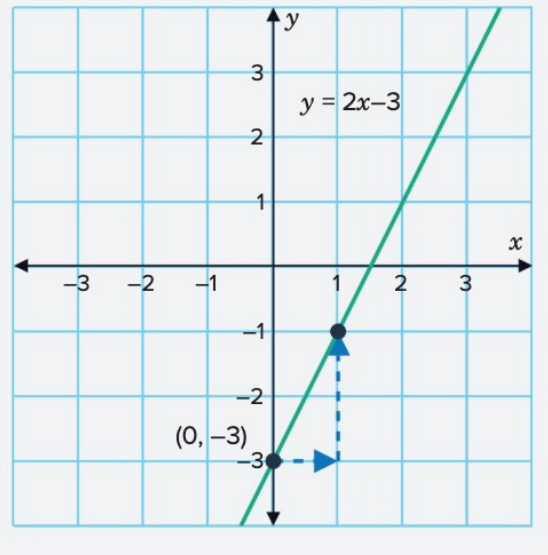
Worked Example 4: Graph the straight line represented by the equation .
Solution:
Identify and plot the y-intercept, then use the gradient to determine a second point. Draw a straight line through the two points to complete the graph.
The y-intercept is , so the point should be plotted first.
The gradient is . From , move unit right and units up to locate a second point at .
Draw a line through the points and .
General form
The general form is an alternative way to express the equation of a straight line.
Definition
Important
A straight line in general form is given as:
where , and are constants.
The general form does not immediately display the gradient or y-intercept, but it is suitable for graphing, particularly when the coefficients are integers and the intercepts are easy to identify.
Finding intercepts from general form
To graph a straight line from general form, you typically find the intercepts first.
Note
Finding Intercepts - Quick Method:
-
The x-intercept is found by setting and solving for . This gives the point where the line crosses the x-axis.
-
The y-intercept is found by setting and solving for . This gives the point where the line crosses the y-axis.
Once both intercepts are determined, plot the corresponding points on the Cartesian plane and draw a straight line through them, extending in both directions.
Converting between forms
Linear equations can be converted between gradient-intercept form and general form using algebraic manipulation.
Converting from gradient-intercept to general form:
To convert to general form, rearrange all terms to one side of the equation so that it equals zero, ensuring the coefficient of is positive.
Converting from general form to gradient-intercept form:
To convert from general form to gradient-intercept form, rearrange the equation to make the subject.
Example
Worked Example 5: Consider the straight line equation .
a) Determine the x-intercept and y-intercept.
Solution:
Set to determine the x-intercept, and to determine the y-intercept.
To determine the x-intercept, substitute :
Therefore, the x-intercept is at .
To determine the y-intercept, substitute :
Therefore, the y-intercept is at .
Verification:
To verify, convert to gradient-intercept form:
The y-intercept is and setting gives . This confirms the intercepts are correct.
b) Graph the straight line represented by the equation.
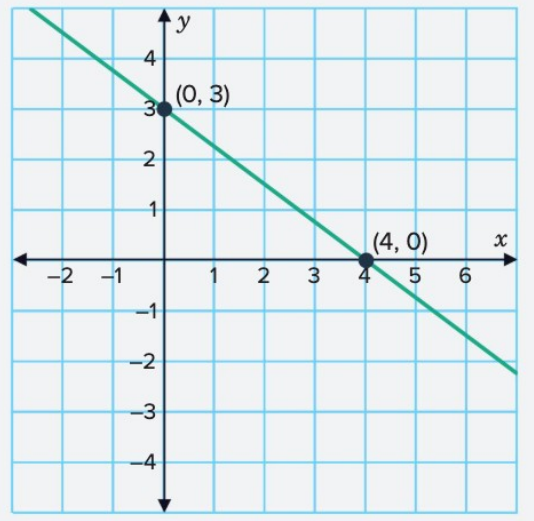
Solution:
Plot the x-intercept and y-intercept from part (a), then draw a straight line through the two points.
Plot the points and , and then draw a straight line through them.
Alternatively, you can use the gradient-intercept form found above to plot the y-intercept at , then use the gradient to find another point:
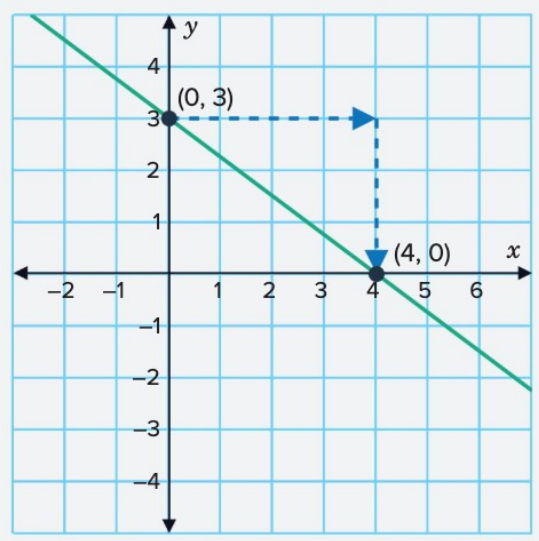
From the y-intercept at , move units right and units down to locate and plot another point at .
Summary
Linear functions have graphs that are always straight lines. The gradient-intercept form immediately shows the gradient and y-intercept , making it useful for both interpreting and graphing straight-line equations.
The gradient represents the rate of change in with respect to . It can be calculated from two points using and interpreted as rise over run when graphing.
To graph using gradient-intercept form, plot the y-intercept at first, then use the gradient as a ratio to find a second point on the line. A straight line is drawn through both points.
The general form is an alternative way to express linear equations. To graph from general form, find the intercepts by setting (for x-intercept) and (for y-intercept), then plot these points and draw a straight line through them.
Linear equations can be converted between gradient-intercept form and general form using algebraic manipulation.
Summary
Key Points to Remember:
- The gradient-intercept form is , where is the gradient and is the y-intercept
- The gradient represents the rate of change and can be interpreted as rise over run
- To find an equation from two points: calculate the gradient first, then substitute one point to find the y-intercept
- To graph from gradient-intercept form: plot the y-intercept, then use the gradient to find a second point
- To graph from general form : find both intercepts by setting and , then draw a line through them
- You can convert between gradient-intercept form and general form by rearranging the equation algebraically