Equations of Lines (HSC SSCE Mathematics Advanced): Revision Notes
📚Revision Notes
Equations of Lines
Introduction
Finding the equation of a straight line is a fundamental skill in coordinate geometry. The equation describes all points that lie on that line. In this topic, you will learn several methods to determine line equations depending on the information given.
Note
After studying this content, you will be able to:
- Use the point-gradient formula to find the equation of a line
- Find the equation of a line passing through two given points
- Find the equation of a line that is parallel or perpendicular to a given line
- Express linear equations in gradient-intercept or general form as required
Point-gradient form
When you know a line's gradient and one point it passes through, you can use the point-gradient formula to find the complete equation of the line.
Point-gradient form: The equation of a line with a known gradient and point can be written as .
The formula is:
Where:
- is the gradient of the line
- is a point on the line
To use this formula, substitute the given gradient and coordinates into the equation, then rearrange to gradient-intercept form if required.
Example
Worked Example: Using point-gradient form
Question: Find the equation of a line with gradient 3 passing through in gradient-intercept form.
Solution:
We have , and . Substitute these values into the point-gradient formula.
The equation in gradient-intercept form is .
Note
Key point: The point-gradient formula determines a line's equation using its gradient and a point . Rearrange to for gradient-intercept form.
Line through two points
When you have two points on a line but no gradient given directly, you must first calculate the gradient before finding the equation.
To find the equation of a line passing through points and :
Step 1: Calculate the gradient using:
Where:
- is the gradient of the line
- are the coordinates of the first point
- are the coordinates of the second point
Step 2: Use the point-gradient formula with one of the points and the calculated gradient, then rearrange to .
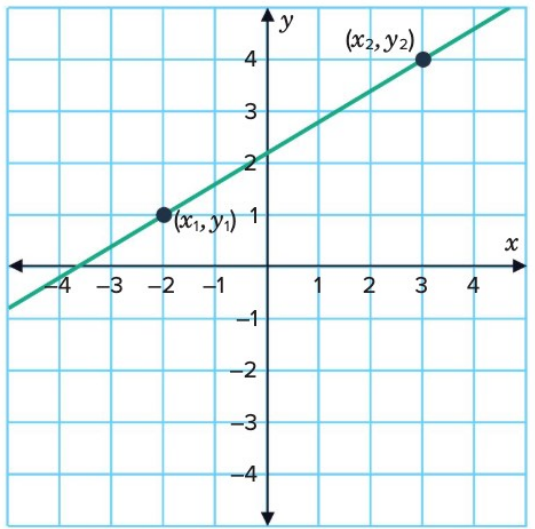
Example
Worked Example: Line through two points
Question: Find the equation of the line through and in gradient-intercept form.
Solution:
First, calculate the gradient using the two points.
Now use the point-gradient formula with and the point :
The equation is .
Note
Key point: For two points and , calculate the gradient , then use the point-gradient formula with one point to find the equation, rearranging to .
Parallel lines
Parallel lines are lines that run in the same direction and never meet, no matter how far they are extended. Understanding parallel lines is essential for solving many geometric problems.
Important
Parallel lines: Two distinct lines, rays or line segments in the same plane that have no points of intersection and necessarily have the same gradient.
Two lines with equations and are parallel if their gradients are equal:
If as well, the two lines are identical rather than distinct parallel lines.
Finding parallel line equations
To determine the equation of a straight line parallel to a given line and passing through a specific point :
- Identify the gradient from the given line
- Use the point-gradient form with the given point and the same gradient
- Rearrange into gradient-intercept form or general form as required
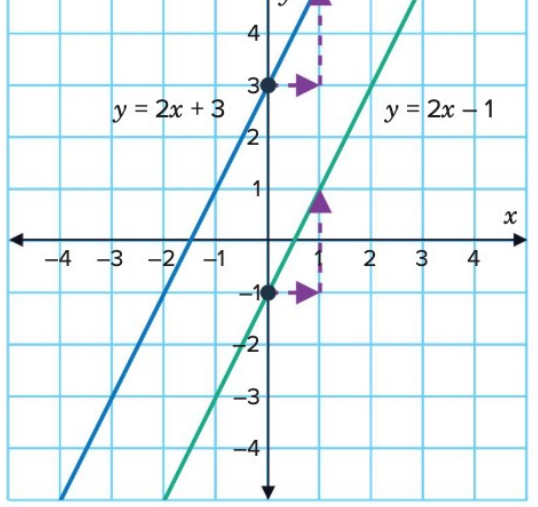
For example, both lines shown have gradient but different y-intercepts ( and ), so they are parallel.
Example
Worked Example: Parallel line
Question: Determine the equation of the line parallel to and passing through in gradient-intercept form.
Solution:
The gradient of is . For a parallel line, the gradient remains .
Using the point-gradient form with :
The equation of the straight line parallel to and passing through is .
Verification: The gradient of both lines is , and their y-intercepts differ ( and ), which confirms they are distinct parallel lines.
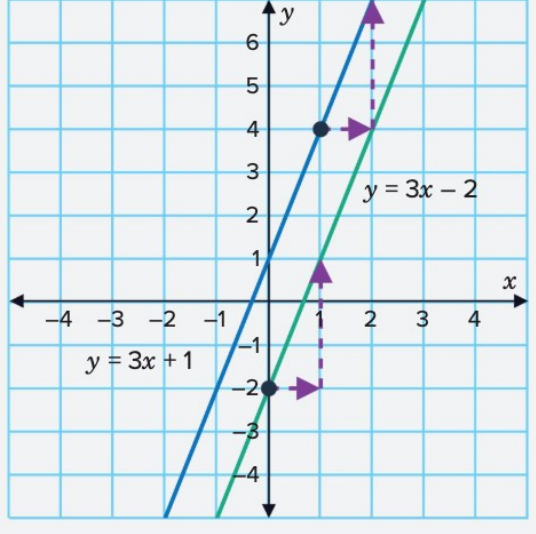
Note
Key point: Two straight lines and are parallel if they have equal gradients () but different y-intercepts. To determine the equation of a line parallel to a given line, use the gradient of the given line in the point-gradient form with the given point, then rearrange into the required form.
Perpendicular lines
Perpendicular lines intersect at right angles, forming a 90-degree corner where they meet. This relationship creates a special connection between their gradients.
Perpendicular lines: Two straight lines that intersect at a 90° angle (a right angle).
If the gradients of two lines are and , they are perpendicular if:
Important
This means the gradient of one line is the negative reciprocal of the other:
Important note: A vertical line (undefined gradient) is always perpendicular to a horizontal line (gradient 0).
Finding perpendicular line equations
To determine the equation of a line perpendicular to a given line through a specific point:
- Determine the gradient of the given line
- Calculate the gradient of the perpendicular line using
- Use the point-gradient form with the given point :
- Rearrange into gradient-intercept or general form as required
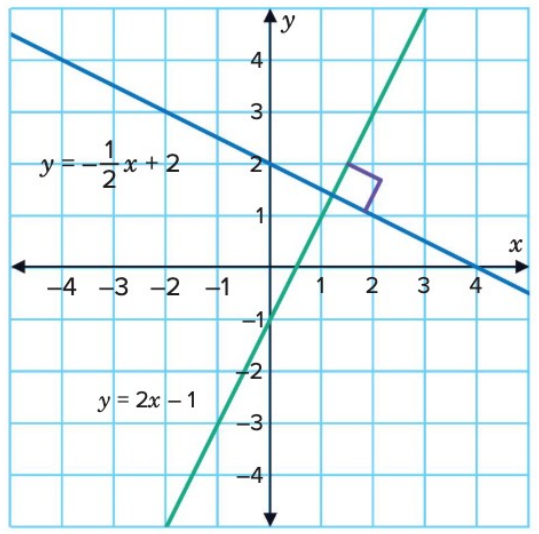
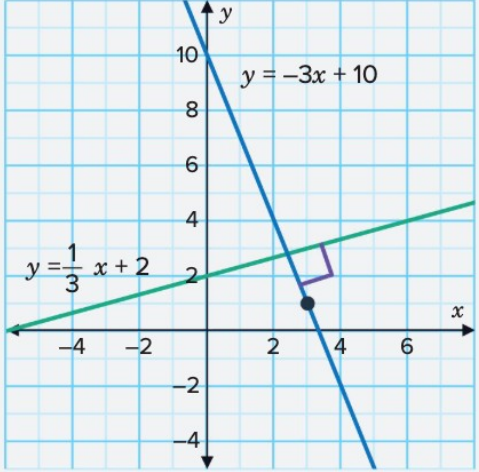
For example, on this graph, the gradients of the two straight lines are and . Their product is , confirming the two lines are perpendicular.
Example
Worked Example: Perpendicular line
Question: Determine the equation of the line perpendicular to and passing through in gradient-intercept form.
Solution:
The gradient of is , so the gradient of the perpendicular line is:
Use the point-gradient form with and :
The equation of the line perpendicular to and passing through is .
Verification:
This confirms the lines are perpendicular.
Note
Key point: Two lines with gradients and are perpendicular if the product of their gradients is . To determine the equation of a line perpendicular to a given line and passing through a point , take the negative reciprocal of the given gradient, substitute it into the point-gradient form with the given point, and rearrange into the required form.
Applications of parallel and perpendicular lines
Parallel and perpendicular lines appear frequently in real-world contexts. Engineers use them when designing roads and bridges, architects apply them when planning building structures, and physicists use them to model scenarios like parallel roads, perpendicular walls, or reflected light paths in optics. These applications often involve specific constraints, such as fixed points or particular angles.
Problem-solving approach
To solve problems involving parallel or perpendicular lines:
- Identify the given line's equation and determine its gradient
- For parallel lines, use the same gradient; for perpendicular lines, use the negative reciprocal
- Apply the point-gradient form with any given points or constraints, and consider the context (e.g., horizontal/vertical lines)
- Verify the solution geometrically (checking angles or intercepts) or algebraically
Example
Worked Example: Laser reflection
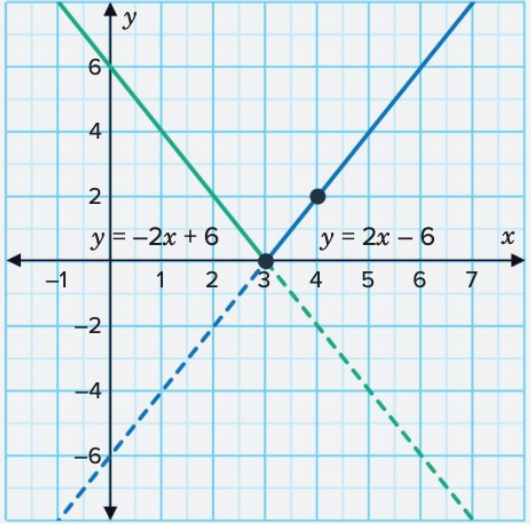
Question: A laser beam follows the path and reflects off a mirror along the x-axis. The reflection passes through .
a) Find the point of reflection on the mirror.
Solution:
The mirror is horizontal, represented by the x-axis where . Find where the laser beam's path intersects .
Set in :
The point of reflection is .
b) Determine the equation of the reflected path in gradient-intercept form.
Solution:
Use the two points (point of reflection) and to determine the gradient of the reflected path.
Use the point-gradient form with and :
The reflected path is .
Note
Key point: Parallel and perpendicular lines model real-world scenarios like reflections or structural alignments. Parallel lines have the same gradient, perpendicular lines have gradients that are negative reciprocals (), and equations are found using point-gradient form, applying any given constraints such as fixed points or specified angles.
Remember!
Summary
Key Points to Remember:
- The point-gradient formula is used when you know a line's gradient and one point it passes through
- To find a line through two points, first calculate the gradient using , then apply the point-gradient formula
- Parallel lines have equal gradients:
- Perpendicular lines have gradients whose product is : , meaning one gradient is the negative reciprocal of the other
- Always verify your solution by checking the gradient relationships or substituting points back into the equation