Linear Inequalities (HSC SSCE Mathematics Advanced): Revision Notes
📚Revision Notes
Linear Inequalities
What is an inequality?
An inequality is a mathematical statement comparing two quantities, showing that one is less than, greater than, less than or equal to, or greater than or equal to the other. Unlike equations which show that two expressions are exactly equal, inequalities describe a range of possible values.
Note
Real-World Applications
Inequalities are essential in real-world situations because many conditions involve limits or thresholds rather than exact values. For instance:
- "You must be at least 16 to drive" means age
- "Speed must be under 60 km/h" means speed
The four types of inequalities
There are four inequality symbols you need to know:
- Less than: means is less than
- Greater than: means is greater than
- Less than or equal to: means is less than or equal to
- Greater than or equal to: means is greater than or equal to
The symbols and are called strict inequalities because they don't include the boundary value. The symbols and are called inclusive inequalities because they include the boundary value itself.
Solving linear inequalities algebraically
Linear inequalities are solved using similar techniques to equations. The goal is to isolate the variable by performing inverse operations on both sides. However, there's one crucial difference: the inequality direction can change under certain conditions.
Properties that preserve or reverse the inequality
When solving inequalities, you must follow these important rules:
Addition and subtraction: Adding or subtracting the same value from both sides keeps the inequality direction unchanged.
Multiplication or division by a positive number: Multiplying or dividing both sides by a positive number keeps the inequality direction the same.
Multiplication or division by a negative number: This is the critical rule to remember. Multiplying or dividing both sides by a negative number reverses the inequality direction.
Important
Critical Rule: Reversing the Inequality
Always watch for negative coefficients! When you multiply or divide by a negative number, you must flip the inequality symbol.
Think of it this way: if , then multiplying both sides by gives and . Since is actually greater than , the inequality reverses: .
Mnemonic: "Multiply or divide by negative? Flip the sign, be directive!"
Steps to solve a linear inequality
Follow this systematic approach:
- Simplify both sides of the inequality (expand brackets, collect like terms)
- Use inverse operations to isolate the variable (addition, subtraction, multiplication, division)
- Remember to reverse the inequality symbol if you multiply or divide by a negative number
- Write your answer as a solution set in inequality form (e.g. )
- Verify your solution by testing a value inside the solution set and one outside it
Example
Worked Example 1: Basic Linear Inequality
Question: Solve the inequality
Solution:
The solution set is x > 4.
Checking the solution:
To verify this answer, we test two values: one inside the solution set and one outside it.
Test (which should satisfy the inequality):
This is true, confirming that 5 is in the solution set.
Test (which should not satisfy the strict inequality):
This is false, confirming that 4 is not in the solution set. This makes sense because our inequality is strict ( not ), so the boundary value 4 is excluded.
Example
Worked Example 2: Inequality Requiring Reversal
Question: Solve the inequality
Solution:
First, expand the brackets to simplify the expression:
The solution set is x ≥ -5.
Notice how dividing by -2 required us to flip the inequality from to .
Checking the solution:
Test (boundary value, should satisfy the inclusive inequality):
This is true, confirming is in the solution set.
Test (outside the solution set):
This is false, confirming is not in the solution set.
Graphing inequalities on a number line
A number line is a horizontal line where each point represents a real number. It provides a clear visual representation of solution sets, making it easy to see which values satisfy an inequality and whether the boundary value is included.
How to graph an inequality on a number line
Follow these steps to accurately represent an inequality:
- Identify the boundary point from your solution (e.g. in , the boundary is 4)
- Mark the boundary point using the appropriate symbol:
- Use an open circle (○) for strict inequalities ( or ) because the boundary is not included
- Use a closed circle (●) for inclusive inequalities ( or ) because the boundary is included
- Draw an arrow showing which values satisfy the inequality:
- Arrow pointing left for or (values less than the boundary)
- Arrow pointing right for or (values greater than the boundary)
- Label key values on the number line, especially the boundary point, so the graph is clear
Note
Graphing Mnemonic
- "Closed circle includes, open circle excludes"
- "Less than points left, greater than goes right"
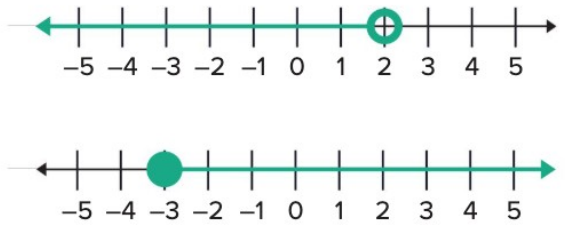
The top number line shows . The open circle at 2 indicates this value is not included, and the arrow points left showing all values less than 2 satisfy the inequality.
The bottom number line shows . The closed circle at indicates this value is included, and the arrow points right showing all values greater than or equal to satisfy the inequality.
Example
Worked Example 3: Solving and Graphing an Inequality
Question: Consider the inequality
a) Solve the inequality
Solution:
The solution set is x ≥ 4.
b) Graph the solution on a number line
Solution:
We need to mark the boundary point at with a closed circle (because the inequality includes "equal to"), then draw an arrow to the right to show all values greater than or equal to 4.

The closed circle at 4 shows this value is included in the solution, and the arrow extending right indicates all numbers greater than 4 are also solutions.
Summary
Key Points to Remember
-
An inequality compares two quantities showing one is less than, greater than, or equal to the other, representing a range of values rather than a single solution.
-
When solving inequalities algebraically, you can add, subtract, multiply, or divide both sides just like equations, but you must reverse the inequality symbol when multiplying or dividing by a negative number.
-
Always verify your solution by substituting a test value from inside the solution set (which should make the inequality true) and one from outside (which should make it false).
-
On a number line, use a closed circle (●) for inclusive inequalities ( or ) and an open circle (○) for strict inequalities ( or ).
-
The arrow direction on a number line shows which values satisfy the inequality: left for less than, right for greater than.