Simultaneous Equations (HSC SSCE Mathematics Advanced): Revision Notes
📚Revision Notes
Simultaneous Equations
What are simultaneous equations?
A simultaneous equation, also called a system of linear equations, is a collection of two or more equations that we consider together at the same time. The goal is to find values for the variables that make all the equations true simultaneously.
At this level, you'll typically work with two equations containing two variables, usually and . Each equation can be represented as a straight line on a coordinate plane. The solution is the point of intersection. The coordinates of this point satisfy both equations at the same time.
Note
When working with simultaneous equations, think of each equation as a constraint. The solution must satisfy all constraints simultaneously, which is why we call them "simultaneous" equations.
Types of solutions
A system of linear equations can have three possible outcomes:
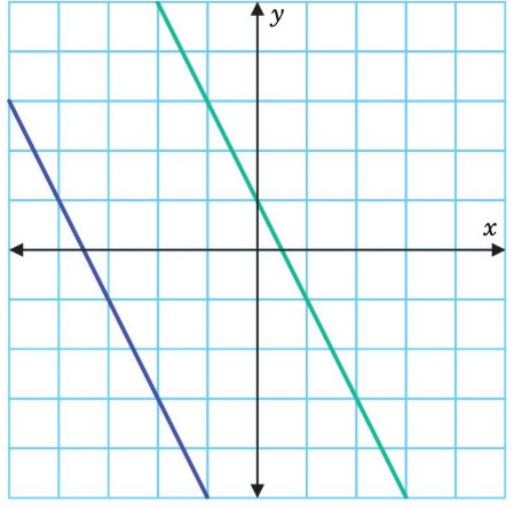
No solutions: When two lines are parallel and distinct (they have the same gradient but different -intercepts), they never meet. The corresponding system has no solutions.
One solution: When two lines are not parallel, they intersect at exactly one point. The corresponding system has one unique solution.
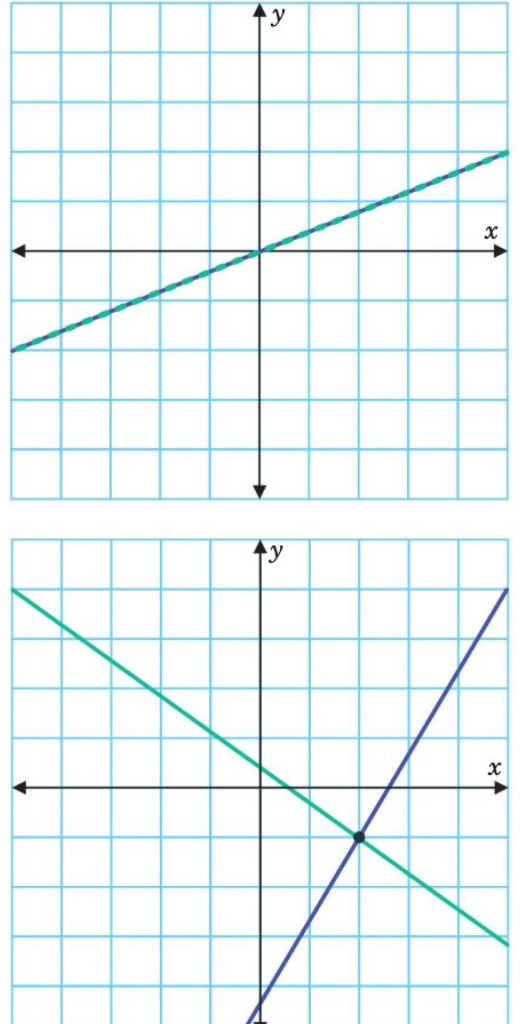
Infinitely many solutions: When two lines are identical (they overlap completely), every point on the line is a solution. The corresponding system has infinitely many solutions.
Important
Identifying Solution Types:
- Same gradient, different intercepts → Parallel lines → No solution
- Different gradients → Intersecting lines → One solution
- Same gradient, same intercepts → Identical lines → Infinite solutions
Viability of solutions
In real-world contexts, a solution is described as viable if it makes practical sense within the problem's context. A solution is non-viable if it doesn't make sense in context, even if it is mathematically correct.
Note
Always check your solutions against real-world constraints! For example:
- Can quantities be negative? (Usually no for physical objects)
- Must values be whole numbers? (For countable items like people or products)
- Are there maximum or minimum limits? (Like test scores between 0 and 100)
Solving simultaneous equations graphically
The graphical method involves plotting both equations on the same coordinate plane and identifying their point of intersection visually.
Method for graphical solution
To solve a system graphically:
- Convert each equation to gradient-intercept form () if necessary
- Find the intercepts of each equation (where the line crosses the -axis and -axis)
- Plot both lines on the same set of axes
- Identify the coordinates of the intersection point
- Verify that these coordinates satisfy both original equations
Finding intercepts
To find the -intercept: Substitute into the equation and solve for .
To find the -intercept: Substitute into the equation and solve for .
Note
The intercepts are particularly useful for graphing because they give you two clear points on each line. You only need two points to draw a straight line accurately!
Example
Worked Example: Graphical solution with infinite solutions
Solve the system graphically:
Strategy: Convert equation 2 to gradient-intercept form and compare with equation 1.
Solution:
Starting with equation 2:
Since equation 2 simplifies to the same form as equation 1, the two lines are identical. The graph shows that both equations represent the same line.
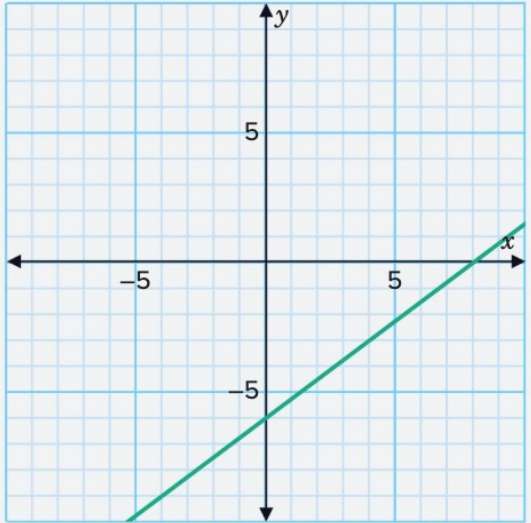
The system has infinitely many solutions because the lines overlap completely.
Example
Worked Example: Graphical solution with no solution
Solve the system graphically:
Strategy: Calculate the intercepts of each equation and plot them.
Finding intercepts for equation 1:
-intercept (let ):
-intercept (let ):
The intercepts for equation 1 are and .
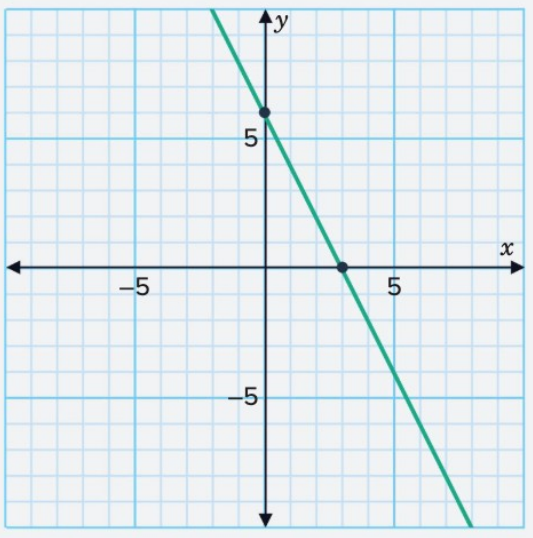
Finding intercepts for equation 2:
-intercept (let ):
-intercept (let ):
The intercepts for equation 2 are and .
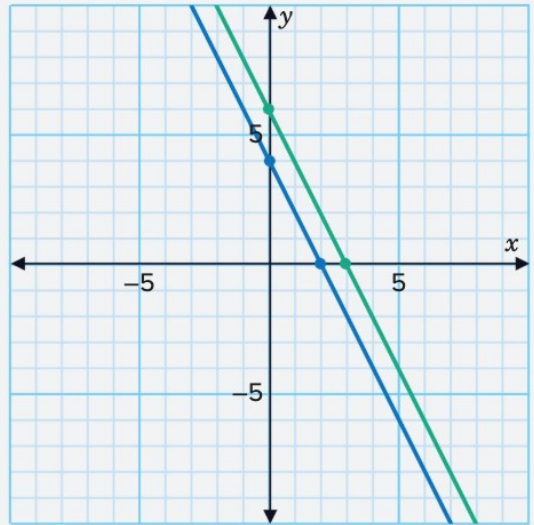
The graphs of the equations never intersect, so there is no solution to this system.
Why? Converting both equations to gradient-intercept form reveals they have the same gradient but different -intercepts, confirming the lines are parallel.
Applications of simultaneous equations
Simultaneous linear equations model practical situations involving two unknowns, such as quantities, prices, or costs. The equations represent relationships described in the problem, and solving the system gives values that satisfy all conditions.
Setting up and solving real-world problems
Step 1: Define variables for the unknowns (for example, for one quantity, for another)
Step 2: Form two equations from the information given (such as total amounts or relationships)
Step 3: Solve the system using a suitable method (graphical, substitution, elimination, or technology)
Step 4: Interpret the solution in context and check if it is viable (for example, quantities should be non-negative integers where appropriate)
Important
When solving real-world problems, always define your variables clearly at the start. This helps you set up correct equations and interpret your final answer properly!
Solution methods
Graphical method: Plot both equations as straight-line graphs and identify their point of intersection. This provides a visual representation, though manual plotting may be less precise.
Substitution method: Rewrite one equation to express one variable in terms of the other, then substitute this expression into the second equation. This works efficiently when a variable already has a coefficient of 1 or -1.
Elimination method: Add or subtract the equations to remove one variable, then solve for the other. This works well when coefficients can be easily matched.
Technology: Use graphing calculators or computer software to model and solve the system quickly and accurately. While efficient, algebraic methods help develop stronger understanding.
Note
Choosing the Best Method:
- Use substitution when one variable is already isolated (like )
- Use elimination when coefficients are easy to match
- Use graphical method for visual understanding or when precision isn't critical
- Use technology for complex systems or when speed is important
Example
Worked Example: Flower shop problem
Gordiano made two trips to a flower shop. On his first trip, he purchased 4 roses and 4 sunflowers for $12. The following day, he went back and purchased 12 roses and 8 sunflowers for $16.
The situation can be represented by:
where = cost per rose and = cost per sunflower.
Part a) Graph the system
Strategy: Define variables, then convert equations to gradient-intercept form.
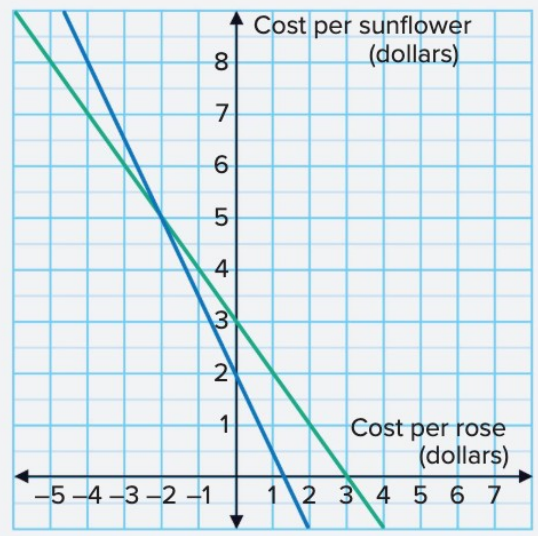
Based on the problem, represents the cost per rose and represents the cost per sunflower.
Converting equation 1:
Converting equation 2:
Part b) Interpret the solution
Each equation models the relationship between the total cost and the quantities of each type of flower purchased on a given day.
The solution to the system is , which suggests a cost of -$3 per rose and $6 per sunflower.
A negative cost is not realistic in this context, so the solution is non-viable.
This indicates that at least one of the per-item costs must have been different on the two days.
Example
Worked Example: Coin jar problem
Bixia is saving 20 cent and 5 cent pieces in a jar. She has a total of $10.50 in 90 coins.
Part a) Write a system of equations
Strategy: Use the information to create two equations - one for the total number of coins, another for the total dollar amount.
Let:
- = number of 20 cent pieces
- = number of 5 cent pieces
The system is:
Verification: Equation 1 represents the total number of coins. Equation 2 represents the total dollar value, where is the value of all 20 cent pieces and is the value of all 5 cent pieces.
Part b) Graph the system
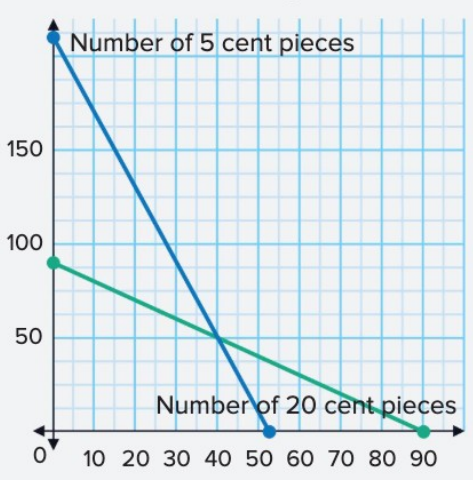
Strategy: Find the intercepts and use them to determine appropriate scales for the axes.
For equation 1:
-intercept (let ):
-intercept (let ):
For equation 2:
-intercept (let ):
-intercept (let ):
Part c) Interpret the solution
The solution to the system is . Since represents the number of 20 cent pieces, Bixia has 40 twenty-cent pieces. Since represents the number of 5 cent pieces, she has 50 five-cent pieces.
Example
Worked Example: Rectangle perimeter problem
The length of a rectangle is 3 metres less than twice its width. If the perimeter is 48 metres, determine the length.
Strategy: Define variables and build a system of equations.
Let = length in metres and = width in metres.
From the problem:
- Length equals 3 metres less than twice the width:
- Perimeter equals sum of twice the length and twice the width:
System:
Solving using substitution:
Now find :
The length of the rectangle is 15 metres.
Example
Worked Example: Test scores problem
Verna noticed that the sum of her Chemistry and English test scores was 128, and their difference was 16. She scored higher on her Chemistry test.
Part a) Write a system of equations
Let = Chemistry test score and = English test score.
Since the Chemistry score is higher, the difference is to get a positive result.
Note: There are constraints based on typical test scores: and .
Part b) Solve the system
Strategy: Since the equations have the same coefficient of with opposite signs, add the equations to eliminate .
$$\begin{array}{rcl} x + y &=& 128 \
- \quad x - y &=& 16 \ \hline 2x + 0y &=& 144 \end{array}$$`
Eliminate the term:
`
Substitute into equation 1:
Verna scored 72 on her Chemistry test and 56 on her English test.
Alternative method: Since both equations also have the same coefficient of with the same sign, the system could be solved by subtracting one equation from the other to find first.
Part c) Does the solution make sense?
Yes. Assuming the tests were out of 100, both 72 and 56 are valid test scores to obtain.
Break-even analysis
Another important application of simultaneous equations in business is break-even analysis, used to identify the sales volume at which total revenue equals total cost.
Break-even point
The break-even point is where income from production equals the cost of production. At this point, there is no profit or loss.
Important
Understanding Break-Even:
The break-even point is crucial in business planning. It tells you:
- The minimum sales needed to cover all costs
- When the business will start making profit
- How pricing and costs affect profitability
At break-even: Cost = Revenue and Profit = $0
Finding the break-even point
Step 1: Write the cost equation in the form and the revenue equation as
Step 2: Equate cost and revenue () and solve for (units sold)
Step 3: Find the corresponding cost/revenue by substituting the value of
Step 4: Interpret the break-even point, considering any constraints (such as integer units)
Note
Break-even analysis can also compare pricing plans by finding where their cost equations intersect. This helps businesses determine which plan is more cost-effective at different production volumes.
Example
Worked Example: Bakery break-even problem
A bakery produces cakes at a cost of $25 each with a daily fixed cost of $200. Each cake sells for $30.
Part a) Write expressions for daily cost and revenue
Strategy: Define as the number of cakes. Write cost as fixed plus variable cost per cake, and revenue as price per cake times quantity.
For the cost, the fixed value is $200 plus $25 per cake:
For the revenue, the value is $30 per cake:
Constraint: (integers), since cakes are sold in whole units.
Part b) Determine the break-even point algebraically
Strategy: Equate cost and revenue (), solve for , then find the corresponding cost and revenue.
Substitute into :
The break-even point is , meaning selling 40 cakes results in cost and revenue both equal to $1200.
Since is an integer and satisfies , it is viable and confirms the break-even point.
Part c) Calculate the profit if 50 cakes are sold
Strategy: Calculate revenue and cost for , then subtract cost from revenue.
For the revenue:
For the cost:
For the profit:
The bakery makes a $50 profit when selling 50 cakes.
Remember!
Summary
Key Points to Remember:
-
Simultaneous equations are a set of equations considered together, with the solution being the ordered pair that satisfies all equations at the same time
-
On a coordinate plane, the solution is the point of intersection of the lines
-
A system can have one solution (intersecting lines), no solution (parallel lines), or infinitely many solutions (identical lines)
-
To solve graphically, convert equations to gradient-intercept form, find intercepts, plot both lines, and identify the intersection point
-
In real-world problems, always check if a solution is viable by considering the practical context (such as non-negative values or integer requirements)
-
The break-even point occurs where cost equals revenue (), representing no profit or loss in business applications