Sets and Notation (HSC SSCE Mathematics Advanced): Revision Notes
📚Revision Notes
Sets and Notation
What is a set?
A set is a collection of distinct objects or items, called elements, that are grouped together based on a shared property or characteristic. Sets provide a fundamental way to organize and work with groups of mathematical objects.
We represent sets using curly brackets (also called braces), with the elements listed inside and separated by commas. For example, the set of even numbers less than 10 can be written as:
Another example:
This represents set , which contains the positive integers less than 5.
Note
Sets can also be described using words rather than listing all elements. For instance, we might refer to "the set of prime numbers" or "the set of vowels in the English alphabet." This is particularly useful when a set has infinitely many elements or too many to list conveniently.
An element is an individual member or object within a set. For example, 3 is an element of the set of natural numbers .
Cardinality
The cardinality of a finite set tells us how many elements the set contains. We denote the cardinality of set using either of these notations:
Both and represent the total number of elements in set .
For example, if , then:
This is because set contains exactly three elements: 1, 2, and 3.
Example
Worked Example: Finding Cardinality
Given the set :
Find the cardinality of .
To find the cardinality, we count the number of elements in the set.
Set contains three elements: cat, dog, and bird.
Therefore:
The empty set
The empty set is a special set that contains no elements at all. We represent the empty set using the symbol or with empty curly brackets .
The empty set has a cardinality of zero because it contains no elements:
An example of an empty set would be "the set of odd numbers divisible by 2". Since no odd number can be divisible by 2, this set contains no elements and is therefore empty.
Important
The empty set is unique and is a subset of every set. It may seem like an abstract concept, but it plays an important role in set theory and helps us handle special cases in mathematical reasoning.
Checking if a set is empty
To determine whether a set is empty, we need to check if it contains any elements.
Using our earlier example, is the empty set?
No, because contains 3 elements. Since the set has elements, it is not empty.
Subsets
A set is called a subset of set (written as ) when every single element in is also an element of . The notation means "all elements of are in ".
For example, if and , then because both 1 and 3 (all elements of ) can be found in .
Proper subsets
When set is a subset of set , but contains more elements than (meaning has at least one element not in ), we call a proper subset of . This is written as:
The key difference is that a proper subset must have strictly fewer elements than the set it is contained in.
Note
Subset vs. Proper Subset
The symbols are similar but have an important distinction:
- means "subset or equal to" (like for numbers)
- means "proper subset" (like for numbers)
A set is always a subset of itself (), but never a proper subset of itself.
Visual representation of subsets
Venn diagrams help us visualize subset relationships. In a Venn diagram, we draw circles to represent sets. When one set is a subset of another, we draw it as a smaller circle completely inside the larger circle.
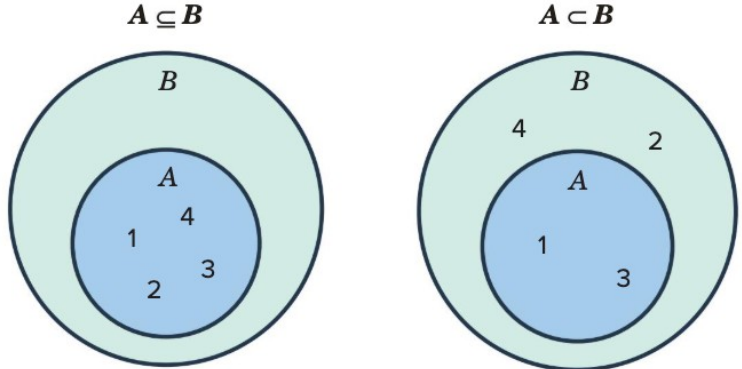
The diagram above shows two different representations of . In both cases, set (the blue inner circle) is completely contained within set (the light blue/green outer circle), illustrating the subset relationship.
Example
Worked Example: Identifying Subsets
Given , , and :
Is ?
To determine if is a subset of , we need to check whether all elements of are present in .
Set contains the elements 1 and 3.
Set contains the elements 1, 3, and 5.
Since both 1 and 3 (all elements of ) appear in , we can confirm:
Yes, is a subset of .
Complements
The complement of a set consists of all elements that are in the universal set but are not in set . The universal set, denoted by , represents the complete collection of all elements under consideration for a particular problem.
We can write the complement of set in several ways:
All three notations mean the same thing: the set of all elements in that are not in .
Understanding the universal set
The universal set contains all possible elements relevant to the problem we're working on. Every set we consider is contained within this universal set.
For example, if and , then the complement contains all elements in that are not in :
Important
Key concept: The complement of a set depends entirely on what the universal set is. The same set can have different complements in different universal sets! Always identify the universal set first before finding complements.
Example
Worked Example: Finding Complements
Given , , and :
Find .
To find the complement of , we list all elements in the universal set that are not in .
Set , so the elements that are not in are 2 and 4.
Therefore:
Find .
To find the complement of , we list all elements in that are not in .
Set , so the elements in that are not in are 2, 4, and 5.
Therefore:
Note
Strategy for Finding Complements
When finding complements, always remember to:
- Identify the universal set first
- List all elements in the universal set
- Remove the elements that appear in the set you're finding the complement of
- The remaining elements form the complement
Summary
Key Points to Remember:
- A set is a collection of distinct elements, represented using curly brackets such as
- Cardinality or tells us the number of elements in a set
- The empty set contains no elements and has cardinality zero
- A subset means every element of is also in
- A proper subset means is a subset of with strictly fewer elements
- The complement contains all elements in the universal set that are not in set