Completed Square Form (HSC SSCE Mathematics Advanced): Revision Notes
📚Revision Notes
Completed Square Form
What is completed square form?
Completed square form is a way of writing quadratic functions that makes it easy to identify key features of the parabola. It is also called vertex form because the vertex can be read directly from the equation.
Note
The general form of a quadratic in completed square form is:
where is the vertex of the parabola, and determines the concavity and stretch of the parabola.
Understanding the parameters
- is the -coordinate of the vertex (horizontal position)
- is the -coordinate of the vertex (vertical position)
- determines:
- Concavity: positive gives a parabola that is concave up (opens upward), negative gives a parabola that is concave down (opens downward)
- Stretch: larger absolute values of make the parabola narrower, smaller absolute values make it wider
Axis of symmetry
The axis of symmetry is a vertical line that passes through the vertex of the parabola. Every parabola is symmetric about this line.
For a quadratic in completed square form , the axis of symmetry is:
This is simply the -coordinate of the vertex.
Converting from general form
When a quadratic is given in general form , we can convert it to completed square form by completing the square. This process reveals the vertex and axis of symmetry.
The method of completing the square
To convert to completed square form:
Step 1: Write the function
Step 2: Factorise from the first two terms
Step 3: Add and subtract inside the brackets
Step 4: Factorise the perfect square trinomial and distribute
Step 5: Simplify the constant terms
Note
From this, we can identify:
- The vertex is
- The axis of symmetry is
Worked example: Monic quadratic
Example
Worked Example: Converting a Monic Quadratic
Let's work through a complete example with the quadratic function .
Part a: Express in completed square form
Strategy: Complete the square for by adding and subtracting .
Working:
Add and subtract :
Factorise and simplify:
The completed square form is f(x) = (x + 3)² - 4.
Part b: Identify the vertex and axis of symmetry
Strategy: Use the form to read the vertex and axis of symmetry .
Working:
From , rewrite as .
This gives and .
Answer: The vertex is (-3, -4), and the axis of symmetry is x = -3.
Part c: Find the -intercept
Strategy: Substitute into .
Working:
Answer: The -intercept is at (0, 5).
Part d: Find the -intercepts
Strategy: Set and solve for using the completed square form.
Working:
Add to both sides:
Take the square root of both sides:
Solve for the two possible values of :
First solution:
Second solution:
Answer: The -intercepts are at (-5, 0) and (-1, 0).
Part e: Sketch the graph
Strategy: Plot the vertex, -intercept, and axis of symmetry. Draw a smooth curve, noting concavity from .
Since , the parabola is concave up.
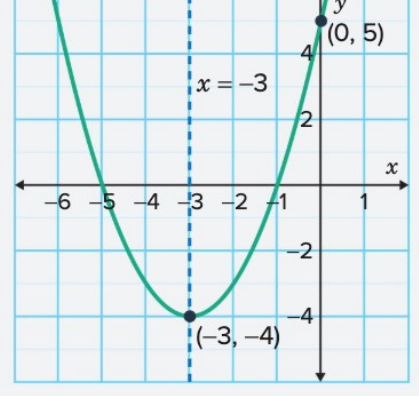
The graph shows the vertex at , the -intercepts at and , the -intercept at , and the axis of symmetry at .
Domain and range of quadratic functions
Domain
The domain of a quadratic function is the set of all real numbers, denoted . This is true unless there are specific restrictions given in the context of a problem.
Range
The range depends on the concavity and the -coordinate of the vertex:
Important
Determining the Range:
- If (concave up), the parabola has a minimum value at the vertex. The range is .
- If (concave down), the parabola has a maximum value at the vertex. The range is .
Here, is the -coordinate of the vertex.
Non-monic quadratics
For non-monic quadratics (where in ), we must factorise before completing the square.
Important
Critical Step for Non-Monic Quadratics:
Always factorise the coefficient from the first two terms before attempting to complete the square. This ensures the algebra works correctly.
Method for non-monic quadratics
Step 1: Write the function
Step 2: Factorise
Step 3: Add and subtract inside the brackets
Step 4: Factorise the perfect square trinomial and distribute
This step ensures we correctly handle the coefficient throughout the process.
Worked example: Non-monic quadratic
Example
Worked Example: Converting a Non-Monic Quadratic
Let's work through a complete example with the quadratic function .
Part a: Express in vertex form
Strategy: Factorise and complete the square for the resulting monic quadratic.
Working:
Factorise :
Add and subtract :
Factorise the perfect square trinomial:
Distribute and simplify:
Answer: The vertex form is f(x) = 2(x - 2)² - 5.
Part b: Find the vertex and axis of symmetry
Strategy: Use to identify and .
Working:
From , we have and .
Answer: The vertex is (2, -5), and the axis of symmetry is x = 2.
Part c: Determine the domain and range
Strategy: The domain is . For the range, use the concavity and the -coordinate of the vertex.
Working:
The domain is .
Since , the parabola is concave up, with a minimum at .
Answer: Domain is ℝ. Range is [[-5, ∞)].
Part d: Find the -intercept
Strategy: Substitute into .
Working:
Answer: The -intercept is at (0, 3).
Part e: Sketch the graph
Strategy: Plot the vertex, -intercept, and axis of symmetry. Draw a concave up parabola.
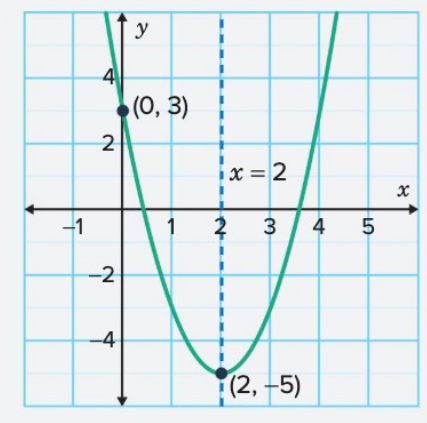
The graph shows the vertex at , the -intercept at , and the axis of symmetry at . The parabola is concave up.
Summary
Key Points to Remember:
- Completed square form is , where is the vertex.
- The axis of symmetry is the vertical line , which passes through the vertex.
- For non-monic quadratics, always factorise before completing the square.
- The domain of any quadratic function is all real numbers ().
- The range depends on concavity: if (concave up), or if (concave down).