Quadratic Inequalities (HSC SSCE Mathematics Advanced): Revision Notes
📚Revision Notes
Quadratic Inequalities
Introduction
In this topic, you will learn how to solve quadratic inequalities using two different approaches: algebraically and graphically. Understanding quadratic inequalities is essential for finding ranges of values that satisfy certain conditions, which has many practical applications in mathematics and real-world problem-solving.
Note
What You'll Learn:
You will be able to:
- Find solutions by identifying boundary points and testing intervals
- Solve inequalities graphically by comparing functions
- Represent your solutions using interval notation and number lines
- Work with inequalities involving quadratic and linear functions or two quadratic functions
What is a quadratic inequality?
A quadratic inequality is a statement that compares a quadratic function to a constant or another function using an inequality symbol. The quadratic function has the form:
where , , and are constants and .
Instead of finding where the function equals a particular value (as with equations), we need to find the range of x-values where the inequality is satisfied. For example:
- (function is greater than constant )
- (function is less than or equal to constant )
- (one function is greater than or equal to another)
Note
Think of quadratic inequalities as asking: "For which -values is my quadratic function above, below, or equal to a certain line or curve?" This is fundamentally different from solving equations, where we find specific points.
Solving quadratic inequalities with constants
When a quadratic inequality compares a quadratic function to a constant value, such as , we can solve it using either an algebraic or graphical approach. Both methods are equally valid, and you can choose the one that works best for you or verify your answer by using both.
The algebraic method
The algebraic method involves these key steps:
Step 1: Find the boundary points
Convert the inequality to an equation by replacing the inequality symbol with an equals sign. Solve to find the boundary points where the parabola crosses the horizontal line .
Step 2: Test intervals
The boundary points divide the number line into intervals. Select a test value from within each interval and substitute it into the original inequality to check whether the inequality holds in that interval.
Step 3: Write the solution
Based on your testing, identify which intervals satisfy the inequality. Express your answer using interval notation or as a compound inequality.
The graphical method
The graphical approach provides a visual way to solve the inequality:
Step 1: Sketch the functions
Plot the graph of and the horizontal line on the same set of axes.
Step 2: Identify the relevant regions
Look at where the graph of the parabola is positioned relative to the line:
- For : find where the parabola is above the line
- For : find where the parabola is below the line
- For or : include the boundary points where the graphs intersect
Step 3: Read off the solution
Determine the -values corresponding to the relevant region and write your solution.
The role of the discriminant
The discriminant of the equation is given by:
Important
The Discriminant Determines the Number of Boundary Points:
The discriminant tells us how many boundary points exist:
- : Two distinct boundary points (parabola crosses the line twice)
- : One boundary point (parabola touches the line at exactly one point)
- : No boundary points (parabola is entirely above or entirely below the line)
Understanding the discriminant helps you anticipate what type of solution to expect.
Worked example 1: Solving
Example
Worked Example: Solving a Quadratic Inequality
Let's solve the inequality using both methods.
Part a: Algebraic solution
Step 1: Convert to an equation and find boundary points
Replace the inequality symbol with an equals sign:
Factorise the quadratic expression:
Apply the null factor law. If the product of two factors equals zero, then at least one factor must equal zero:
The boundary points are at x = -1 and x = 5.
Step 2: Test intervals
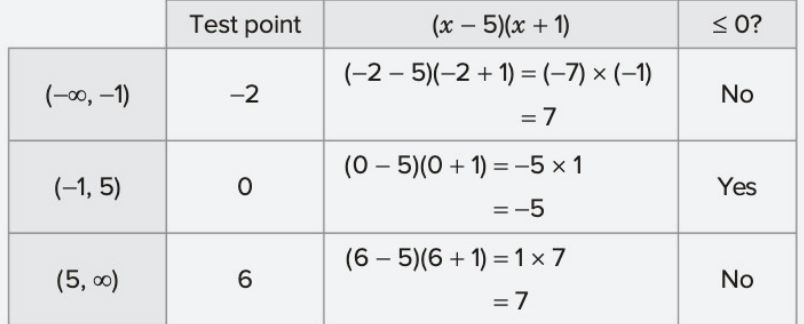
The boundary points divide the number line into three intervals:
Choose a test point from each interval. Good test points are , , and .
For each test point, substitute into the factorised form and check if the result satisfies the inequality :
Step 3: Write the solution
The inequality is satisfied in the interval . Since the original inequality includes "equal to" (the symbol), we include the boundary points.
Solution: -1 ≤ x ≤ 5
Part b: Graphical solution
Step 1: Set up the graph
We need to plot and identify where the parabola is on or below the -axis (since we're comparing to , which is represented by ).
Step 2: Sketch and analyse
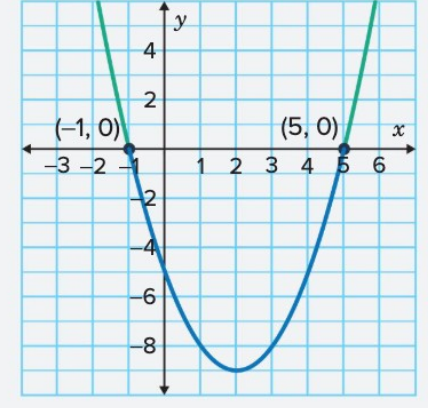
The parabola crosses the -axis at and . These are the boundary points we found algebraically.
Step 3: Identify the solution region
The parabola is on or below the x-axis (where ) between and .
Solution: -1 ≤ x ≤ 5
Notice that both methods give the same answer, confirming our solution.
Solving quadratic inequalities with linear or quadratic functions
Sometimes we need to solve inequalities that compare a quadratic function to a linear function or to another quadratic function. For example:
- Comparing quadratic to linear:
- Comparing two quadratics: where
The solution process is similar to what we've already learned, but instead of finding where a parabola crosses a horizontal line, we find where two curves intersect.
The algebraic method
Step 1: Find intersection points
Set the two functions equal to each other and solve for . These intersection points become your boundary points.
Step 2: Test intervals
Use the boundary points to divide the number line into intervals. Choose test points and substitute them into the original inequality to determine which intervals satisfy the condition.
Step 3: State the solution
Express your answer based on which intervals make the inequality true.
The graphical method
Step 1: Plot both functions
Sketch the graphs of both functions on the same coordinate plane.
Step 2: Identify the relevant region
Determine where one function is above, below, or equal to the other function, depending on the inequality symbol.
Step 3: Read the solution
Find the -values that correspond to the relevant region.
Note
Choosing Between Methods:
The algebraic method is often more precise and works well when factorisation is straightforward. The graphical method provides visual insight and can be particularly helpful when dealing with more complex expressions or when you want to verify your algebraic solution.
Worked example 2: Solving
Example
Worked Example: Comparing Two Quadratic Functions
Let's solve this inequality comparing two quadratic functions.
Part a: Algebraic solution
Step 1: Convert to an equation
Begin with the inequality:
Set the functions equal to find intersection points:
Rearrange by subtracting from both sides:
Factorise:
Apply the null factor law:
The boundary points are at x = -2 and x = 1.
Step 2: Test intervals
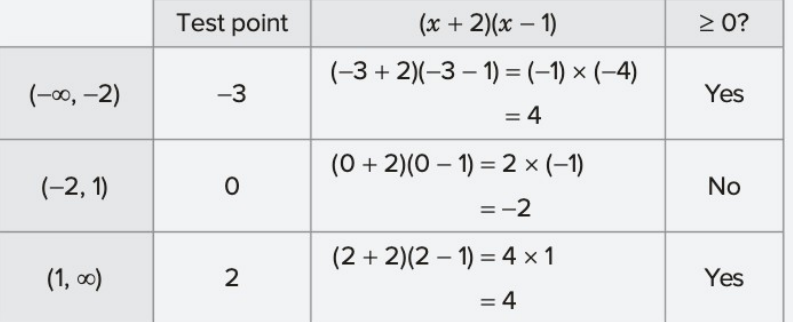
The boundary points create three intervals:
Choose test points: , , and .
For each test point, substitute into the factorised form and check if the result satisfies :
Step 3: State the solution
The inequality is satisfied in the intervals and . Including the boundary points (since we have ):
Solution: x ≤ -2 or x ≥ 1
Part b: Graphical solution
Step 1: Set up the graph
We need to plot both and on the same axes.
Step 2: Sketch and analyse
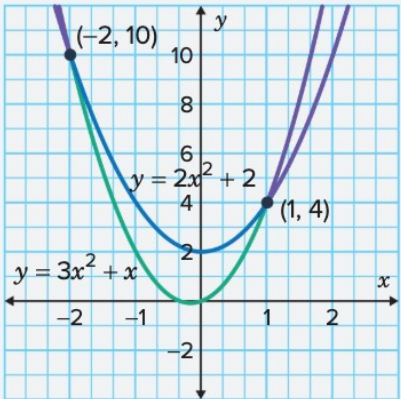
The two parabolas intersect at the points and .
Step 3: Identify where the first parabola is above or on the second
Looking at the graph, the parabola is above or on the parabola when:
- (to the left of the first intersection point)
- (to the right of the second intersection point)
Solution: x ≤ -2 or x ≥ 1
Again, both methods confirm the same solution.
Exam tips
Important
Common Mistakes to Avoid:
- Always check whether the inequality includes equality ( or ) or not ( or ). This determines whether you include the boundary points in your solution.
- When testing intervals, choose simple values that are easy to calculate, such as , , , etc.
- If you're using the graphical method, sketch your graph carefully and clearly label all intersection points.
- Double-check your factorisation by expanding to ensure you haven't made an error.
- Remember that the solution to a quadratic inequality is typically a range (or ranges) of values, not just discrete points.
Remember!
Summary
Key Points to Remember:
-
Quadratic inequalities compare a quadratic function to a constant or another function. Solutions are ranges of x-values, not single points.
-
Two solution methods are available: The algebraic method (find boundary points, test intervals) and the graphical method (sketch functions, identify regions).
-
Boundary points are found by solving the corresponding equation. These points divide the number line into intervals that must be tested.
-
The discriminant determines the number of boundary points: gives two points, gives one point, and means no boundary points exist.
-
Always check whether to include boundary points. Use or to include them; use or to exclude them.