The Derivative (HSC SSCE Mathematics Advanced): Revision Notes
📚Revision Notes
Graphical Behaviour of Functions
Introduction
The graphical behaviour of a function describes how the function changes as we move along its curve. Understanding this behaviour is crucial for analysing functions and solving real-world problems. The first derivative of a function provides valuable information about whether the function is increasing, decreasing, or stationary at any point.
Note
In this topic, we will explore how to use the derivative to determine the characteristics of a function's graph, find important points such as stationary points, sketch derivative graphs, and estimate derivative values using different methods.
Features of a function from its derivative
The first derivative of a function, denoted as , gives us information about the gradient of the tangent line to the curve at any point . This gradient is the key to understanding how the function behaves.
Increasing and decreasing functions
When we examine the sign of the first derivative, we can determine whether the function is rising or falling:
- If the derivative is positive at a point, the function is increasing at that point
- If the derivative is negative at a point, the function is decreasing at that point
- If the derivative is zero at a point, the function may have a stationary point at that point
Note
Let's look at two simple examples to illustrate these concepts:
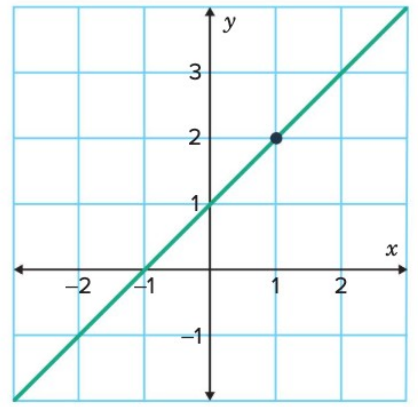
The function is always increasing. At every point on this line, the gradient is positive. Specifically, the gradient , which is always positive, confirming that the function constantly increases.
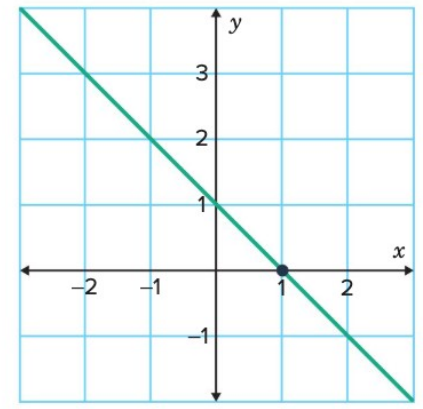
In contrast, the function is always decreasing. Here, the gradient is always negative, indicating that the function continuously decreases as increases.
Stationary points
A stationary point is a special location on a function's graph where the tangent line is horizontal. At these points, the function momentarily stops increasing or decreasing.
Important
Definition: A stationary point on the graph of a differentiable function is a point where .
A differentiable function is a function that can be differentiated at each point in its domain. This means we can find the derivative at any point along the curve.
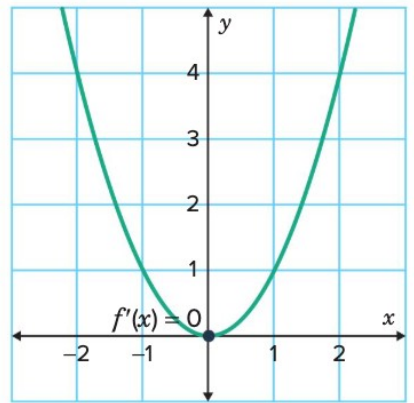
Consider the parabola . This function has a stationary point at where the gradient . At this minimum point, the tangent to the curve is perfectly horizontal.
Understanding function behaviour through derivatives
Summary
Key Relationships Between Derivatives and Function Behaviour:
- If on an interval, then is an increasing function on that interval
- If on an interval, then is a decreasing function on that interval
- If at a point , then the function has a stationary point at , where the tangent to the curve is horizontal
These relationships allow us to analyse the behaviour of more complex functions by examining their derivatives.
Cubic functions and stationary points
The concepts of increasing, decreasing, and stationary behaviour are particularly useful when analysing polynomial functions, especially cubic functions.
What is a cubic function?
Note
A cubic function is a polynomial function of degree 3. It has the general form:
where , , , and are constants, and .
Cubic functions often have interesting graphical features, including up to two stationary points (a local maximum and a local minimum) and an inflection point where the curve changes its direction of curvature.
Finding stationary points on cubic functions
To find the stationary points of any function, including cubic functions, we use the derivative. The process involves setting the derivative equal to zero and solving for .
Let's work through a detailed example to see how this works in practice.
Worked example: Finding intervals of increase and decrease
Example
Consider the function
a) Determine the values of for which the function is increasing or decreasing.
Strategy
Our approach will be to:
- Find the derivative
- Set the derivative equal to zero to find stationary points
- Test values of around these stationary points to determine where is positive (increasing) or negative (decreasing)
Solution
Step 1: Find the derivative
Step 2: Find stationary points
Set :
Factorise:
Using the null factor law:
Step 3: Test intervals
These values divide the -axis into three intervals: , , and . We need to test a point in each interval to determine the sign of .
For , test :
Since , the function is increasing for .
For , test :
Since , the function is decreasing for .
For , test :
Since , the function is increasing for .
Conclusion: The function is increasing for and , and decreasing for .
b) Determine the coordinates of the stationary points and show them on a sketch of the function.
Strategy
We already know the -coordinates of the stationary points from part (a). We now substitute these values into the original function to find the corresponding -coordinates, then plot the points on a graph.
Solution
When :
When :
The coordinates of the stationary points are and .
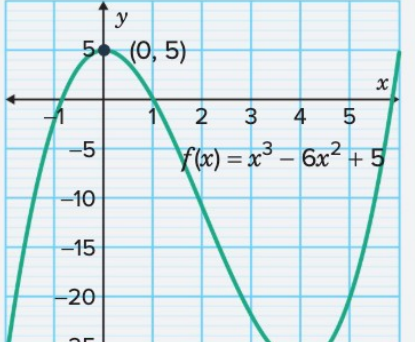
The graph confirms our analysis. The function increases up to , decreases between and , and then increases again for . The stationary points at and are clearly visible.
Important
Key Insight:
The sign of the first derivative, , tells us whether the function is increasing, decreasing, or stationary at any given point. To find stationary points for a cubic function (or any polynomial), we calculate the derivative, set it equal to zero, and solve for .
Graphing the derivative function
We can sketch the graph of a function's derivative, , directly from the graph of the original function, , by carefully observing the gradient behaviour.
Key relationships between a function and its derivative
When sketching the derivative from the original function, look for these important relationships:
Note
1. Stationary points become x-intercepts
Where has a stationary point (horizontal tangent), the graph of will cross the -axis. This is because the gradient is zero at stationary points.
2. Increasing intervals correspond to positive derivative values
Where is increasing (positive gradient), the graph of will be above the -axis, since .
3. Decreasing intervals correspond to negative derivative values
Where is decreasing (negative gradient), the graph of will be below the -axis, since .
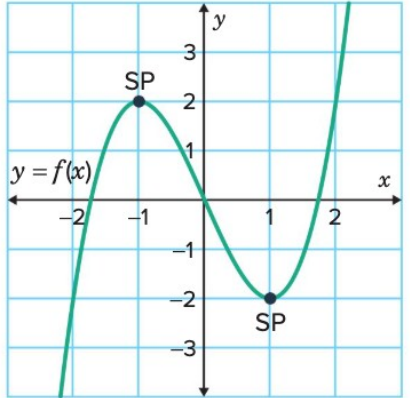
This cubic function has two stationary points (SP) marked on the graph. These occur where the tangent line is horizontal.
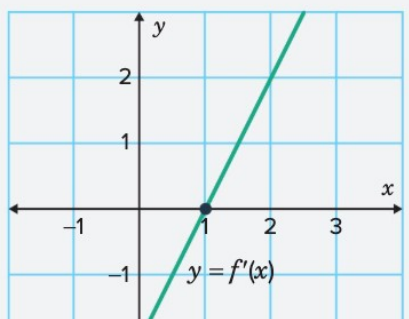
The derivative is shown here. Notice that its -intercepts match the locations of the stationary points on the original function .
Degree of the derivative
Important
An important property to remember is that the degree of the derivative of a polynomial is one less than the degree of the original function. For example:
- If is a quadratic (degree 2), then will be linear (degree 1)
- If is a cubic (degree 3), then will be quadratic (degree 2)
This helps us determine the general shape of the derivative graph.
Worked example: Sketching the derivative graph
Example
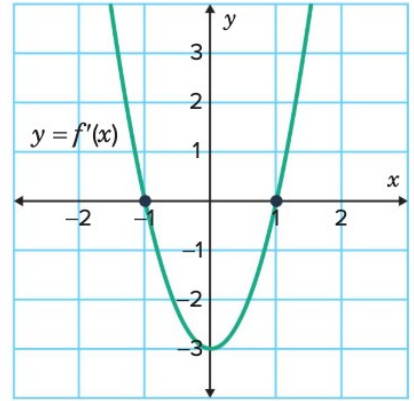
The graph of a quadratic function is shown. Sketch the graph of its derivative, .
Strategy
To sketch the derivative:
- Find the -coordinate of the stationary point, which will become an -intercept of
- Determine the intervals where is decreasing and increasing to know where is negative and positive
- Remember that since is quadratic, will be a straight line
Solution
Step 1: Identify the stationary point
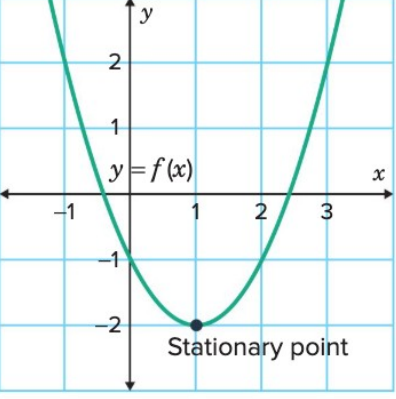
The graph of has a stationary point at . At this point, the gradient is zero. Therefore, the graph of must have an -intercept at .
Step 2: Identify the decreasing interval
The graph of is decreasing for all . This means the gradient is negative in this interval. Therefore, the graph of must be below the -axis (where ) for .
Step 3: Identify the increasing interval
The graph of is increasing for all . This means the gradient is positive in this interval. Therefore, the graph of must be above the -axis (where ) for .
Step 4: Sketch the derivative
Combining these observations, we know that is a straight line that:
- Passes through the point
- Has a positive gradient (rises from left to right)
- Is below the -axis for
- Is above the -axis for
This is the graph of the derivative function .
Summary
Steps for Sketching a Derivative Graph:
To sketch the graph of the derivative from the graph of :
- Identify the -coordinates of any stationary points on . These become the -intercepts on the graph of
- Identify the intervals where is increasing. The graph of will be above the -axis for these intervals
- Identify the intervals where is decreasing. The graph of will be below the -axis for these intervals
- Remember that the derivative of a polynomial has a degree one less than the original function
Estimating the derivative at a point
While differentiation rules allow us to calculate the exact value of a derivative, it is sometimes useful to estimate the derivative at a specific point. This can be done using either a graphical method or a numerical method.
Graphical estimation
The graphical method involves drawing a tangent line to the curve at the point of interest and calculating the gradient of that tangent line.
Note
Process:
- Draw the graph of the function
- Identify the point where the derivative needs to be estimated
- Draw a straight line that just touches the curve at point (the tangent)
- Choose two distinct points on the tangent line
- Use the gradient formula to calculate the tangent's gradient
The gradient of the tangent line is an estimate of the derivative at that point.
Numerical estimation
The numerical method uses a formula based on the gradient of a secant line through two very close points. This provides a good approximation of the gradient of the tangent.
When we have two points that are very close together, the secant line connecting them is nearly identical to the tangent line at that location. The closer the points, the better the approximation.
Important
The gradient of the secant line through and is given by:
where:
- is the approximate derivative (gradient) at
- is a very small number (e.g., or )
The smaller the value of , the better the approximation. Digital tools such as graphing calculators can perform this calculation very efficiently.
Worked example: Estimating the derivative
Example
Consider the function where the derivative has to be estimated at .
a) Estimate graphically.
Strategy
We need to sketch the graph of , draw a tangent at the point , select another point on this tangent, and then calculate the gradient using the two points.
Solution
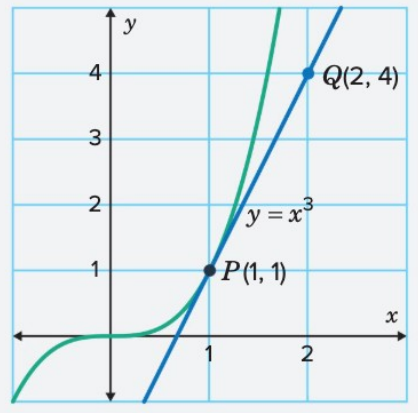
The tangent line at is drawn in blue. Another point on the tangent is . We can now calculate the gradient.
The graphical estimate for is .
b) Estimate numerically using a value of .
Strategy
We use the numerical estimation formula with and .
Solution
Substitute and :
Simplify the input to the function:
Apply the function rule :
Evaluate the powers:
Evaluate the subtraction:
Evaluate the division:
The numerical estimate for is .
c) Find the exact value of and compare it with the estimates from parts (a) and (b). Interpret the results.
Strategy
We differentiate to find , then evaluate at . We can then compare this exact value with our graphical and numerical estimates to assess their accuracy.
Solution
Differentiate using the power rule:
Substitute :
The exact value of is .
Comparison and interpretation
Graphical estimate: The graphical estimate is , which is exactly the same as the exact value. This indicates a precise tangent line approximation in this case. The simplicity of the cubic function and the carefully chosen tangent points made this method very accurate.
Numerical estimate: The numerical estimate is , which is slightly higher than the exact value by . This small difference arises because is not infinitesimally small, but the estimate is still very close. The numerical method demonstrates effectiveness even with relatively small values of .
Note
Both estimation methods provide results close to the exact derivative. The graphical method happened to be exact in this instance due to the function's simplicity and the chosen tangent points. The numerical method's slight error highlights that smaller values of would improve accuracy, as the secant line would better approximate the tangent line.
Summary
Methods for Estimating Derivatives:
The value of the derivative at a point on a curve can be estimated using two main methods:
Graphically: Draw a tangent to the curve at the point of interest and calculate the gradient of that tangent line using two points on the tangent.
Numerically: Use the formula with a very small value for (such as or ).
These methods provide approximations of the derivative, while differentiation rules give the exact value. The numerical method becomes more accurate as gets smaller, and graphing calculators can perform these calculations instantly for very precise estimates.
Remember!
Summary
Key Points to Remember:
-
The first derivative tells us about the gradient of the tangent to the curve at any point. If , the function is increasing; if , the function is decreasing; if , the function has a stationary point.
-
A stationary point occurs where . At these points, the tangent line is horizontal. To find stationary points, set the derivative equal to zero and solve for .
-
For cubic functions and other polynomials, we can determine intervals of increase and decrease by finding stationary points, then testing the sign of the derivative in each interval between these points.
-
The graph of the derivative function can be sketched from the graph of by observing where the function is increasing (derivative above -axis), decreasing (derivative below -axis), and stationary (derivative crosses -axis).
-
The derivative can be estimated graphically by drawing a tangent and calculating its gradient, or numerically using the formula with a small value of . These methods approximate the exact value obtained through differentiation.