Horizontal and Vertical Translations (HSC SSCE Mathematics Advanced): Revision Notes
📚Revision Notes
Horizontal and Vertical Translations
Introduction
Translations are fundamental transformations in mathematics that allow us to move graphs around the coordinate plane. Understanding how to translate functions is essential for sketching graphs and analysing function behaviour.
After studying this topic, you will be able to:
- Describe how replacing with creates a horizontal translation
- Describe how replacing with (or ) creates a vertical translation
- Determine the equation of a function after translation
- Sketch translated functions and identify effects on key features like vertices and intercepts
What is a translation?
A translation is a transformation that moves every point of a graph by the same distance in the same direction. This could be left or right (horizontal translation), or up or down (vertical translation).
Note
The shape and size of the graph do not change during a translation. Only its position on the coordinate plane changes.
Horizontal translations
A horizontal translation moves a graph left or right along the -axis.
For a function , the transformed function produces a horizontal translation of units.
The horizontal translation formula
Note
Horizontal Translation Formula
The value of determines the direction of movement:
- When : the graph moves right by units
- When : the graph moves left by units
Important
This might seem counterintuitive at first. Subtracting a positive value actually moves the graph to the right, whilst subtracting a negative value (which is the same as adding) moves it to the left.
Remember: For horizontal translations, the direction is opposite to what you might expect!
Example of horizontal translation
Consider the basic parabola , which has its vertex at the origin .
When we apply the transformation , the parabola shifts 2 units to the right. The vertex moves from to (2, 0).
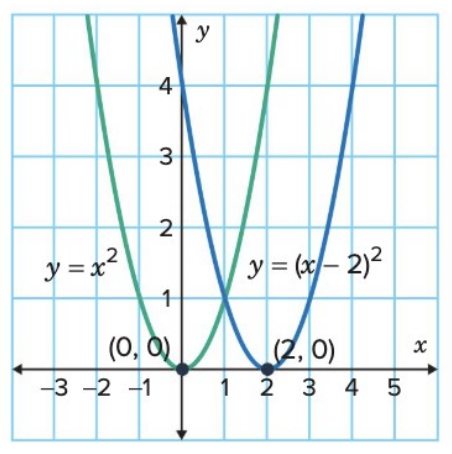
The key point to remember is that horizontal translations affect the x-coordinates of all points on the graph. The -coordinates remain unchanged.
Worked example: horizontal translation
Example
Worked Example: Horizontal Translation of a Parabola
Given: The function and its graph.
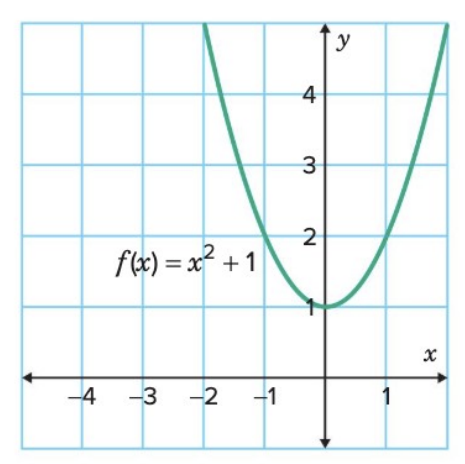
Part a: Finding the equation after translation
Question: Determine the equation after a horizontal translation of 3 units left.
Solution:
A horizontal translation of 3 units to the left means we use the transformation where .
The new function will be .
Starting with the original function:
Applying the translation by replacing x with (x + 3):
The translated graph has equation f(x) = (x + 3)² + 1.
Part b: Finding the vertex
Question: Determine the vertex of the translated graph.
Solution:
The vertex of the original graph is at .
A horizontal translation shifts the x-coordinate by the translation value, whilst the y-coordinate stays the same.
Since we translated 3 units to the left (which is ), we subtract 3 from the -coordinate:
New vertex
New vertex = (-3, 1)
We can verify this by substituting into the translated equation:
This confirms the vertex is at (-3, 1).
Part c: Sketching the graphs
Question: Sketch both the original and translated graphs, showing the vertices.
Solution:
We plot both parabolas, marking their vertices clearly.
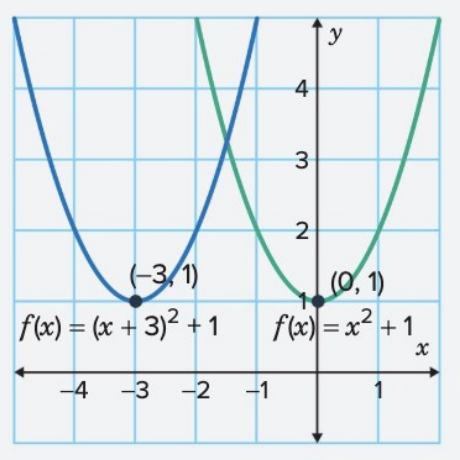
The blue parabola on the left is the translated version, shifted 3 units to the left of the original teal parabola.
Vertical translations
A vertical translation moves a graph up or down along the -axis.
For a function , the transformed function produces a vertical translation of units.
The vertical translation formula
Note
Vertical Translation Formula
The value of determines the direction of movement:
- When : the graph moves up by units
- When : the graph moves down by units
This is more intuitive than horizontal translations. Adding a positive value moves the graph up, and adding a negative value (subtracting) moves it down.
Example of vertical translation
Consider again the basic parabola , with vertex at .
When we apply the transformation , the parabola shifts 3 units upward. The vertex moves from to (0, 3).
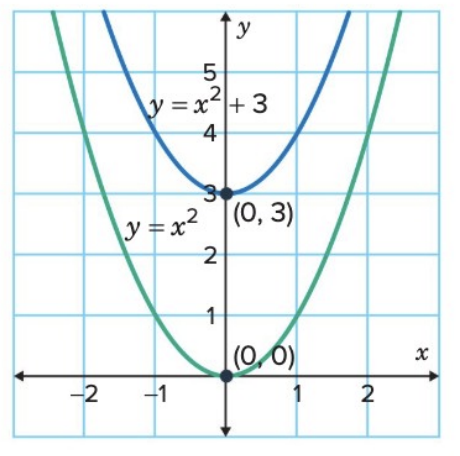
Vertical translations affect the y-coordinates of all points on the graph. The -coordinates remain unchanged.
Worked example: vertical translation
Example
Worked Example: Vertical Translation of a Linear Function
Given: The function
Part a: Finding the equation after translation
Question: Find the equation after a vertical translation of 4 units down.
Solution:
A vertical translation of 4 units down means we use the transformation where .
Starting with the original function:
Applying the translation:
Substituting :
Substituting :
The translated graph has equation y = 2x - 4.
Part b: Sketching both graphs
Question: Sketch both graphs, including the -intercept.
Solution:
For the original function :
- The -intercept is at (0, 0)
- The slope is 2
For the translated function :
- The -intercept is at (0, -4)
- The slope remains 2 (unchanged)
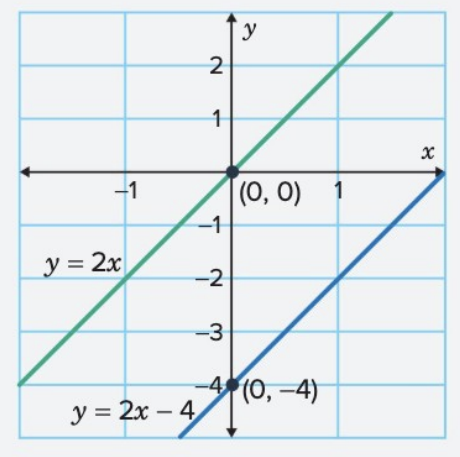
Both lines are parallel because they have the same slope. The translated line is shifted 4 units downward from the original.
Combining horizontal and vertical translations
Functions can undergo both horizontal and vertical translations. When this happens, we apply both transformations:
Note
Combined Translation Formula
This represents:
- A horizontal translation of units (right if , left if )
- A vertical translation of units (up if , down if )
For example, if , then represents:
- A horizontal translation 2 units right (because of )
- A vertical translation 3 units up (because of )
The vertex would move from to (2, 3).
Key features and translations
When a graph is translated, different features are affected in specific ways:
Note
How Translations Affect Key Features
Horizontal translation ():
- Changes the x-coordinates of all points
- Affects -intercepts and vertices
- Does not change -intercepts (usually)
Vertical translation ():
- Changes the y-coordinates of all points
- Affects -intercepts and vertices
- Does not change -intercepts (for most functions)
Summary
Key Points to Remember:
-
A translation shifts a graph without changing its shape or size
-
Horizontal translations use the form :
- When , the graph moves right
- When , the graph moves left
- This affects x-coordinates
-
Vertical translations use the form :
- When , the graph moves up
- When , the graph moves down
- This affects y-coordinates
-
Key features like vertices and intercepts translate with the graph
-
The counterintuitive part: For horizontal translations, minus moves right and plus moves left!