Reflections in Axes (HSC SSCE Mathematics Advanced): Revision Notes
📚Revision Notes
Reflections in Axes
What you'll learn
By the end of this note, you will be able to:
- Describe how replacing x with -x in creates a reflection in the y-axis
- Describe how replacing y with -y in creates a reflection in the x-axis
- Find the equation of a function after reflection in either axis
- Sketch functions and their reflections, identifying key points and features
What is a reflection?
A reflection is a type of transformation that creates a mirror image of a shape or graph on the opposite side of a given line.
When we reflect graphs in coordinate geometry, we typically use either the x-axis or y-axis as the line of reflection.
Note
Think of a reflection like looking in a mirror - the image appears on the opposite side of the mirror line, at the same distance but in the reverse direction.
Reflection in the y-axis
Understanding y-axis reflections
A reflection in the y-axis flips a graph horizontally. This transformation maps each point to a new position at .
Notice that:
- The y-coordinate stays the same
- The x-coordinate becomes its opposite (changes sign)
- The distance from the y-axis remains equal but on the opposite side
Important
Key Point: In a y-axis reflection, only the x-coordinates change - they become negative. The y-coordinates remain unchanged.
The transformation rule
To reflect a function in the y-axis, we replace x with -x:
This gives us the equation of the reflected graph.
Simple example
Consider the linear function .
When we replace with , we get , which is the reflection of the original line in the y-axis.
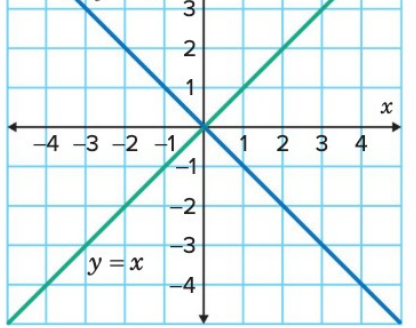
The graph shows how is the mirror image of across the y-axis.
Example
Worked Example 1: Reflecting a cubic function
Question: For the function , find the equation of the graph after reflection in the y-axis, then sketch both graphs showing key points.
Part a: Finding the equation
Strategy: Substitute with .
Working:
(Write the function)
(Substitute )
(Simplify)
The reflected graph has equation y = -x³.
Part b: Sketching both graphs
To sketch the graphs accurately, we choose simple x-values such as , , and , then substitute them into each equation.
For :
- If , then
- If , then
- If , then
This gives key points: , and .
For :
- If , then
- If , then
- If , then
This gives key points: , and .
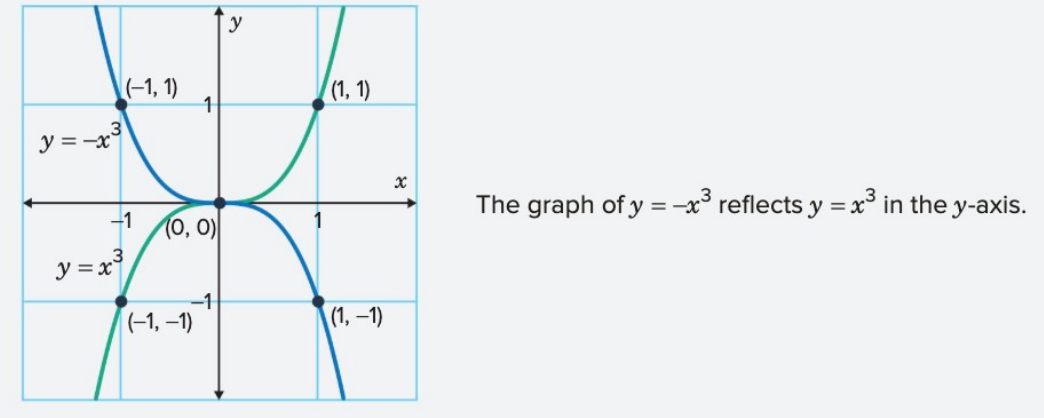
The graph shows that is the reflection of in the y-axis.
Key observation: When we reflect in the y-axis, points on opposite sides of the y-axis swap positions. For instance, the point on corresponds to on the reflected graph.
Reflection in the x-axis
Understanding x-axis reflections
A reflection in the x-axis flips a graph vertically. This transformation maps each point to a new position at .
Notice that:
- The x-coordinate stays the same
- The y-coordinate becomes its opposite (changes sign)
- The distance from the x-axis remains equal but on the opposite side
Important
Key Point: In an x-axis reflection, only the y-coordinates change - they become negative. The x-coordinates remain unchanged.
The transformation rule
To reflect a function in the x-axis, we replace with , which is equivalent to negating the entire function:
This gives us the equation of the reflected graph.
Simple example
Consider the quadratic function .
When we apply the reflection rule, we get , which reflects the parabola downward across the x-axis.
Example
Worked Example 2: Reflecting a linear function
Question: For the function , find the equation of the graph after reflection in the x-axis, then sketch both graphs showing key points.
Part a: Finding the equation
Strategy: Substitute with .
Working:
(Write the function)
(Substitute to apply reflection)
(Multiply both sides by )
(Simplify)
The reflected graph has equation y = -2x - 1.
Part b: Sketching both graphs
When sketching linear graphs, we only need two points since a straight line is completely determined by any two distinct points. A good choice is to use the y-intercept (when ) and one other simple x-value, such as .
For :
- If , then
- If , then
This gives key points: and .
For :
- If , then
- If , then
This gives key points: and .
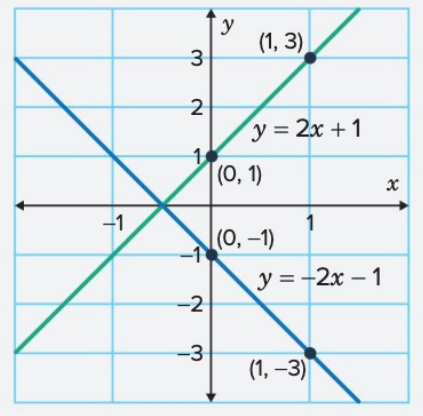
The graph shows that is the reflection of in the x-axis.
Key observation: When we reflect in the x-axis, points above and below the x-axis swap positions. The y-coordinate of each point becomes its opposite, while the x-coordinate remains unchanged.
Summary
Key Points to Remember:
-
Y-axis reflection: Replace x with -x in the function to get . This creates a horizontal flip, mapping each point to .
-
X-axis reflection: Negate the entire function to get . This creates a vertical flip, mapping each point to .
-
Finding key points: To sketch reflections accurately, substitute simple values (like , , ) into both the original and reflected equations to find corresponding points.
-
Quick check: After reflection in the y-axis, the x-coordinates of points change sign. After reflection in the x-axis, the y-coordinates change sign.
-
Points on the axis: Points that lie on the axis of reflection remain unchanged. For example, any point on the y-axis stays in the same position when reflected in the y-axis.