Trigonometric Identities and Equations (HSC SSCE Mathematics Advanced): Revision Notes
📚Revision Notes
Simplify and Prove Identities
Introduction to Pythagorean identities
Pythagorean identities are essential relationships in trigonometry that connect different trigonometric functions. These identities are fundamental because they come from either the geometry of right-angled triangles or the properties of the unit circle. Understanding these identities helps you simplify complex trigonometric expressions and prove more advanced relationships.
The identities link sine, cosine, tangent, secant, cosecant, and cotangent functions in powerful ways that you can use throughout your studies.
Note
The three Pythagorean identities form the foundation for simplifying and proving many other trigonometric relationships. Mastering these identities will make advanced trigonometry much easier to understand.
The three Pythagorean identities
There are three main Pythagorean identities you need to know. Each one is derived from the basic relationship between sine and cosine.
First identity:
This is the fundamental Pythagorean identity. You can derive it using a right-angled triangle and Pythagoras' theorem.
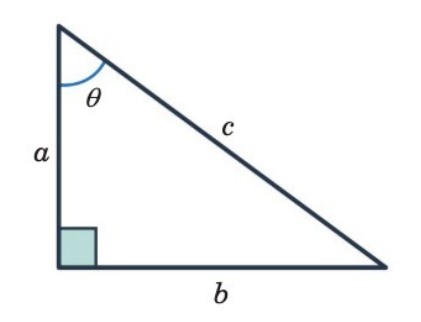
Consider a right-angled triangle with sides , , and hypotenuse , with angle .
The trigonometric ratios give us:
Now let's prove the identity:
Using Pythagoras' theorem ():
Therefore:
Note
On the unit circle, represents the x-coordinate and represents the y-coordinate of a point, which gives another way to understand this identity.
Second identity:
You can derive the second identity by dividing the first identity by . This identity is valid when .
Starting with:
Divide both sides by :
Simplify:
Express as squared ratios:
Substitute the definitions and :
Important
Key definitions:
- is the ratio , undefined when
- is the ratio , undefined when
Third identity:
The third identity comes from dividing the first identity by . This identity is valid when .
Starting with:
Divide both sides by :
Simplify:
Express as squared ratios:
Substitute the definitions and :
Important
Key definitions:
- is the ratio , undefined when
- is the ratio , undefined when
Verifying identities at specific angles
You can verify that the Pythagorean identities work by substituting specific angle values. Let's check all three identities at .
Example
Worked Example: Verify the Three Identities at θ = 30°
Part (a): Check
Substitute :
The identity holds for .
Part (b): Check
For :
For :
Since , the identity holds where . ✓
Part (c): Check
For :
For :
Since , the identity holds where . ✓
Simplifying trigonometric expressions
The Pythagorean identities help you simplify complex trigonometric expressions. When simplifying, it's usually easiest to express everything in terms of and . In proofs, always start with the more complicated side and work to make it match the simpler side.
Example
Worked Example: Simplify
Strategy: Multiply the fractions together, then look for opportunities to apply Pythagorean identities.
Solution:
Use the rearranged form of the first Pythagorean identity:
Apply the reciprocal identity :
Example
Worked Example: Simplify
Strategy: Use quotient and reciprocal identities to express in terms of and .
Solution:
Substitute and :
The expression simplifies to .
Example
Worked Example: Simplify
Strategy: Use the equivalent Pythagorean and reciprocal identities.
Solution:
Substitute :
Use the identity :
Use the identity :
Example
Worked Example: Simplify
Strategy: Use the equivalent Pythagorean and reciprocal identities.
Solution:
Apply the identity :
Apply :
Proving trigonometric identities
When proving identities, you need to show that one side of an equation equals the other. Here's the key strategy: start with the more complex side and simplify it step by step until it matches the simpler side. It often helps to express all terms using only and .
Example
Worked Example: Prove
Strategy: The left-hand side (LHS) is more complex than the right-hand side (RHS), so we'll simplify the LHS until it equals the RHS.
Solution:
Start with the LHS:
Substitute :
Rewrite with a common denominator:
Apply :
Apply :
Therefore, the identity holds.
Example
Worked Example: Find the Exact Value Using a Proven Identity
Question: Find the exact value of .
Strategy: Use the proven identity from the previous example, then substitute the known trigonometric values and simplify.
Solution:
Use the identity :
Apply the identity :
Substitute :
Check: You can verify this by substituting values directly: , ,
This gives: ✓
Example
Worked Example: Prove
Strategy: Both sides appear equally complex, so we can simplify either one. We'll use the fundamental Pythagorean identity to manipulate the left-hand side until it matches the right-hand side.
Solution:
Start with the LHS:
Substitute :
Expand the brackets:
Combine the constant terms:
Therefore, the identity is proven.
Exam tips
Note
Helpful Strategies for Success:
- Always express in and first: This makes it easier to spot patterns and apply identities.
- Start with the complex side: When proving identities, begin with the more complicated expression and simplify towards the simpler one.
- Know your reciprocal identities: , ,
- Recognise difference of squares: Patterns like are very useful.
- Check domains: Remember when functions are undefined (e.g., when ).
Remember!
Summary
Key Points to Remember:
- The three Pythagorean identities are: , , and
- All three identities come from the same source: The second and third are derived from the first by division
- When simplifying: Express everything in terms of and whenever possible
- When proving identities: Always start with the more complex side and work towards the simpler side
- Be careful with domains: Remember that and are undefined when , while and are undefined when