Complementary Angle Identities (HSC SSCE Mathematics Advanced): Revision Notes
📚Revision Notes
Complementary Angle Identities
Introduction
By studying this note, you will understand how to work with complementary angle identities in trigonometry. These powerful relationships connect trigonometric functions of an angle with functions of its complement, and they are essential tools for simplifying expressions and solving equations.
Complementary angles are two adjacent angles that together form a right angle. In other words, if you have two angles that add up to , they are complementary to each other.
For example, if one angle is , its complementary angle is .
Note
Complementary angle identities are particularly useful for simplifying complex trigonometric expressions and solving equations where direct evaluation would be difficult. They also form the foundation for understanding more advanced trigonometric relationships.
The six complementary angle identities
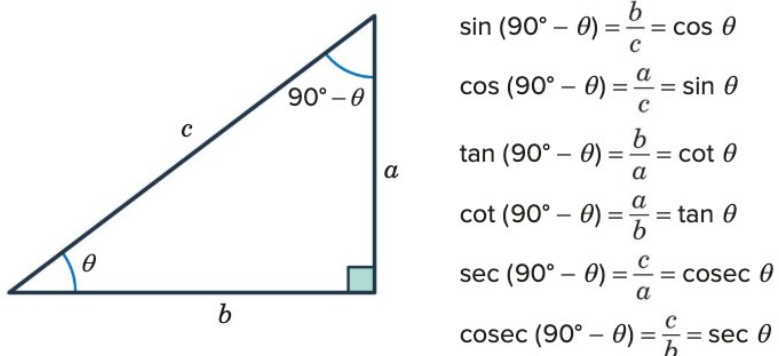
Complementary angle identities, also called cofunction identities, show the special relationships between trigonometric functions of complementary angles. These identities are:
Notice the pattern: each function on the left becomes its cofunction on the right. Sine and cosine are cofunctions, tangent and cotangent are cofunctions, and secant and cosecant are cofunctions.
Note
Understanding the Pattern:
The "co-" prefix in cofunction indicates the complementary relationship. When you see sine, think of its cofunction cosine. When you see tangent, think of its cofunction cotangent. This pattern makes these identities easier to remember: each function swaps with its cofunction at complementary angles.
These identities hold for all values of where both sides are defined. This is an important consideration we'll explore later in this note.
Proving the identities using right-angled triangles
We can prove these identities by examining a right-angled triangle. Consider a right-angled triangle where one acute angle is and the other acute angle is . Label the side opposite to as , the side adjacent to as , and the hypotenuse as .
When we look at the angle , something interesting happens: the opposite and adjacent sides swap roles compared to angle . What was opposite to becomes adjacent to , and vice versa.
Using the definitions of trigonometric ratios as side lengths:
For :
But is precisely the definition of , since is adjacent to :
Therefore:
The same reasoning applies to all six identities. Each identity arises from the fact that opposite and adjacent sides swap when we consider the complementary angle.
Note
Why the sides swap:
In a right-angled triangle, the two acute angles are always complementary (they sum to ). When you shift your perspective from one acute angle to the other, what you're really doing is rotating your viewpoint by around the right angle vertex. This rotation causes the roles of opposite and adjacent to interchange.
Alternative proof using the unit circle
The complementary angle identities can also be confirmed using the unit circle. When we plot an angle and its complement on the unit circle, the coordinates of the corresponding points reveal these relationships geometrically.
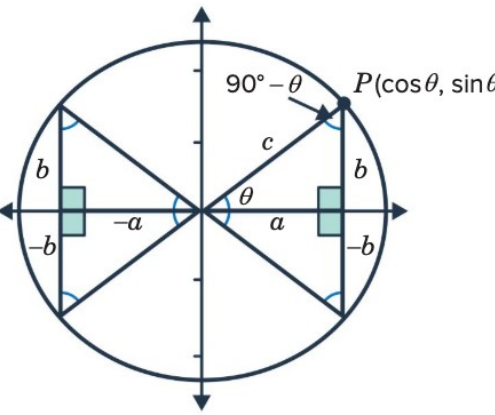
On the unit circle, a point at angle has coordinates . The complementary angle corresponds to a different point whose coordinates demonstrate the same relationships we derived using triangles. This provides a more general proof that works for all angle values, not just acute angles.
Worked examples
Example
Worked Example 1a: Proving
Method:
We'll use a right-angled triangle where one angle is and the other acute angle is its complement, . By comparing the sine ratio of the complementary angle with the cosine ratio of the original angle, we can establish the identity.
Working through the proof:
Consider a right-angled triangle with angle . Label the side opposite to as , the side adjacent to as , and the hypotenuse as .
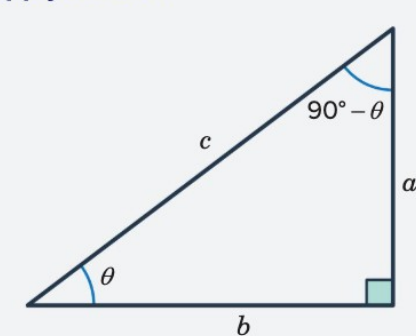
The complementary angle is . For this complementary angle, the opposite and adjacent sides swap their roles compared to angle .
For :
Substitute the side lengths:
For :
Substitute the side lengths:
Since both expressions equal , the identity holds:
Verification:
Let's verify this identity works for a specific angle. Try :
Evaluate:
Now evaluate :
Both sides equal , confirming the identity for this angle.
Important
The identity holds for all values of where both functions are defined. It doesn't hold at because , but the identity itself remains valid at all other angles.
Example
Worked Example 1b: Proving
Method:
We'll use the same right-angled triangle approach, but this time compare the tangent ratio of the complementary angle with the cotangent ratio of the original angle.
Working through the proof:
Consider the same right-angled triangle with angle , opposite side , adjacent side , and hypotenuse .
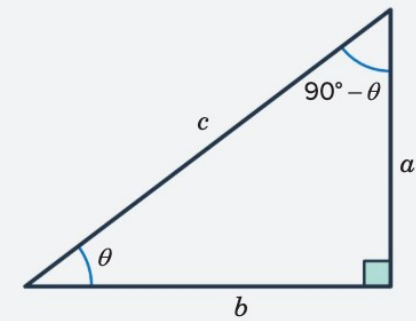
For :
Substitute the side lengths:
For :
Substitute the side lengths:
Since both expressions equal , the identity holds:
Verification:
Verify with :
Evaluate:
Now evaluate :
Both sides equal , confirming the identity.
Important
The identity holds for all values of where both functions are defined. This excludes angles where or (where or ), as these would create division by zero.
Understanding when identities are undefined
Some complementary angle identities become undefined at certain angles due to division by zero in their definitions. This occurs when the denominator of a trigonometric ratio equals zero.
Important
Critical Concept: Division by Zero
Whenever a trigonometric function has zero in its denominator, the function becomes undefined. This is a fundamental rule in mathematics: you cannot divide by zero. Always check for these cases when working with tangent, cotangent, secant, and cosecant functions.
Let's examine when each function is undefined:
Tangent function:
This is undefined when , which occurs at , where is an integer.
Cotangent function:
This is undefined when , which occurs at , where is an integer.
Secant function:
This is undefined when , which occurs at , where is an integer.
Cosecant function:
This is undefined when , which occurs at , where is an integer.
Note
For each complementary angle identity, we need to check both sides. To find where the identity is undefined, substitute into the angle on the left-hand side to find where the right-hand side is undefined.
Further worked examples
Example
Worked Example 2a: Identifying angles where is undefined
Question: Identify the angles where the identity is undefined.
Method:
We'll use the quotient identities and to determine where each side is undefined. A function is undefined when its denominator equals zero, so we'll set each denominator to zero and solve.
Working:
For :
Apply the complementary angle identity :
This is undefined when .
The angles where are , where is an integer (e.g., ).
For :
This is undefined when .
The angles where are , where is an integer.
Therefore, the identity is undefined when .
Verification:
Let's verify by substituting :
Evaluate:
Undefined - Division by zero.
Now check :
Undefined - Division by zero.
Both sides are undefined at , confirming the identity is undefined at .
Example
Worked Example 2b: Identifying angles where is undefined
Question: Identify the angles where the identity is undefined.
Method:
We'll use the reciprocal identities and to determine where each side is undefined. Check where the denominators equal zero.
Working:
For :
Use the complementary angle identity :
This is undefined when .
The angles where are , where is an integer (e.g., ).
For :
This is undefined when .
The angles where are , where is an integer.
Therefore, the identity is undefined when .
Verification:
Verify by substituting :
Evaluate:
Undefined - Division by zero.
Now check :
Undefined - Division by zero.
Both sides are undefined at , confirming the identity is undefined at .
Key takeaways
Summary
Remember These Essential Points:
-
Complementary angles are two angles that sum to . If one angle is , its complement is .
-
The six complementary angle identities are: , , , , , and .
-
These identities can be proven using right-angled triangles, where the opposite and adjacent sides swap roles for complementary angles, or using the unit circle for a more general proof.
-
Identities involving tangent, cotangent, secant, and cosecant are undefined when their denominators equal zero. Always check both sides of an identity to determine where it is undefined.
-
For exam questions, verify your identities by substituting specific angle values to check that both sides produce the same result.