Unit Circle with Secant, Cosecant, and Cotangent (HSC SSCE Mathematics Advanced): Revision Notes
📚Revision Notes
Unit Circle with Secant, Cosecant, and Cotangent
Understanding reciprocal trigonometric functions
The unit circle provides a powerful way to understand the three reciprocal trigonometric functions: secant, cosecant, and cotangent. These functions are defined for any circle centered at the origin, not just the unit circle.
Definitions for a circle of radius r
When we have a circle of radius centered at the origin, and we measure an angle anticlockwise from the positive -axis to reach a point on the circle, we define three reciprocal trigonometric functions:
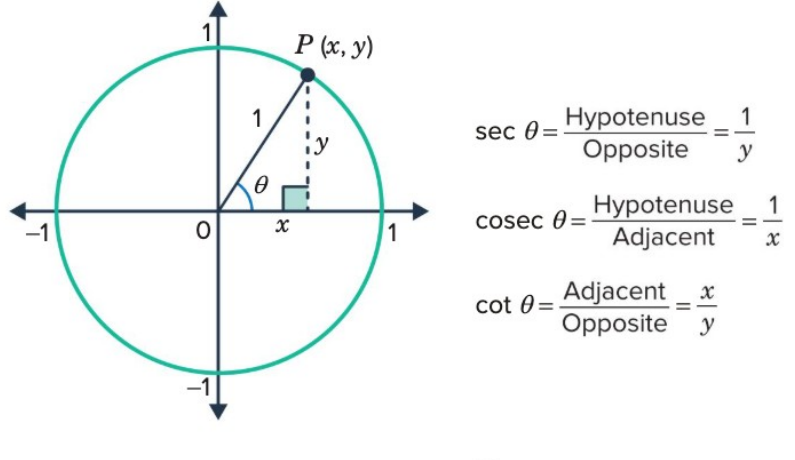
Secant is the reciprocal of the cosine function. The formula is:
where:
- is the secant of angle
- is the radius of the circle
- is the -coordinate of the point on the circle
Cosecant is the reciprocal of the sine function. The formula is:
where:
- is the cosecant of angle
- is the radius of the circle
- is the -coordinate of the point on the circle
Cotangent is the reciprocal of the tangent function. The formula is:
where:
- is the cotangent of angle
- is the -coordinate of the point on the circle
- is the -coordinate of the point on the circle
Note
The radius can be calculated using the distance formula: . This relationship is fundamental to understanding how these functions work on circles of different sizes.
Simplified formulas for the unit circle
For the unit circle (where ), these formulas become simpler:
Note
These simplified formulas are particularly useful because we often work with the unit circle when finding exact values of trigonometric functions. With , the calculations become much more straightforward, making it easier to work with special angles and memorize key values.
When are these functions undefined?
Important
Each reciprocal function becomes undefined when its denominator equals zero. This is a crucial concept to understand:
-
Secant () is undefined when , which occurs at and (or and in radians)
-
Cosecant () is undefined when , which occurs at and (or and in radians)
-
Cotangent () is undefined when , which occurs at and (or and in radians)
Always check whether the denominator is zero before calculating these functions!
Exact values for multiples
When working with angles that are integer multiples of (such as , etc.), we can find exact values for the reciprocal trigonometric functions using the unit circle coordinates.
Unit circle coordinates for and multiples
These special angles correspond to 30° and 60° intervals. The diagram below shows the key coordinates around the unit circle:
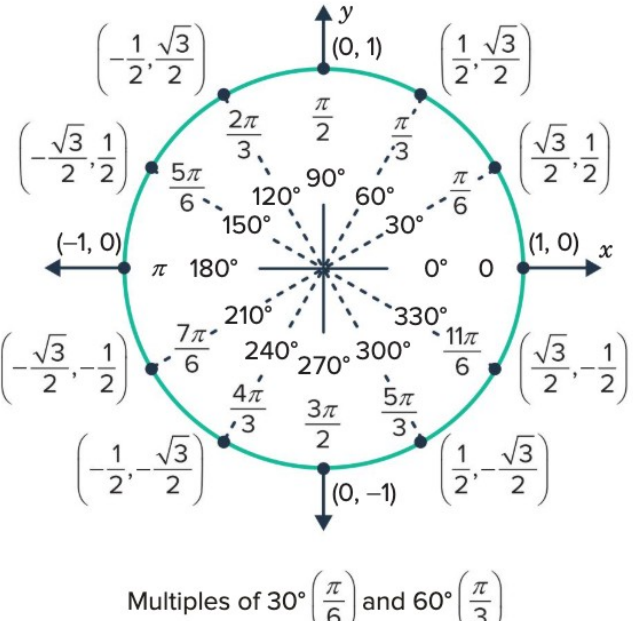
Key coordinates to remember include:
- At (30°):
- At (60°):
- At (90°):
Note
Notice that the coordinates for and are related - the and values are swapped! This reflects the complementary nature of these angles. Memorizing one set helps you remember the other.
Worked example: Finding reciprocal trig values
Example
Worked Example: Finding sec θ, cosec θ, and cot θ for a point on the unit circle
Let's find the exact values of , , and for an angle on the unit circle that passes through the point .
Finding :
We use the formula with .
Substitute :
Simplify by multiplying by the reciprocal:
Rationalise the denominator by multiplying numerator and denominator by :
Finding :
We use the formula with .
Substitute :
Simplify:
Finding :
We use the formula with and .
Substitute and :
Simplify by multiplying by the reciprocal:
Additional worked examples for multiples
Example
Worked Example: Finding
From the unit circle, at , we have .
Therefore, .
Example
Worked Example: Finding
From the unit circle, at , we have .
Therefore, .
Example
Worked Example: Finding
From the unit circle, at , we have and .
Therefore, .
Exact values for multiples
Angles that are integer multiples of (such as , etc.) also have exact values for the reciprocal trigonometric functions.
Unit circle coordinates for multiples
These special angles correspond to 45° intervals. The diagram below shows the coordinates:
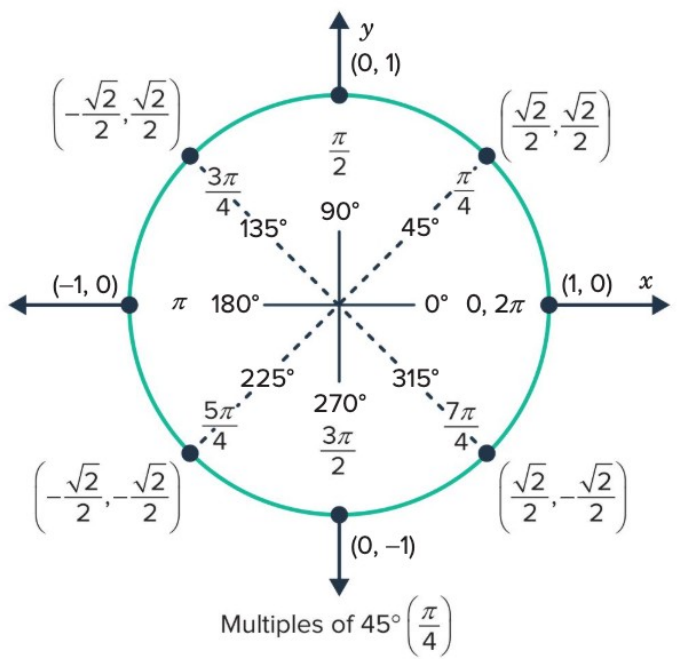
Key coordinates to remember:
- At (45°):
- At (135°):
- At (225°):
- At (315°):
Note
For angles that are multiples of , both coordinates have the same absolute value: . The signs change depending on the quadrant, but the magnitude remains constant. This pattern makes these angles particularly easy to work with.
Worked examples for multiples
Example
Worked Example: Finding
From the unit circle, at , we have .
Substitute :
Simplify:
Rationalise:
Therefore, .
Example
Worked Example: Finding
From the unit circle, at , we have .
Substitute :
Simplify and rationalise:
Therefore, .
Example
Worked Example: Finding
From the unit circle, at , we have and .
Substitute and :
Simplify:
Therefore, .
Note
When working with angles in the second quadrant (like ), remember that the -coordinate is negative while the -coordinate is positive. This affects the signs of your final answers, particularly for cotangent.
Exam tips
Note
Helpful strategies for solving reciprocal trigonometric function problems:
- Identify the coordinates from the unit circle for the given angle
- Apply the appropriate formula: , , or
- Substitute the values carefully, paying attention to signs
- Rationalise denominators when they contain square roots
- Check for undefined values by ensuring denominators are not zero
Remember: Always verify that your denominator is not zero before calculating, as this will result in an undefined value.
Summary
Key Points to Remember:
- Secant is the reciprocal of cosine: on the unit circle
- Cosecant is the reciprocal of sine: on the unit circle
- Cotangent is the reciprocal of tangent: on the unit circle
- These functions are undefined when their denominators equal zero: sec θ when , cosec θ when , and cot θ when
- Use unit circle coordinates for special angles (multiples of and ) to find exact values efficiently
- When simplifying, remember to rationalise denominators that contain square roots