Angles of Elevation, Depression, and Bearings (HSC SSCE Mathematics Advanced): Revision Notes
📚Revision Notes
Angles of Elevation, Depression, and Bearings
Understanding angles of elevation and depression
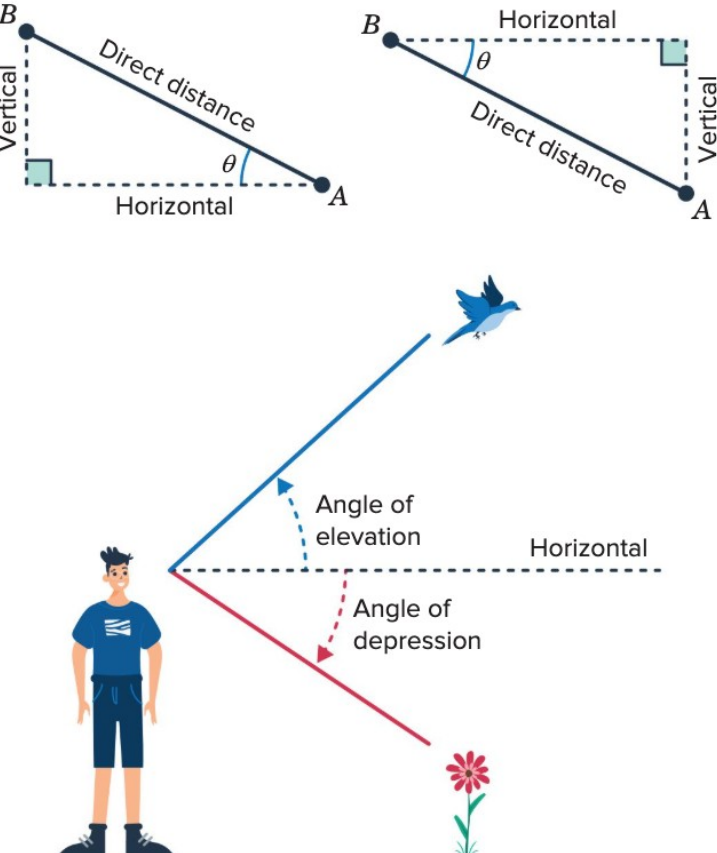
When we observe objects at different heights, we create angles with an imaginary horizontal reference line passing through our eyes. These angles help us solve real-world problems involving heights and distances.
Angle of elevation
The angle of elevation is measured upward from a horizontal reference line to the line of sight when viewing an object above eye level. Imagine looking up at a bird flying overhead - the angle your line of sight makes with the horizontal is the angle of elevation.
Angle of depression
The angle of depression is measured downward from a horizontal reference line to the line of sight when viewing an object below eye level. If you're standing on a cliff looking down at a boat, the angle your line of sight makes with the horizontal is the angle of depression.
Note
Both angles are always measured relative to the horizontal line. This horizontal reference line is an imaginary line parallel to the ground that passes through the observer's eye level.
Important relationship between these angles
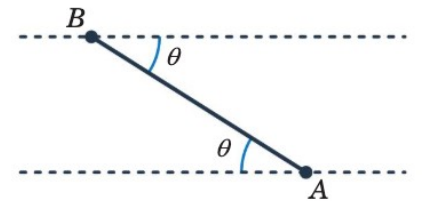
An important property to remember is that the angle of elevation from one point to another equals the angle of depression from the second point back to the first. This occurs because horizontal lines are parallel to each other, creating alternate angles on a transversal line.
Important
This alternate angle relationship is particularly useful when solving problems, as it allows us to work with whichever angle is more convenient in our calculations. When two observers look at each other, one person's angle of elevation equals the other person's angle of depression.
Three key distances in practical problems
When working with angles of elevation and depression, problems typically involve three different distance measurements that form a right-angled triangle:
- Horizontal distance: The distance measured along the ground or horizontal plane between two points
- Vertical distance: The height or depth measured perpendicular to the horizontal, representing the difference in elevation between two points
- Direct distance: The straight-line distance between two points, often representing the line of sight (this forms the hypotenuse of the right triangle)
Note
Understanding which distance you need to find and which distances are given is crucial for selecting the appropriate trigonometric ratio. Always identify all three distances in your diagram before starting calculations.
Worked example: Finding an angle of depression
Example
Worked Example: Helicopter Landing Pad
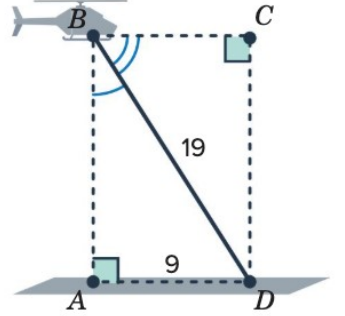
A helicopter at point observes a landing pad at point . The horizontal distance is units and the direct distance is units. Find the angle of depression from the helicopter to the landing pad.
Solution approach:
First, identify which angle we need to find. The angle of depression is labelled in the diagram.
We know:
- Adjacent side
- Hypotenuse
- Unknown angle
Since we have the adjacent side and hypotenuse, we use the cosine ratio:
Substituting our values:
To find , we apply the inverse cosine function:
Using a calculator:
Therefore, the angle of depression is 61.73° (to two decimal places).
Worked example: Finding horizontal distance
Example
Worked Example: Rocky Cliff and Boat
From the top of a rocky ledge m high, the angle of depression to a boat is . If the boat is m from the foot of the cliff, determine rounded to two decimal places.
Solution approach:
Drawing a diagram helps us visualise the situation:
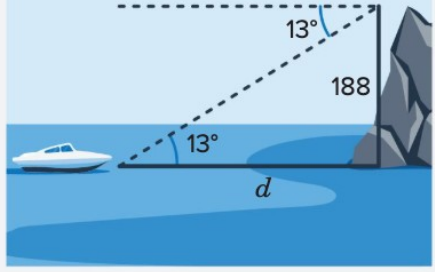
Notice that the angle opposite the m side is also (alternate angles). Since we have the opposite and adjacent sides, we use the tangent ratio:
Where and
Write the formula:
Multiply both sides by :
Divide both sides by :
Evaluate using a calculator:
The boat is 814.32 m from the foot of the cliff.
Worked example: Fighter jet with multiple angles
Example
Worked Example: Fighter Jet Approaching Target
A fighter jet flying at an altitude of m is approaching a target. At point , the pilot measures the angle of depression to the target to be . After a minute, at point , the pilot measures the angle of depression to be .
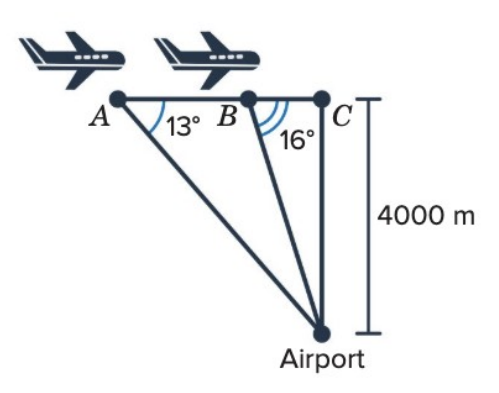
Part a: Determine the distance , rounded to the nearest metre.
Solution approach:
With respect to the given angle , the opposite side is m, and the adjacent side is . We use the tangent ratio:
Substitute values:
Multiply both sides by :
Divide both sides by :
Part b: Determine the distance , rounded to the nearest metre.
Solution approach:
With respect to the angle , use the tangent ratio where the opposite side is m and the adjacent side is :
Multiply both sides by :
Divide both sides by :
Part c: Determine the distance covered by the jet in one minute.
Solution approach:
The distance covered is the length of , which we find by subtracting from :
The jet covered 3376 m in one minute.
Compass bearings
Navigation and surveying use bearings to describe directions precisely. A bearing specifies the direction from one point on the Earth's surface to another.
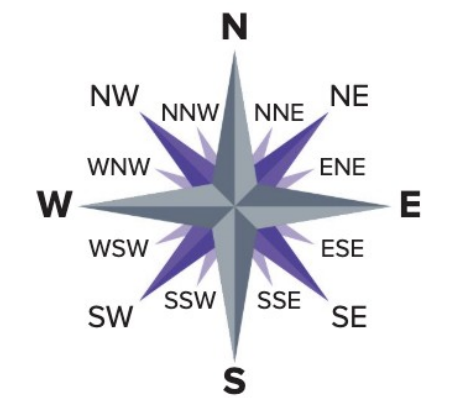
Understanding cardinal and intermediate directions
Cardinal directions are the four main compass points:
- North (N)
- South (S)
- East (E)
- West (W)
Intermediate directions lie midway between cardinal directions at intervals:
- Northeast (NE) - between North and East
- Southeast (SE) - between South and East
- Southwest (SW) - between South and West
- Northwest (NW) - between North and West
What is a compass bearing?
A compass bearing describes direction by specifying:
- Starting direction (north or south)
- An acute angle () of rotation
- Direction of rotation (east or west)
For example, a compass bearing of N50°E means: start facing north, then rotate toward the east.
Another example: S53°E means start facing south, then rotate toward the east.
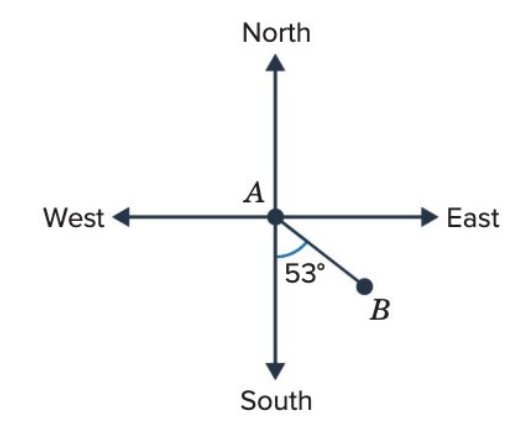
Important
Key point: Compass bearings always start from either north or south, never from east or west, and the angle given is always 90° or less.
Worked example: Finding a compass bearing
Example
Worked Example: Determining Compass Bearing
A compass shows point relative to point . Point is clockwise from north. Determine the compass bearing of from .
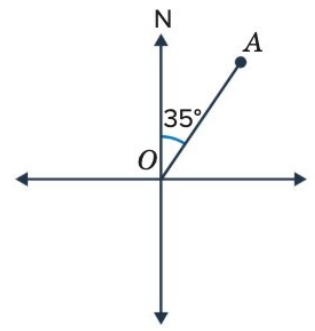
Solution:
Point is positioned clockwise from the north direction. Since the rotation is toward the east (clockwise from north moves toward east), the bearing is written as:
N35°E
This tells us to start at north, rotate toward the east.
True bearings
True bearings provide another way to specify direction, commonly used in navigation, aviation, and marine contexts.
What is a true bearing?
A true bearing is measured clockwise from true north and is always written using three digits to specify the direction precisely. Examples include:
- North: T
- East: T
- South: T
- Northwest: T
Note
The "T" indicates "true" bearing (as opposed to magnetic bearing). In some contexts, the T may be omitted, but the three-digit format remains essential.
Key properties of true bearings
True bearings are defined by:
- Starting from north ()
- Measuring clockwise
- Always written with three digits (e.g., not )
For instance, a true bearing of 127°T means rotate clockwise from north.
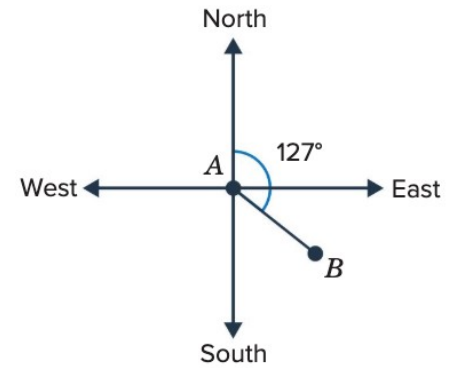
Important
Remember the three-digit rule: Even for small angles, you must write them with three digits. For example, becomes T, and becomes T. This standardized format prevents confusion in navigation.
Converting between compass and true bearings
It's important to be able to convert between these two bearing systems for navigation and problem-solving.
Converting compass bearing to true bearing
Example
Worked Example: Compass to True Bearing (Eastward)
Determine the true bearing of point from point when the compass bearing is N35°E.
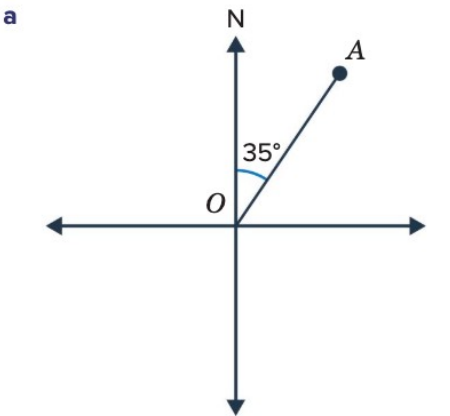
Solution:
The angle between the north direction and line measured clockwise is . Therefore, the true bearing is:
035°T
Remember to write it with three digits.
Converting when angle is on the opposite side
Example
Worked Example: Compass to True Bearing (Westward)
Determine the true bearing when point is west of north.
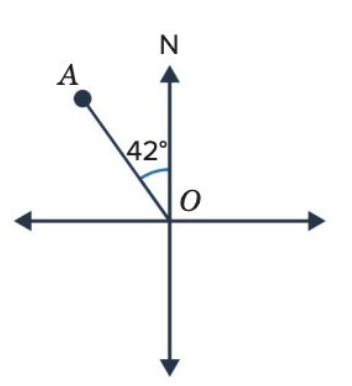
Solution:
To measure the angle clockwise from north when the point is to the west, we subtract the given angle from :
The true bearing is 318°T.
Note
When converting compass bearings that involve west directions, you need to calculate how far clockwise from north by going "the long way around" - this typically involves subtracting from or depending on whether you start from north or south.
Applications of bearings in problem-solving
Bearings are applied in navigation and surveying to calculate distances and positions using trigonometry, often involving right-angled triangles.
Steps to solve bearing problems
When approaching bearing problems, follow this systematic approach:
- Sketch a diagram with the reference point at the compass centre
- Label angles and lengths, ensuring north points upward for true bearings
- Apply the right-angled trigonometry rule (SOH-CAH-TOA)
Important
Reversing direction: To reverse direction and find the return bearing, add or subtract from the original bearing. This gives the angle needed to return to your starting point.
- If the original bearing is less than , add
- If the original bearing is greater than , subtract
Note
SOH-CAH-TOA reminder:
- SOH:
- CAH:
- TOA:
Worked example: Finding height using angle of elevation
Example
Worked Example: Tower Height
A tower is m from point on the ground, making an angle of elevation of to its top. Find the tower's exact height.
Solution approach:
We use the tangent ratio with , where the opposite side is the height and the adjacent side is m.
Substitute values:
Multiply both sides by :
Use the exact value :
Simplify:
The tower's height is m.
Worked example: Ship bearing and distance
Example
Worked Example: Ship's Northward Distance
A ship is km from point on a true bearing of T. Find the ship's northward distance from , rounded to one decimal place.
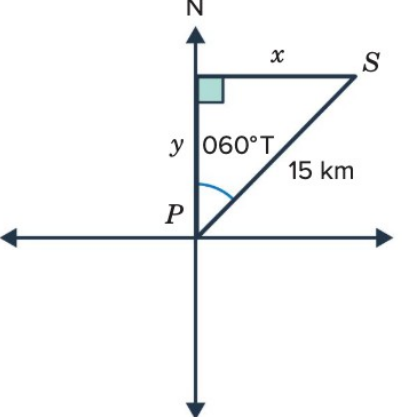
Solution approach:
We use the cosine ratio with . The adjacent side represents the northward distance , and the hypotenuse is km.
Substitute:
Multiply both sides by :
Use the exact value :
The northward distance is 7.5 km.
Worked example: Return bearing
Example
Worked Example: Return Journey Bearing
If a hiker walks from point to point on a bearing of , determine the bearing to return to from .
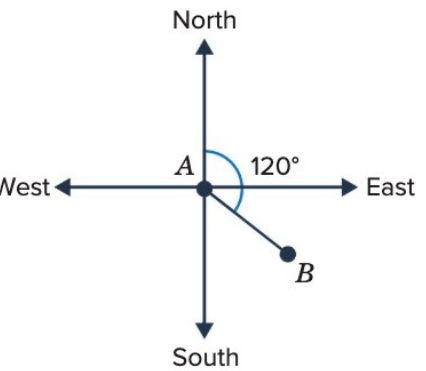
Solution approach:
To find the return bearing, add to the original bearing:
The return journey bearing is 300°.
Exam tip: When the original bearing is greater than , subtract instead of adding it. The key principle is that opposite directions are apart.
Summary
Summary
Key Points to Remember:
- The angle of elevation is measured upward from the horizontal to an object above eye level; the angle of depression is measured downward to an object below eye level
- These angles are equal between two points because horizontal lines are parallel (creating alternate angles)
- Problems involve three distances: horizontal, vertical, and direct (hypotenuse)
- Compass bearings specify direction using north or south as starting point, an acute angle, and rotation toward east or west (e.g., N45°E)
- True bearings are measured clockwise from north and written with three digits (e.g., 035°T, 127°T)
- To reverse direction, add or subtract from the bearing
- Always sketch diagrams when solving bearing problems, with north pointing upward
- Use SOH-CAH-TOA to select the correct trigonometric ratio for calculations