Radians (HSC SSCE Mathematics Advanced): Revision Notes
📚Revision Notes
Radians
What is a radian?
A radian is a unit of angular measurement used frequently in mathematics. Unlike degrees, which divide a full circle into 360 equal parts, radians are based on the relationship between an angle and the arc it creates on a circle.
Note
One radian is defined as the angle formed when the arc length created by that angle equals the radius of the circle. This geometric definition makes radians particularly useful in calculus and advanced mathematics.
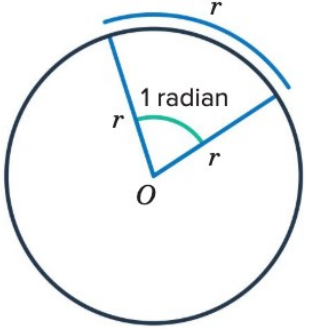
This definition leads to an important relationship: the radian measure of any angle can be calculated using the formula:
The relationship between degrees and radians
To understand how radians relate to the more familiar degree measure, consider a complete circle. The circumference of a circle with radius is given by .
For a unit circle (where the radius is 1), the circumference is . Since the entire circumference represents a complete revolution of 360°, we can conclude that:
Important
From this fundamental relationship, we can derive other useful conversions:
- (a half of 180°)
These relationships form the basis for converting between degrees and radians.
Converting between degrees and radians
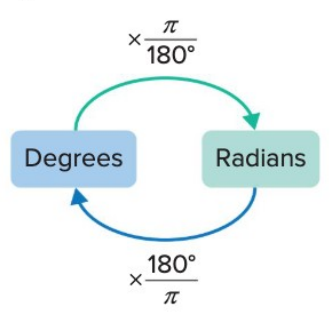
Since radians equals 180°, we can create conversion formulas by using this as a conversion factor:
To convert degrees to radians: Multiply the degree measure by
To convert radians to degrees: Multiply the radian measure by
Note
Think of these conversion factors as unit multipliers. When converting from degrees to radians, you're essentially canceling out the degree units and replacing them with radians. The factor has units of radians/degree, which makes the conversion work.
Common radian measures
It's helpful to memorise these commonly used angle measures in both degrees and radians:

Note
These values appear frequently in trigonometry problems, so knowing them will save you time in calculations. Try to memorize at least the values for π, π/2, π/3, π/4, and π/6 as these form the foundation for most trigonometric work.
Worked example: Converting degrees to radians
Example
Worked Example: Converting -300° to radians
Question: Convert to radians in exact form.
Solution:
Multiply by
To check this result, note that , so the radian measure should exceed . Since and , this confirms our answer is correct.
Worked example: Converting radians to degrees
Example
Worked Example: Converting radians to degrees
Question: Convert radians to degrees.
Solution:
Multiply by
Trigonometric ratios with radians
Trigonometric ratios (, , and ) work with angles measured in radians just as they do with degrees. When working with radians, we use the unit circle where the radius equals 1.
The ASTC rule
The sign of each trigonometric ratio depends on which quadrant the angle is in. The ASTC rule is a helpful memory aid:
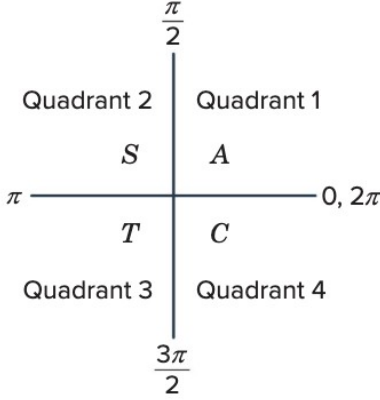
- Quadrant 1 (): All ratios are positive
- Quadrant 2 (): Sine is positive, cosine and tangent are negative
- Quadrant 3 (): Tangent is positive, sine and cosine are negative
- Quadrant 4 (): Cosine is positive, sine and tangent are negative
Note
Memory tip: "All Students Take Calculus" or "All Stations To Central"
This mnemonic helps you remember which trigonometric ratios are positive in each quadrant, starting from Quadrant 1 and moving counterclockwise.
Reference angles and the unit circle
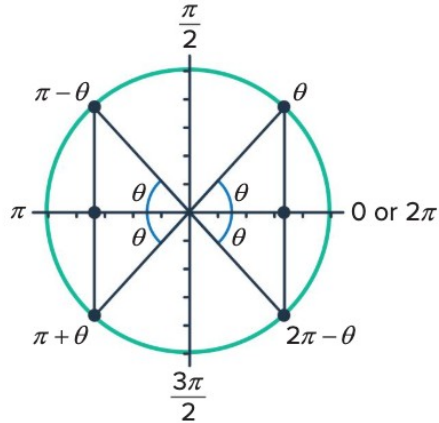
When finding trigonometric ratios for angles in any quadrant, we use reference angles. A reference angle is the acute angle between the terminal side of the given angle and the horizontal axis.
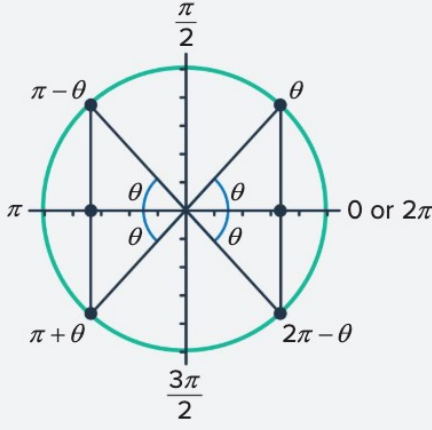
The unit circle shows the symmetry of angles:
Note
For any angle in the first quadrant, we can find related angles in the other quadrants:
- In Quadrant 2:
- In Quadrant 3:
- In Quadrant 4:
These related angles all share the same reference angle , but their trigonometric ratios will have different signs according to the ASTC rule.
Worked example: Finding a trigonometric ratio using a reference angle
Example
Worked Example: Using reference angles
Question: Write an equivalent ratio using a reference angle for
Solution:
First, locate on the unit circle to determine its quadrant and reference angle.
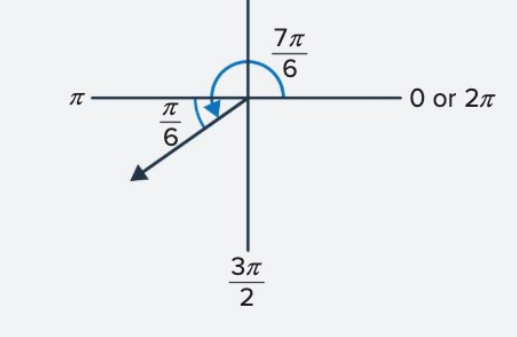
The angle is in Quadrant 3 (between and ).
The reference angle is:
Since sine is negative in Quadrant 3 (according to the ASTC rule), we have:
Exact values from special triangles
Exact values for multiples of and can be found using special triangles:
- The triangle (which is in radians)
- The triangle (which is in radians)
Worked example: Evaluating exact trigonometric values
Example
Worked Example: Exact trigonometric values
Question: Evaluate the exact values of , , and
Solution:
Note that , , and
For : Using the triangle (with sides 1, , 2):
For : Using the triangle (with sides 1, 1, ):
For : Using the triangle:
(after rationalising)
Important note about calculators
Important
When evaluating trigonometric expressions involving radian measure, ensure your calculator is set to radian mode rather than degree mode. This is essential for obtaining correct results.
A common mistake is leaving your calculator in degree mode when working with radians, which will give you completely incorrect answers!
Remember!
Summary
Key Points to Remember:
- One radian is the angle where the arc length equals the radius of the circle
- Key relationship: radians and radians
- Convert degrees to radians: multiply by
- Convert radians to degrees: multiply by
- ASTC rule tells you which trig ratios are positive: All (Q1), Sine (Q2), Tangent (Q3), Cosine (Q4)
- Reference angles help find trig ratios in any quadrant using symmetry
- Always check your calculator is in radian mode when working with radians