Related Angles and Identities (HSC SSCE Mathematics Advanced): Revision Notes
📚Revision Notes
Related Angles and Identities
Introduction to related angles
When working with trigonometric ratios, we often need to find values for angles of any size. A related angle (also called a reference angle) helps us do this. The related angle for any angle is the acute angle formed between the terminal ray and the -axis on the unit circle.
Note
This concept is incredibly useful because it allows us to express trigonometric ratios for any angle using an acute angle, which we can more easily calculate or look up in tables. Instead of memorizing values for hundreds of angles, we only need to know the ratios for acute angles and apply the appropriate rules!
Understanding quadrants
The coordinate plane is divided into four quadrants by the -axis and -axis. Each quadrant contains angles within a specific range.
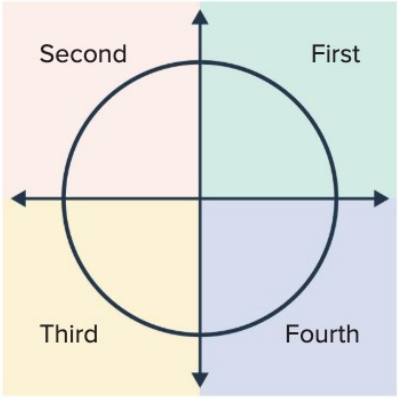
The four quadrants are classified as:
- Quadrant 1:
- Quadrant 2:
- Quadrant 3:
- Quadrant 4:
Understanding which quadrant an angle lies in is essential for determining the signs of its trigonometric ratios.
Finding related angles
The method for finding a related angle depends on which quadrant the angle is in. Here are the formulas for each quadrant:
- Quadrant 1: Related angle
- Quadrant 2: Related angle
- Quadrant 3: Related angle
- Quadrant 4: Related angle
Important
If your angle is outside the range to , you first need to bring it into this range by adding or subtracting multiples of . This is a crucial first step that students often forget!
The ASTC rule
The ASTC rule (sometimes called the CAST rule) is a memory aid that tells us which trigonometric functions are positive in each quadrant. The letters stand for the positive functions in each quadrant, starting from Quadrant 1 and moving anticlockwise.
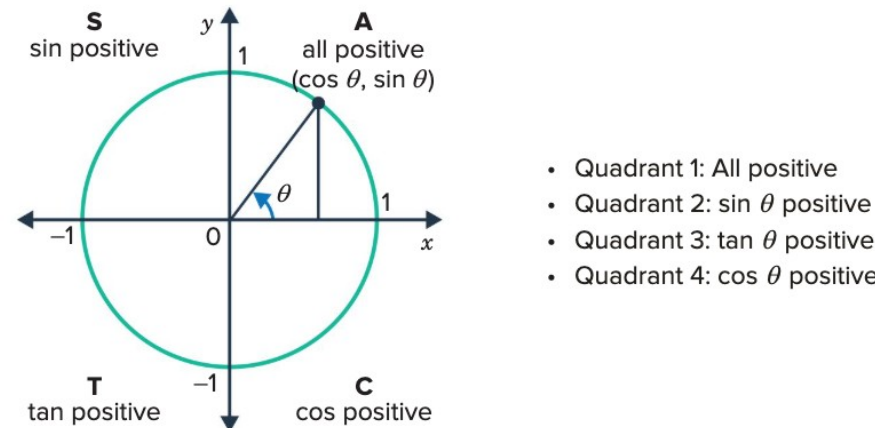
Here's what ASTC means:
- Quadrant 1 (A): All trigonometric ratios are positive (, , and are all positive)
- Quadrant 2 (S): Only sine is positive (, while and )
- Quadrant 3 (T): Only tangent is positive (, while and )
- Quadrant 4 (C): Only cosine is positive (, while and )
Note
Memory tip: "All Stations To Central" or "All Students Take Calculus" can help you remember the order. Choose whichever phrase resonates with you and practice it until it becomes automatic!
Related angle identities
When angles are expressed in the forms or , where is an acute angle, we can use specific identities to find their trigonometric ratios. These identities are summarised in the table below:
| Angle form | |||
|---|---|---|---|
These identities allow us to express the trigonometric ratios of any angle in terms of an acute angle , making calculations much simpler. Notice the patterns in the signs - they follow directly from the ASTC rule for each quadrant.
Negative angle identities
Negative angles are formed by rotating clockwise from the positive -axis, rather than anticlockwise. When we have a negative angle , we can find its trigonometric ratios using these important identities.
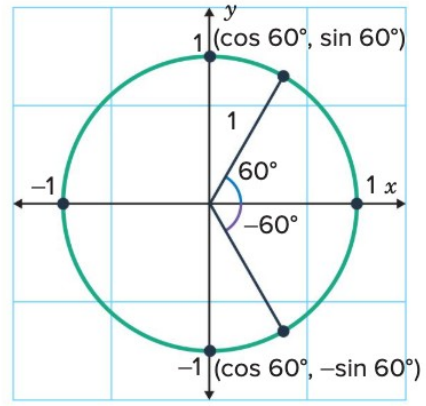
The diagram above shows that for an angle , the point on the unit circle is . For the negative angle , the point is . Notice that the x-coordinate stays the same, but the y-coordinate becomes negative.
This observation leads to the following fundamental identities:
Note
These identities show that:
- Cosine is an even function (unchanged for negative angles)
- Sine and tangent are odd functions (they change sign for negative angles)
Understanding these properties helps you work with negative angles without confusion!
Worked examples
Example
Worked Example 1: Finding a related angle and using it to evaluate cosine
Question: Find the related angle for and express using an acute angle.
Solution:
First, we need to reduce to an angle between and :
The angle is in Quadrant 1, where and the related angle is .
Therefore:
Example
Worked Example 2: Evaluating sine without technology
Question: Evaluate without using a calculator.
Solution:
The angle is in Quadrant 4 (since ).
To find the related angle, we apply the formula :
In Quadrant 4, sine is negative (using the ASTC rule). We know that .
Therefore:
Example
Worked Example 3: Using a related angle to find tangent
Question: Express using an acute angle and determine its value, rounded to two decimal places.
Solution:
The angle is in Quadrant 3 (since ).
To find the related angle, we use the formula :
In Quadrant 3, tangent is positive (using the ASTC rule).
Therefore:
Note: The exact value of can be found using compound angle formulas, but for this example, we use the identity to show that has the same value as and is positive.
Example
Worked Example 4: Evaluating negative angles using identities
Question: Find and using identities.
Solution:
We apply the negative angle identities and .
We know that and .
For sine:
For cosine:
Example
Worked Example 5: Finding tangent of a negative angle
Question: Express using a positive acute angle and determine its sign.
Solution:
First, we convert to a positive angle:
The angle is in Quadrant 3 (since ).
To find the related angle, we use the formula :
In Quadrant 3, tangent is positive (using the ASTC rule).
Therefore:
So is positive.
Alternatively, we could use the negative angle identity directly:
Since is in Quadrant 2 where tangent is negative, we have .
Therefore: , which is positive.
Summary
Key Points to Remember:
- Related angles are acute angles between the terminal ray and the -axis, used to find trigonometric ratios for any angle.
- Use the ASTC rule to determine which trigonometric functions are positive in each quadrant: All (Q1), Sine (Q2), Tangent (Q3), Cosine (Q4).
- Related angle formulas vary by quadrant: (Q1), (Q2), (Q3), (Q4).
- Identity table for and helps express any angle's trigonometric ratios using acute angles.
- Negative angle identities: , , .