Calculations with Ratios (HSC SSCE Mathematics Standard): Revision Notes
📚Revision Notes
Calculations with Ratios
Understanding ratios
A ratio is a way to compare amounts of the same type in a specific order. When we write a ratio like , we're saying that for every parts of one quantity, there are parts of another quantity.
Ratios can be expressed in several different ways:
- As a ratio:
- As a fraction:
- As a decimal:
- As a percentage:
Note
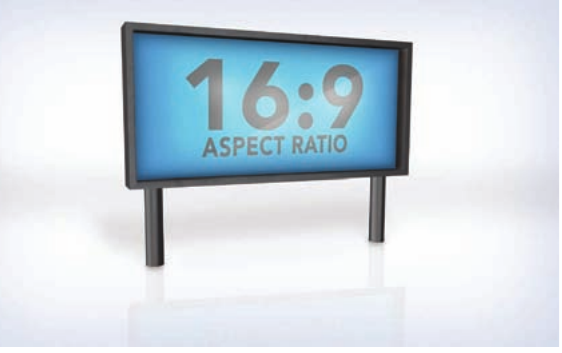
You see ratios in everyday life. For example, television screens and computer monitors often have an aspect ratio of , which describes the relationship between width and height.
Equivalent ratios
Just like fractions, ratios can be simplified or expanded while maintaining the same relationship. We create equivalent ratios by multiplying or dividing both amounts in the ratio by the same number.
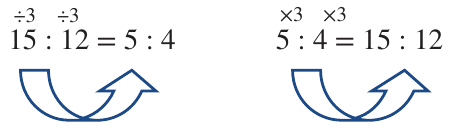
In the diagram above, the ratio can be simplified to by dividing both numbers by (the highest common factor). Similarly, we can expand back to by multiplying both numbers by . These ratios are equivalent because they represent the same relationship.
Important
Key principle: Equivalent ratios are obtained by multiplying or dividing each amount by the same number.
Simplifying ratios
To simplify a ratio means to express it in its lowest terms, similar to simplifying a fraction. The method you use depends on what type of numbers are in the ratio.
Simplifying ratios with fractions
When a ratio contains fractions, multiply both sides by the lowest common denominator (LCD) to eliminate the fractions.
Example
Worked Example: Simplifying a ratio with fractions
Simplify
Step 1: Identify that we need to multiply both sides by (the denominator)
Step 2: Calculate the result
Answer: The simplified ratio is 6:1.
Simplifying ratios with decimals
When a ratio contains decimals, multiply both sides by a power of 10 to convert to whole numbers, then simplify by dividing by the highest common factor.
Example
Worked Example: Simplifying a ratio with decimals
Simplify
Step 1: Multiply both sides by to remove decimals
Step 2: Calculate
Step 3: Find the highest common factor of and , which is
Step 4: Divide both sides by
Step 5: Calculate the final answer
Answer: The simplified ratio is 3:7.
Simplifying ratios with fractions only
When both parts of a ratio are fractions, convert them to a common denominator, then use the numerators to form the simplified ratio.
Example
Worked Example: Simplifying a ratio with two fractions
Simplify
Step 1: Find a common denominator. The LCD of and is
Step 2: Convert both fractions to have denominator
Step 3: Since the denominators are the same, use the numerators as the ratio
Answer: The simplified ratio is 6:5.
Dividing a quantity in a given ratio
Sometimes you need to split a total amount according to a given ratio. This is common in sharing problems, recipe scaling, or dividing money or resources.
Method for dividing quantities
Important
Follow these four steps to divide a quantity in a given ratio:
-
Calculate the total number of parts by adding each amount in the ratio together
-
Divide the quantity by the total number of parts to find the value of one part
-
Multiply each amount in the ratio by the value of one part
-
Check your answer by adding all the parts together - they should equal the original quantity
Two-part ratio example
Example
Worked Example: Dividing money in a two-part ratio
Problem: Mikhail and Ilya were given $450 to share in the ratio . How much did each person receive?
Solution:
Step 1: Calculate the total number of parts
Step 2: Find the value of one part
Step 3: Calculate each person's share
- Mikhail's share:
- Ilya's share:
Step 4: Check the answer
✓
Answer: Mikhail received $200 and Ilya received $250.
Three-part ratio example
Example
Worked Example: Dividing money in a three-part ratio
Problem: A man left $6000 to be divided among his three children, Xia, Yui and Zi, in the ratio in that order. How much did each child receive?
Solution:
Step 1: Calculate the total number of parts
Step 2: Find the value of one part
Step 3: Calculate each child's share
- Xia's share:
- Yui's share:
- Zi's share:
Step 4: Check the answer
✓
Answer: Xia received $1500, Yui received $2400, and Zi received $2100.
Note
Exam tip: Always check your answer by adding all the parts back together. This quick verification can catch calculation errors before you submit your work.
Remember!
Summary
Key Points to Remember:
- A ratio compares amounts of the same units in a specific order
- Ratios can be expressed as fractions, decimals, or percentages
- Create equivalent ratios by multiplying or dividing both amounts by the same number
- To simplify ratios with fractions, multiply by the lowest common denominator
- To simplify ratios with decimals, multiply by a power of 10, then divide by the highest common factor
- When dividing a quantity in a ratio, use the four-step method: calculate total parts, find one part, multiply for each share, and check your answer