Refraction, Snell’s Law, and Total Internal Reflection (HSC SSCE Physics): Revision Notes
📚Revision Notes
Refraction, Snell's Law, and Total Internal Reflection
What is refraction?
When light travels from one transparent material into another, it changes direction. This change in direction is called refraction. Refraction occurs because light travels at different speeds in different materials.
The amount light bends depends on the electrical properties of each material. For example, a pencil placed partially in water appears to bend at the water's surface due to refraction.
Note
When light refracts, two things happen simultaneously: its speed changes and its direction changes. These two changes are directly connected - the change in speed causes the change in direction.
Refractive index
Every transparent material can be characterised by its refractive index, represented by the symbol . The refractive index tells us how much light slows down when travelling through that material compared to travelling through a vacuum.
Definition and formula
The refractive index of a medium is defined as:
where:
- is the refractive index of medium
- is the speed of light in a vacuum ()
- is the speed of light in medium
By definition, the refractive index of a vacuum is exactly 1.00. All other materials have refractive indices greater than 1.00 for visible light.
Important
A higher refractive index means light travels more slowly in that material. For example, light travels much slower in diamond () than in water ().
Common refractive indices
The table below shows refractive indices for common materials:
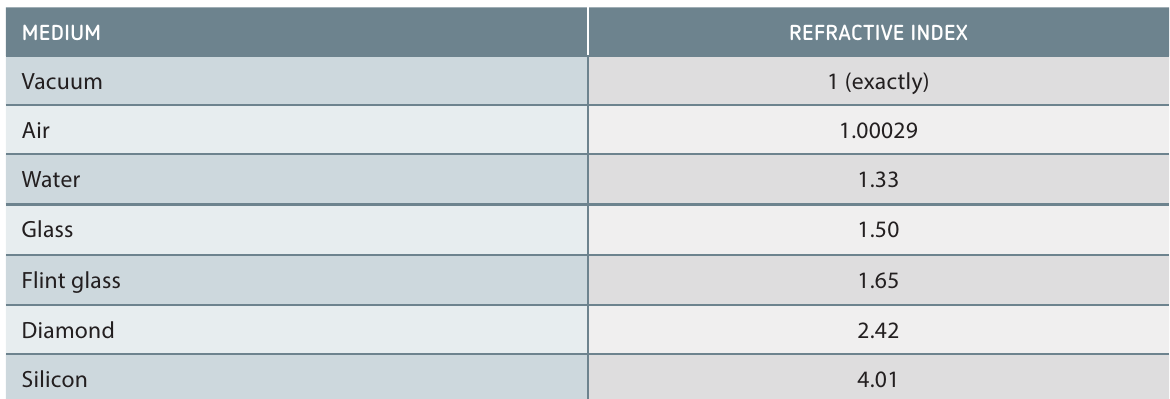
When light moves between materials with similar refractive indices, very little bending occurs. For example, light moving from vacuum to air (refractive index 1.00029) barely bends at all. However, when light enters materials with very different refractive indices, strong refraction occurs. Diamond, with a refractive index of 2.42, causes significant bending of light.
Note
The refractive index actually varies slightly with the wavelength (colour) of light. This variation causes effects like rainbows and the sparkle of diamonds, where different colours separate because blue light bends more than red light in materials like diamond.
Snell's law
Snell's law is the mathematical relationship that describes how light refracts when passing from one medium to another.
The law of refraction
When a light ray travels from a medium with refractive index into a medium with refractive index , two laws govern the refraction:
- The incident ray, the normal, and the refracted ray all lie in the same plane (they are coplanar)
- Snell's law is obeyed
Snell's law formula
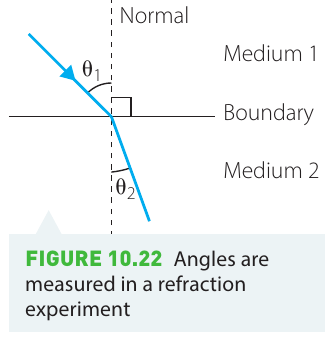
Snell's law states:
where:
- is the refractive index of the first medium
- is the angle of incidence (measured from the normal)
- is the refractive index of the second medium
- is the angle of refraction (measured from the normal)
Important
Critical measurement rule: All angles are measured from the normal line (the line perpendicular to the boundary between the two media), NOT from the surface itself. This is a common mistake to avoid!
For simple cases involving a single refraction, Snell's law can also be written as:
where is the angle of incidence and is the angle of refraction.
Finding the refractive index
In many experiments, light enters a material from air. Since the refractive index of air is approximately 1.00, we can simplify Snell's law to find the refractive index of the second medium:
Starting with:
If (air), then:
This means we can determine the refractive index of a material by measuring the angles of incidence and refraction when light enters from air.
Investigation: Investigating Snell's law
Aim: To measure the angles of incidence and refraction, and find the relationship between them for a range of angles.
Materials
- Semi-circular glass or perspex block
- Ruler
- Protractor
- Graph paper
- Pencil
- Ray box
- Computer with spreadsheet program
Risk assessment
The globe in a ray box can get very hot. Take care when handling the box and don't touch the globe directly.
Method
- Trace the straight edge of the semi-circular glass block along a line on the graph paper
- Trace the outline of the block
- Construct the normal line perpendicular to the centre of the flat edge of the block (shown as a dashed line in the diagram below)
- Direct a single ray of light from the ray box to the centre of the flat edge of the block
- Trace both the incident ray and the refracted ray
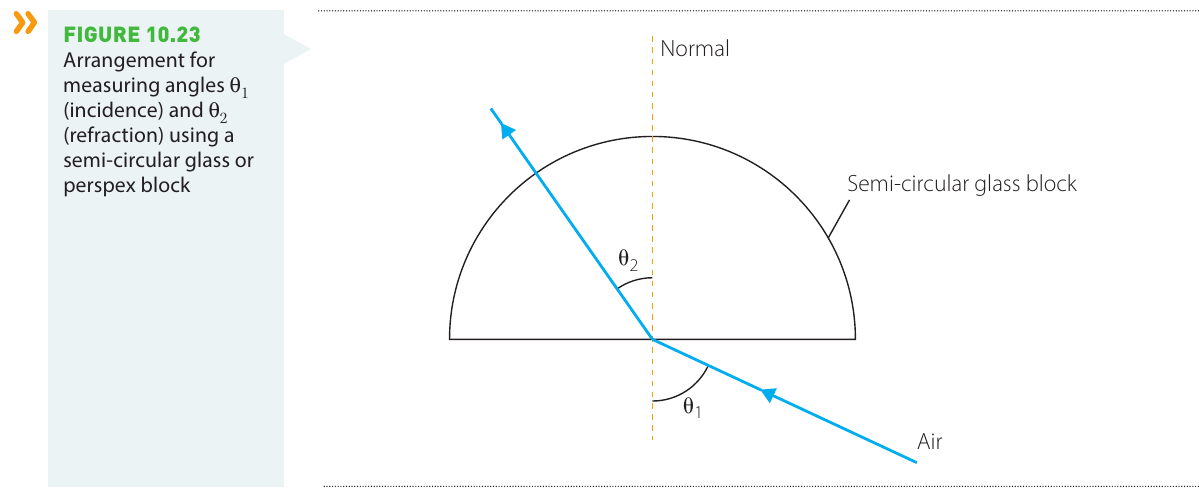
- Remove the block and carefully measure the angle of incidence () and angle of refraction (). Record these values in a table
- Replace the block and repeat for five different angles of incidence, ranging from approximately 20° to 60°
Note
Why use a semi-circular block? The curved surface allows light to enter perpendicular to the surface (no refraction at entry), so all refraction occurs at the flat surface. This makes measurements simpler and more accurate.
Results
Record the following data in a properly constructed table:
Raw data:
- Angle of incidence,
- Angle of refraction,
Derived data:
Analysis of results
- Plot versus on a graph using a spreadsheet program
- Insert a trend-line for the plotted points and display the equation of this trend-line
Discussion points
- Is the ratio constant for all values of ? Consider whether the graph is a straight line
- The refractive index of glass can be determined from the gradient of the graph of versus
- Estimate the uncertainty in the refractive index value by first estimating the uncertainty in angle measurements
- Consider ways to make the measurements more precise
Refraction towards and away from the normal
The direction light bends when refracting depends on the relative refractive indices of the two media.
Refraction towards the normal
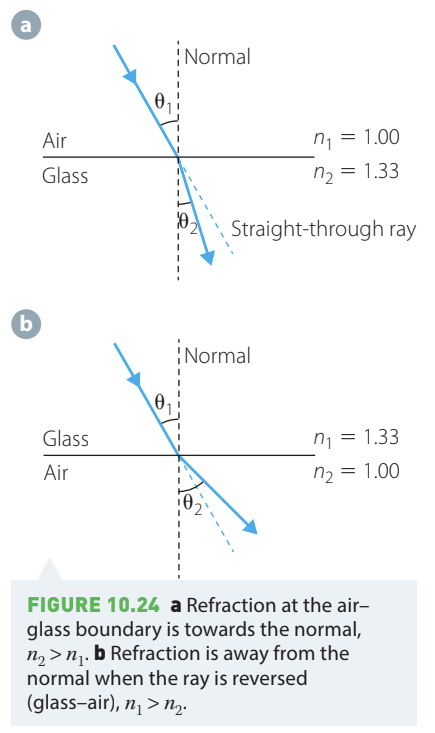
When light travels from a medium with a lower refractive index to a medium with a higher refractive index (), the light ray bends towards the normal.
Example: Light travelling from air () into glass () bends towards the normal.
Refraction away from the normal
When light travels from a medium with a higher refractive index to a medium with a lower refractive index (), the light ray bends away from the normal.
Example: Light travelling from glass () into air () bends away from the normal.
Note
Memory aids to help remember refraction patterns:
- "FAST to SLOW, bend TO" - Light entering a denser medium (slowing down) bends towards the normal
- "SLOW to FAST, bend AWAY at last" - Light entering a less dense medium (speeding up) bends away from the normal
Total internal reflection
At every boundary between media, some reflection always occurs. Usually, refraction also occurs. However, under certain conditions, light can be completely reflected back into the medium it came from, with no refraction occurring at all. This is called total internal reflection.
Conditions for total internal reflection
Total internal reflection can only occur when:
- Light travels from a denser medium to a less dense medium ()
- The angle of incidence exceeds a specific value called the critical angle ()
Important
Key requirement: Total internal reflection ONLY happens when going from high to low refractive index (). If you're going from low to high refractive index, total internal reflection cannot occur, no matter what angle you use!
The critical angle
The critical angle is the angle of incidence at which the refracted ray travels along the boundary between the two media (angle of refraction = 90°).
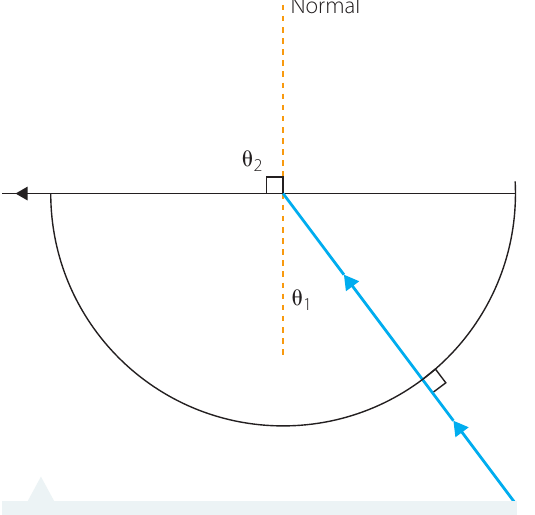
At the critical angle, using Snell's law:
Since :
When light travels from a medium into air (where ), this simplifies to:
where is the refractive index of the medium the light is leaving.
Important
When the angle of incidence exceeds the critical angle (), total internal reflection occurs and no light is refracted into the second medium. All the light is reflected back into the first medium.
Worked example: Refraction and critical angle calculations
Example
Worked Example: Refraction between water and flint glass
Problem: Light travelling in water () strikes the interface with flint glass () at an incident angle to the normal.
- What is the angle of refraction, , in the glass?
- What is the critical angle, , for light travelling from flint glass into water?
Part 1: Finding the angle of refraction
Given:
- (water)
- (flint glass)
Using Snell's law:
Rearranging for :
The light is deviated by 7.7° towards the normal.
Part 2: Finding the critical angle
The critical angle occurs when the refracted angle , so at this point.
Given:
- (flint glass - now the first medium)
- (water - now the second medium)
Using Snell's law:
Any angle of incidence greater than 53.7° will result in total internal reflection when light travels from flint glass into water.
Investigation: Calculating the refractive index using total internal reflection
Aim: To calculate the refractive index of a medium by measuring the critical angle, .
Materials
- Ray box
- Semi-circular glass or perspex block
- Paper, pencil and ruler
- Protractor
Risk assessment
Risk: The globe in the ray box gets very hot and may cause burns if touched.
Safety measure: Take care not to touch the globe in the ray box.
Method
- Place the semi-circular block onto a flat piece of paper
- Arrange the ray box so a single ray enters the curved surface perpendicular to the surface (parallel to the normal at that point)
- By adjusting the ray box angle, make the ray leave the semi-circular block with an angle of refraction of 90°. The exiting ray should travel along the boundary between the flat side of the block and the air
- Trace the complete path of the ray and the semi-circular block outline on the paper
Note
Finding the critical angle: The critical angle is reached when the refracted ray just grazes along the boundary. Look for the point where the ray barely emerges - this is when .
Results
Remove the block and measure the angle of incidence () at the middle of the flat face inside the semi-circular block. This is the critical angle.
Analysis of results
Calculate the refractive index of the semi-circular block using Snell's law:
With the values:
- = refractive index of the block material (unknown)
- = angle of incidence (measured)
- (angle of refraction at critical angle)
- (refractive index of air)
Rearranging:
Discussion points
- Could this investigation be conducted with the glass block in a medium other than air?
- What changes could improve the precision of the results?
Applications of total internal reflection
Total internal reflection isn't just a laboratory phenomenon - it has crucial real-world applications in modern technology and optical instruments.
Optical fibres
An optical fibre is made from a glass core with a slightly higher refractive index than the surrounding glass cladding. These fibres are used extensively in modern telecommunications and the internet.
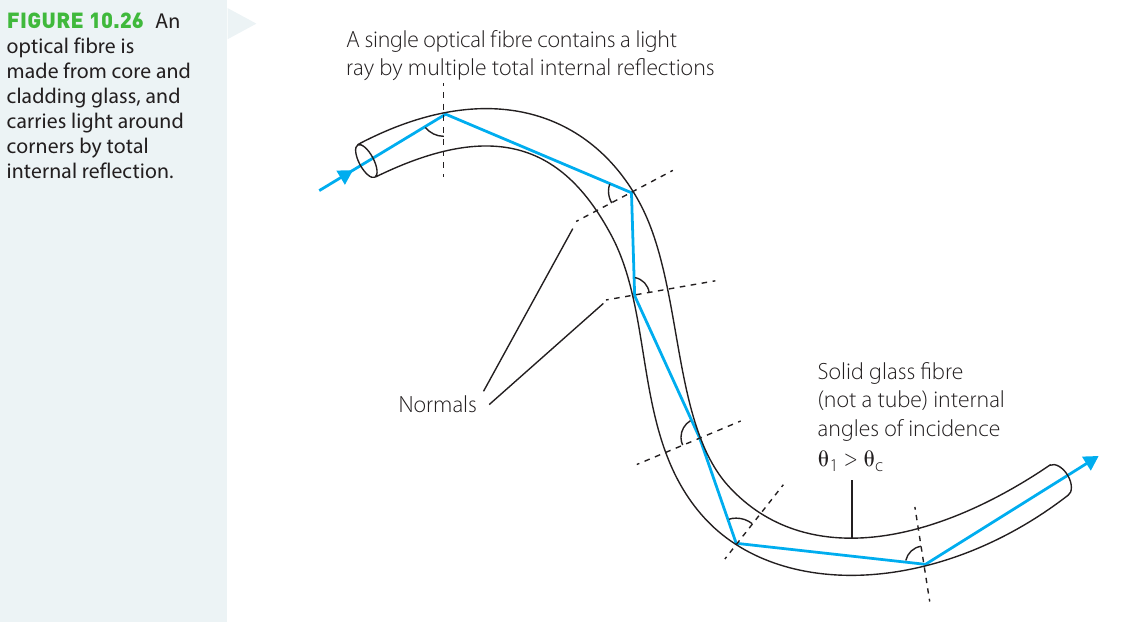
Light entering the optical fibre is constrained to travel down the core by multiple total internal reflections. This occurs because:
- The core has a higher refractive index than the cladding
- Light rays strike the core-cladding boundary at angles greater than the critical angle
- Each reflection causes minimal energy loss (about 500 times less than a polished mirror)
Optical fibres are highly flexible, allowing light to be carried around corners. Although each bend increases energy loss slightly, the total loss remains much less than with ordinary mirror surfaces.
Note
Real-world applications of optical fibres:
- The National Broadband Network (NBN) uses optical fibres to deliver high-speed internet
- Telephone companies connect exchanges and mobile base stations with optical fibres
- Bundles of optical fibres laid on ocean floors connect continents to the internet, enabling global communications
Optical instruments
Total internal reflection can replace mirrors in optical instruments such as periscopes and binoculars. Triangular prisms use total internal reflection at glass-air surfaces to redirect light. Images formed this way have much better clarity than those formed using mirrors.
The advantage of using prisms instead of mirrors is that no reflective coating is needed - the total internal reflection naturally occurs at the glass-air boundary, resulting in brighter, clearer images with less distortion.
Summary
Key Points to Remember:
-
Refraction occurs when light changes direction as it passes from one transparent medium to another due to a change in light speed
-
The refractive index () of a material is the ratio of the speed of light in a vacuum to the speed of light in that material:
-
Snell's law relates the angles of incidence and refraction to the refractive indices:
-
Light bends towards the normal when entering a denser medium () and away from the normal when entering a less dense medium ()
-
Total internal reflection occurs when light travels from a denser to a less dense medium () and the angle of incidence exceeds the critical angle ()
-
The critical angle is given by: where
-
Optical fibres use total internal reflection to transmit light and data over long distances with minimal energy loss