Reflection, Diffraction and Resonance of Sound Waves (HSC SSCE Physics): Revision Notes
📚Revision Notes
Reflection, Diffraction and Resonance of Sound Waves
Sound waves, like all waves, exhibit characteristic behaviours when they encounter obstacles or openings. This note explores how sound waves reflect from surfaces, diffract through openings, and the conditions under which these phenomena occur.
Reflection of sound
How sound interacts with surfaces
When a sound wave encounters a surface, two things can happen: the sound can be reflected (bounced back) or absorbed. The type of surface determines which effect dominates. Smooth, hard surfaces such as concrete walls, glass, or whiteboards act as excellent reflectors, bouncing most of the sound energy back. In contrast, soft, rough surfaces like curtains, carpets, or acoustic foam tend to absorb sound energy rather than reflect it.
Note
This property of reflection has important practical applications. Concert halls use hard reflective surfaces strategically to project sound to the audience, while recording studios use soft absorptive materials to prevent unwanted reflections.
Reverberation
Reverberation occurs when sound reflects back to you so quickly that your brain perceives it as a prolonging of the original sound rather than as a separate sound. This happens when the reflecting surface is no more than 17 metres away from you.
Important
The 17 metre rule: Human perception cannot distinguish between sounds that arrive within 0.1 seconds of each other. When a reflecting surface is 17 m away, the sound travels a total distance of 34 m (to the surface and back), taking exactly 0.1 s at the speed of sound. This is why 17 m is the critical threshold between reverberation and echo.
To understand why 17 metres is the critical distance, we need to consider the total distance the sound travels and the speed of sound in air. When you make a sound and it reflects from a surface 17 metres away, the sound must travel to the surface and back again, covering a total distance of 34 metres.
Example
Worked Example: Calculating the time threshold for reverberation
Given:
- Distance to reflecting surface = 17 m
- Total distance traveled = 2 × 17 m = 34 m
- Speed of sound in air =
Using the relationship between distance, speed, and time:
Therefore, when the reflection arrives within this 0.1 second time window, we hear it as a continuation of the original sound rather than as a distinct separate sound.
You can experience reverberation easily in an empty room. Try clapping your hands sharply in an empty classroom or bathroom. The brief, sharp sound will seem to last longer than it should because the sound waves are reflecting off the walls, floor, and ceiling multiple times within that 0.1 second window, creating reverberation.
Echo
An echo is a distinct, separate reflected sound that you can clearly identify as different from the original sound. Echoes occur when the reflecting surface is more than 17 metres away from you. At this distance, the reflected sound takes more than 0.1 seconds to return, which is long enough for your brain to perceive it as a separate sound.
For an echo to be heard clearly, the reflecting surface must be hard enough to reflect most of the sound energy rather than absorbing it. This is why you might hear echoes when shouting near a cliff face or a large concrete wall, but not when surrounded by trees or soft materials.
Note
Key difference between reverberation and echo:
The distinction is based entirely on timing and distance:
- Reverberation: Reflecting surface ≤ 17 m away; reflection arrives ≤ 0.1 s; heard as prolonged sound
- Echo: Reflecting surface > 17 m away; reflection arrives > 0.1 s; heard as distinct separate sound
Investigation 9.5: Observing the reflection of sound waves
This investigation demonstrates that sound waves obey the law of reflection, just like light waves.
Aim: To observe cases of the reflection of sound waves
Materials:
- 2 cardboard or plastic tubes, approximately 30-40 cm in length and 5-8 cm in diameter
- Smooth, hard surface (e.g. a small portable whiteboard)
- Portable source of sound (e.g. a smartphone playing music)
- Protractor, paper and pencil
Method:
- Set up the apparatus on a flat horizontal surface (such as a table top) with the smooth hard surface positioned vertically. Place the two tubes on the horizontal surface facing the vertical hard surface.
- Place the speaker of the sound source over the end of tube 1. Play a soft sound into the tube - music works well, or you could use an app that plays the sound of a ticking clock.
- Arrange the tubes so that they make equal angles with an imaginary perpendicular line drawn from the hard surface. In other words, if you drew a line at right angles to the hard surface, each tube should make the same angle with this line.
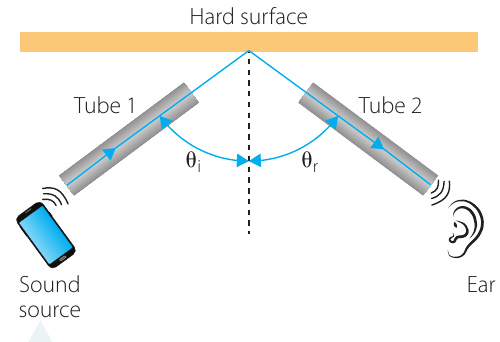
- Listen carefully at the end of tube 2 and note how well you can hear the sound.
- Now rearrange the tubes so that they make different angles with the perpendicular line to the hard surface.
- Again, listen at the end of tube 2 and compare how well you can hear the sound in this arrangement versus the previous arrangement.
- Repeat this comparison for several different angles.
Note
Expected observations: You should find that the sound is heard most clearly in tube 2 when both tubes make equal angles with the perpendicular to the hard surface. This demonstrates that sound follows the law of reflection, where the angle of incidence equals the angle of reflection.
Safety: Keep the volume at a moderate level to protect your hearing.
Diffraction of sound
What is diffraction?
Diffraction is the spreading out of a wave as it passes through an opening or around an obstacle. All types of waves, including sound waves, exhibit diffraction. The amount of spreading that occurs depends on the relationship between the wavelength of the wave and the size of the opening.
Important
Key principle: Waves with longer wavelengths spread out more than waves with shorter wavelengths when passing through the same opening. This has significant implications for how we hear different frequencies of sound.
Wavelength and frequency relationship
Sound waves of different frequencies have different wavelengths. We can calculate the wavelength of a sound wave using the wave equation:
where:
- is the speed of the wave ( for sound in air)
- is the frequency in hertz (Hz)
- is the wavelength in metres (m)
Rearranging this equation to find wavelength:
Wavelength calculations for musical sounds
Music typically contains a range of frequencies from about 100 Hz (low bass sounds) to around 5 kHz (high treble sounds). Let's calculate the wavelengths at each end of this range.
Example
Worked Example: Wavelength of a low frequency sound
For a low frequency sound of 100 Hz:
Given:
- Frequency, Hz
- Speed of sound,
Using the wave equation:
The wavelength of a 100 Hz sound is 3.40 m - several metres long!
Example
Worked Example: Wavelength of a high frequency sound
For a high frequency sound of 5 kHz (5000 Hz):
Given:
- Frequency, Hz
- Speed of sound,
Using the wave equation:
The wavelength of a 5 kHz sound is 68 mm - only a few centimetres!
This shows us that low frequency sounds have wavelengths of several metres, while high frequency sounds have wavelengths of only a few centimetres.
Diffraction through doorways
Consider a typical doorway with a width of approximately 1 metre. Now compare this to our calculated wavelengths:
- Low frequency sound (100 Hz): wavelength = 3.4 m (larger than the doorway)
- High frequency sound (5 kHz): wavelength = 68 mm (much smaller than the doorway)
Since waves diffract most when the opening size is similar to or smaller than the wavelength, we can predict that:
Low frequency sounds (with wavelengths of several metres) will diffract significantly through a doorway. They will spread out widely, allowing you to hear bass sounds even when standing to the side of a doorway.
High frequency sounds (with wavelengths of only centimetres) will diffract much less through the same doorway. They will continue in a more direct path, making treble sounds harder to hear when you're not directly in line with the doorway.
Note
Why you hear more bass from adjacent rooms:
When music is playing in a room and you're standing outside in the corridor, you hear the bass notes more clearly than the high-pitched instruments. The low frequency sounds are diffracting through the doorway much more effectively because their wavelengths (several metres) are comparable to the doorway size, while high frequency sounds have wavelengths much smaller than the doorway and therefore diffract very little.
Investigation 9.6: Observing diffraction of sound waves
This investigation allows you to experience the frequency-dependent nature of sound diffraction.
Aim: To observe the diffraction of sound and to relate the extent of diffraction to the wavelength of the sound
Materials:
- Loudspeaker (or sound system) playing music
- A room with a doorway and a door that can close
Method:
- Set up the loudspeaker or sound system inside the classroom or laboratory. Play music that contains a good range of frequencies (both bass and treble).
- Move around inside the room and note the quality of the sound you hear. Pay particular attention to both the low frequency (bass) sounds and the high frequency (treble) sounds.
- Move outside the room, leaving the door open. Position yourself in different locations relative to the doorway:
- Stand directly in front of the doorway
- Stand to one side of the doorway
- Stand as far to one side of the doorway as possible while still being able to hear any sound
- At each position, carefully observe which frequencies you can hear most clearly. Ask yourself: Can I hear the bass notes? Can I hear the high-pitched instruments? How does this compare to what I heard inside the room?
Note
Expected observations: You should find that:
- Inside the room, all frequencies are audible
- Directly in front of the doorway, all frequencies remain audible
- To the side of the doorway, low frequency sounds are much more audible than high frequency sounds
- The further to the side you move, the more pronounced this effect becomes
Analysis: The low frequency sounds have longer wavelengths (several metres) that are comparable to the size of the doorway opening. This means they diffract significantly, spreading out in all directions as they pass through the doorway. The high frequency sounds have much shorter wavelengths (centimetres) that are much smaller than the doorway, so they diffract very little and continue in a more straight-line path.
Safety: Maintain volume at a safe level throughout the investigation.
Summary
Key Points to Remember:
- Sound reflects from hard surfaces and is absorbed by soft surfaces
- Reverberation occurs when a reflecting surface is 17 metres or less away, causing the reflection to arrive within 0.1 seconds and blend with the original sound
- An echo is a distinct reflected sound that occurs when the reflecting surface is more than 17 metres away
- Diffraction is the spreading out of waves as they pass through an opening
- Waves with longer wavelengths diffract more than waves with shorter wavelengths
- Low frequency sounds (long wavelengths) diffract more through doorways than high frequency sounds (short wavelengths), which is why you hear more bass when music plays in another room
- The wave equation allows us to calculate wavelengths from frequency