Sound in Air Is a Longitudinal Wave (HSC SSCE Physics): Revision Notes
📚Revision Notes
Sound in Air Is a Longitudinal Wave
What is a longitudinal wave?
When sound travels through air, the particles vibrate back and forth in the same direction as the sound wave moves. This type of wave motion is called a longitudinal wave. In a longitudinal wave, particle oscillations are parallel to the direction that energy travels.
This is different from transverse waves (like water waves or light waves), where particles move perpendicular to the direction the wave travels.
Limitations of the model
Note
The sound wave model is useful but not perfect. For example, gas particles are actually in constant random motion, so the idea that they oscillate about a fixed rest position is a simplification. Like all scientific models, this representation has limitations and doesn't perfectly describe what happens in real life.
Sound transmission as a longitudinal pressure wave
When sound travels through a medium like air, the particles create alternating regions where they are bunched together and spread apart. These regions are called compressions and rarefactions.
Compressions and rarefactions
- Compressions are regions where air particles are crowded together. The air pressure is higher than normal in these regions.
- Rarefactions are regions where air particles are spread apart. The air pressure is lower than normal in these regions.
As the sound wave travels, these compressions and rarefactions move through the medium in a repeating pattern.
Representing pressure variation
Scientists often represent sound waves using a graph showing how pressure varies with distance from the source. This graph shows the pressure variation, represented by the symbol , from normal air pressure.
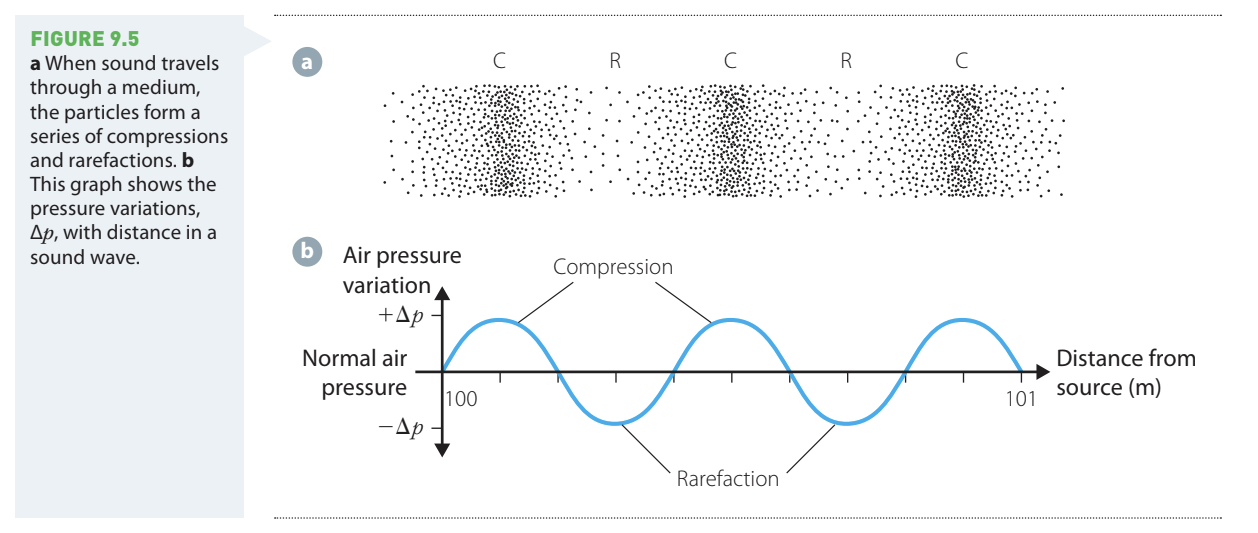
On this type of graph:
- The peaks (highest points) represent compressions (high pressure regions)
- The troughs (lowest points) represent rarefactions (low pressure regions)
- The middle line represents normal air pressure
This graphical representation is often easier to work with than trying to draw all the individual particle positions. If you were using a microphone to detect a sound wave, an oscilloscope would display these pressure variations as a function of time rather than distance.
Worked example: Calculating frequency from compressions
Example
Worked Example: Calculating Frequency from Compressions
Question: As a sound wave passes a point, compressions were detected in s. What is the frequency of this sound wave?
Solution:
The frequency formula is:
where:
- is frequency (in hertz, Hz)
- is the number of waves (compressions or rarefactions)
- is time (in seconds)
Substituting the values:
Answer: The frequency is 300 Hz.
Important
Exam tip: Remember that one complete wave includes both a compression and a rarefaction. You can count either compressions or rarefactions to find the number of waves—just don't count both!
Investigation 9.3: Modelling sound as a longitudinal pressure wave
Aim
To use a slinky spring to model a sound wave as a longitudinal pressure wave.
Materials
- Slinky spring
- Ribbon
- Ruler
- Safety glasses
- Video recording device (preferably with slow-motion playback capabilities)
Risk assessment
Important
Safety First:
Always wear safety glasses and handle the slinky spring carefully. Do not overstretch the spring or let it go unexpectedly, as it could flick back and cause injury.
Method
- Stretch a slinky spring on smooth ground with a student holding each end.
- Tie a ribbon around one of the coils of the slinky spring at about the midpoint of the spring.
- Place a clearly marked ruler next to the spring with the centre of the ruler at the ribbon.
- Have one student move the end of the spring rapidly and smoothly backwards and forwards in a line with the spring, while the motion of the ribbon is videoed.
Results
View the recording of the motion of the ribbon.
Analysis of results
- If possible, view the motion of the ribbon in slow motion.
- Describe the motion of the ribbon as a wave passes through the spring.
Note
What you should observe: As the compression and rarefaction pattern moves along the spring, the ribbon moves back and forth parallel to the length of the spring, but stays roughly in the same average position.
Discussion
The slinky spring models how air particles behave when sound passes through them. Just as the spring coils (marked by the ribbon) vibrate back and forth along the length of the spring, air particles vibrate back and forth in the direction the sound travels. The compressions in the spring represent high-pressure regions in air, and the stretched sections represent low-pressure regions (rarefactions).
Remember!
Summary
Key Points to Remember:
- Sound is a longitudinal wave where particles vibrate parallel to the direction of energy travel.
- Sound creates alternating compressions (high pressure regions) and rarefactions (low pressure regions) as it travels through air.
- In compressions, air pressure is higher than normal; in rarefactions, air pressure is lower than normal.
- Sound waves can be represented graphically by plotting pressure variation against distance from the source.
- The frequency of a sound wave can be calculated using , where is the number of compressions (or rarefactions) and is time.