Standing Waves (HSC SSCE Physics): Revision Notes
📚Revision Notes
Standing Waves
What are standing waves?
Standing waves are wave patterns that appear to remain stationary in one location rather than travelling through a medium. While the pattern stays fixed, the particles within the medium continue to vibrate in their normal transverse or longitudinal motion. The wave pattern itself, however, does not move along the string, spring, or air column.
When you create waves in a string that is fixed at one end, the forward-moving waves and the reflected waves interfere with each other through superposition. Most of the time, this interference creates a complex, chaotic pattern. However, at specific frequencies, something special happens - a stable pattern of maximum and minimum displacements forms. This is a standing wave.
Note
Standing waves can form in stretched strings, springs, and air columns inside pipes. Musicians use this principle extensively in instruments to create resonant sounds with specific pitches.
How standing waves form
A standing wave forms when two conditions are met:
- Two waves with identical frequency and amplitude travel in opposite directions through the same medium
- The length of the string, spring, or air column has a specific mathematical relationship with the wavelength
When these conditions are satisfied, the waves interfere with each other in a way that creates fixed points of zero displacement (nodes) and fixed points of maximum displacement (antinodes).
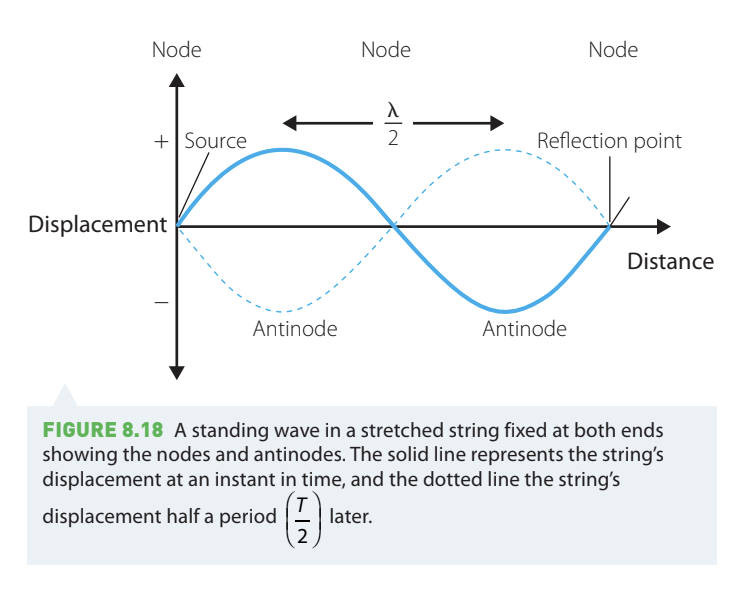
Nodes - points of zero displacement
Nodes are locations along the medium where destructive interference occurs continuously. At a node, the displacement is always zero, regardless of what time you observe it.
This happens because at any moment, the displacement caused by one wave is exactly equal in magnitude but opposite in direction to the displacement caused by the other wave.
Example
How Destructive Interference Creates a Node:
- When a crest from one wave passes through a node, a trough of equal size from the reflected wave also passes through that same point
- When one wave creates a displacement of half its amplitude upward, the other wave creates a displacement of half its amplitude downward
- These opposite displacements cancel each other out through superposition
The result is that particles located at nodes remain perfectly still, even though waves are continuously travelling through those points. This might seem strange, but it's a direct consequence of destructive interference.
Antinodes - points of maximum displacement
Antinodes are locations where particles oscillate with the maximum possible amplitude. At these points, constructive interference occurs continuously.
The maximum displacement happens when:
- Two crests meet at the same point simultaneously, or
- Two troughs meet at the same point simultaneously
When this occurs, the displacements add together, giving a total displacement equal to the sum of the individual wave amplitudes (which are equal, so the antinode displacement is twice the amplitude of each individual wave).
Note
Particles at antinodes oscillate up and down at the same frequency as the wave frequency. Between nodes and antinodes, particles also oscillate at this same frequency, but with smaller amplitudes that vary depending on their position.
Key characteristics of standing waves
Standing wave patterns always show an alternating pattern of nodes and antinodes along the medium. This pattern has specific mathematical properties:
- The distance between two consecutive nodes equals (half a wavelength)
- The distance between two consecutive antinodes also equals
- The distance from a node to the nearest antinode equals (quarter wavelength)
Important
Despite appearing stationary, it's crucial to understand that standing waves result from two waves actively travelling in opposite directions. The standing wave pattern is simply the observable result of their superposition - it's not a different type of wave, but rather an interference pattern.
The solid line in the diagram represents the string's position at one instant in time, while the dotted line shows its position half a period () later. Notice how nodes remain at zero displacement while antinodes reach their maximum displacement in the opposite direction.
Investigation: Using standing waves to calculate wave speed in a spring
This practical investigation demonstrates how to use standing wave patterns to determine the speed of waves travelling through a spring.
Aim
To observe how stretching a spring affects wave speed by measuring standing wave properties.
Hypothesis
Stretching a spring further increases the speed of waves travelling through the spring.
Materials
- Slinky springs
- Metre ruler
- Stopwatch
- Optional: digital camera or recording device
Method overview
The investigation involves creating standing waves in a slinky spring and measuring key properties:
- Extend the slinky along the ground with one end fixed and create travelling waves by moving the free end side to side
- Adjust the movement frequency until standing waves form (nodes and antinodes become visible and stationary)
- Time 10 complete side-to-side movements to determine the period
- Measure the distance between two consecutive nodes while maintaining the standing wave
- Record the investigation with video if possible
- Repeat the entire process with the spring stretched to a different length
Analysis of results
From your measurements, calculate the wave properties:
Period: Calculate the period by dividing the time for 10 movements by 10.
Frequency: Use the relationship to find the wave frequency.
Wavelength: Since the distance between consecutive nodes equals , the wavelength is:
Wave speed: Finally, calculate the wave speed using the wave equation:
Repeat these calculations for both spring lengths to compare how stretching affects wave speed.
Note
Key discussion points:
Consider why reflection is essential for creating standing waves even though there's only one source of wave motion. The reflected waves from the fixed end interfere with the forward-travelling waves to create the standing wave pattern.
The amount of stretch in the spring affects the tension, which in turn changes how quickly waves can travel through the spring. Greater tension typically allows waves to travel faster.
Remember!
Summary
Key Points to Remember:
- Standing waves are interference patterns that appear stationary, formed when two waves of equal frequency and amplitude travel in opposite directions
- Nodes are points of zero displacement where destructive interference occurs continuously
- Antinodes are points of maximum displacement where constructive interference occurs continuously
- The spacing between consecutive nodes (or consecutive antinodes) is always
- You can determine wave speed by measuring standing wave properties using , where frequency comes from timing oscillations and wavelength comes from measuring node spacing