Gene Regulation (VCE SSCE Biology): Revision Notes
📚Revision Notes
Gene Regulation
Introduction to gene regulation
Cells are constantly working to maintain their functions, but they need to be efficient with their energy use. One way cells conserve energy is through gene regulation, which is the control of gene expression. Gene regulation allows cells to switch genes on or off as needed, preventing the wasteful production of proteins when they aren't required.
Gene expression refers to the process of reading the information stored within a gene to create a functional product, typically a protein. By regulating gene expression, organisms can respond to changing conditions and ensure that proteins are only made when needed.
Note
Energy conservation through gene regulation is essential for cell survival. By producing proteins only when needed, cells can redirect their resources to other critical processes and respond more efficiently to environmental changes.
Types of genes involved in regulation
There are two main types of genes involved in gene regulation: structural genes and regulatory genes.
Structural genes are segments of DNA that code for proteins involved in the structure or function of a cell. These proteins might include enzymes, transport proteins, receptors, or peptide hormones. Structural genes are the genes whose expression is being controlled.
Regulatory genes are segments of DNA that code for proteins that control the expression of other genes, particularly structural genes. The proteins produced by regulatory genes include:
- Repressor proteins: proteins that prevent or decrease gene expression by binding to the operator region of DNA
- Activator proteins: proteins that initiate or increase gene expression
Important
The key relationship between these two types of genes is that regulatory genes produce proteins that control when and how much structural genes are expressed. This hierarchical control system is fundamental to how cells regulate their protein production.
Understanding operons
In prokaryotic organisms (such as bacteria), genes are often organised into structures called operons. An operon is a cluster of linked genes that all share a common promoter and operator, and are transcribed at the same time.
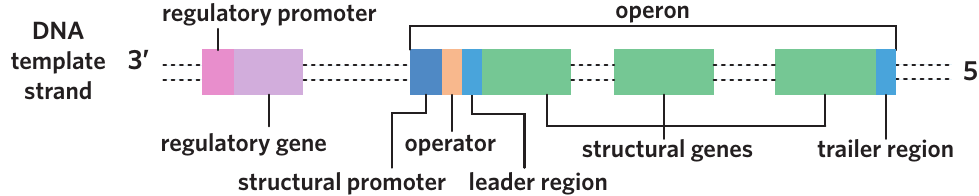
The basic components of an operon include:
- Regulatory gene: located upstream, produces repressor or activator proteins
- Promoter: the DNA sequence where RNA polymerase binds to begin transcription
- Operator: a short DNA region that interacts with repressor proteins to control transcription
- Leader region: a segment immediately before the coding regions
- Structural genes: multiple genes that code for related proteins
- Trailer region: a segment at the end of the operon
Note
The operator is always located downstream of the promoter. When a repressor protein binds to the operator, it blocks RNA polymerase from moving forward, preventing transcription. When the operator is not bound by a repressor, RNA polymerase can transcribe the structural genes normally.
The trp operon structure
The trp operon is found in certain bacteria such as Escherichia coli (E. coli). It provides an excellent example of how gene regulation works in prokaryotes. The trp operon controls the production of the amino acid tryptophan, which cells use as a building block for making proteins.

The trp operon consists of:
- A regulatory gene (located upstream)
- A promoter region
- An operator region
- A leader region
- Five structural genes (trpE, trpD, trpC, trpB, and trpA) that code for enzymes involved in tryptophan synthesis
- A trailer region
The expression of these structural genes depends on the levels of tryptophan present in the cell:
- High tryptophan levels: transcription of the structural genes is stopped to prevent unnecessary tryptophan production
- Low tryptophan levels: transcription of the structural genes continues to increase tryptophan availability
Note
There are two main mechanisms that regulate the trp operon: repression and attenuation. These complementary systems work together to fine-tune tryptophan production based on cellular needs.
Repression mechanism
Repression is one way the trp operon responds to high tryptophan levels in the cell. Here's how it works:
The regulatory gene for the trp operon is constantly expressed, continuously producing repressor proteins. However, these repressor proteins are initially inactive and cannot bind to the operator.
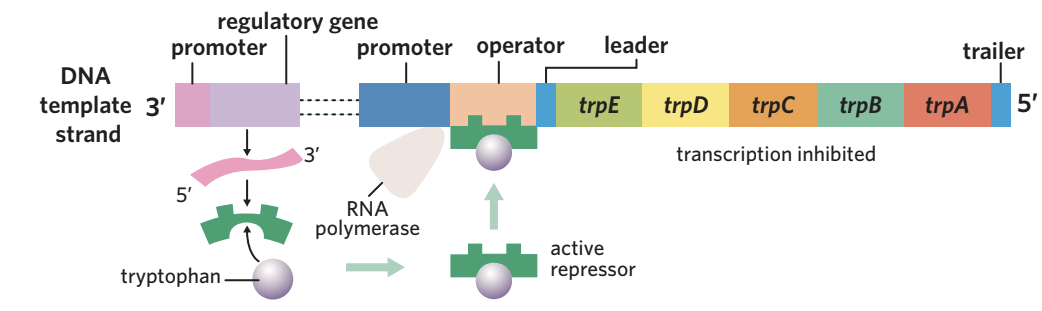
When tryptophan levels are high in the cell, tryptophan molecules act as corepressors. They bind to the inactive repressor protein, causing a conformational change (a change in the three-dimensional shape) of the repressor. This change activates the repressor protein.
The active repressor protein can now bind to the operator region. When bound to the operator, the repressor blocks the path of RNA polymerase, preventing it from transcribing the structural genes. This stops the production of enzymes needed to make more tryptophan, which makes sense because the cell already has plenty.
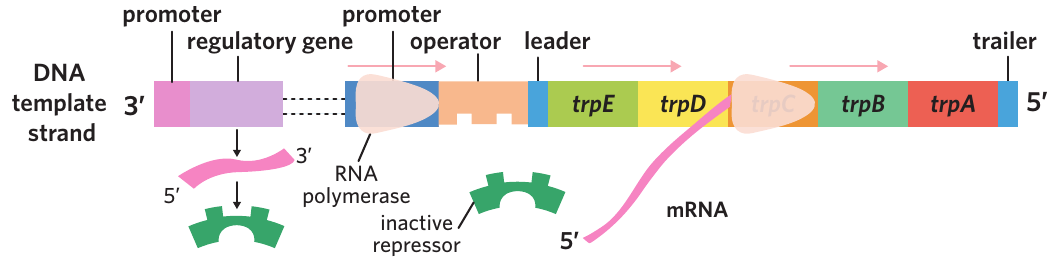
Conversely, when tryptophan levels are low, there aren't enough tryptophan molecules to consistently bind to and activate the repressor proteins. The inactive repressor detaches from (or never binds to) the operator region, allowing RNA polymerase to transcribe the structural genes. This increases the production of enzymes that synthesise tryptophan.
Important
Feedback Regulation
As tryptophan begins to accumulate in the cell, it will eventually bind to repressor proteins again, gradually slowing down transcription. This creates a negative feedback system that maintains relatively constant tryptophan levels, demonstrating the cell's ability to self-regulate.
Attenuation mechanism
Attenuation is the second mechanism for regulating the trp operon. It works differently from repression but achieves the same goal of controlling tryptophan production.
In attenuation, transcription of the structural genes actually begins, but can be stopped prematurely before any functional proteins are made. This mechanism depends on two key features of prokaryotic cells:
- In prokaryotes, transcription and translation occur simultaneously and in close proximity in the cytoplasm
- The leader region of the trp operon contains an attenuator sequence that comes after two tryptophan codons in a row
When tryptophan levels are high
Example
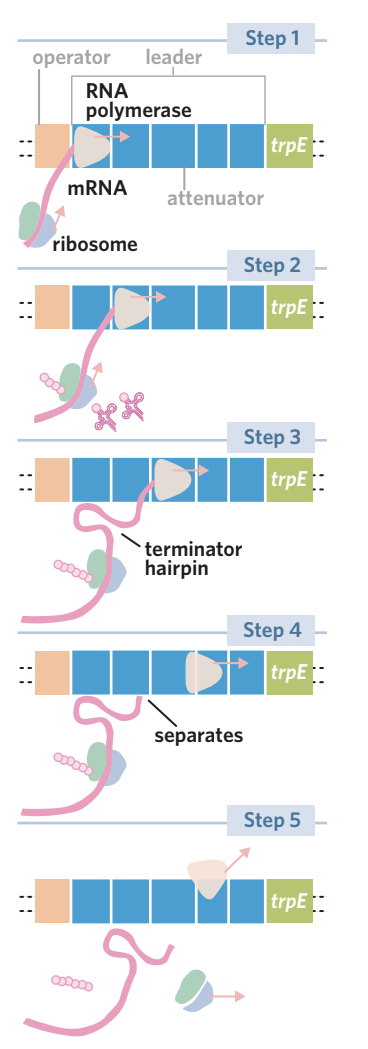
Worked Example: Attenuation with High Tryptophan
When the cell has plenty of tryptophan and doesn't need to make more:
Step 1: Transcription and translation of the trp operon begin simultaneously
Step 2: A ribosome translating the mRNA arrives at the two tryptophan codons in the leader region
Step 3: Because tryptophan is abundant, tRNA molecules carrying tryptophan are readily available and quickly deliver tryptophan to the ribosome
Step 4: This causes the mRNA to fold into a specific structure called a terminator hairpin loop through hydrogen bonding
Step 5: The terminator hairpin causes the mRNA to separate from the DNA template at the attenuator sequence, and RNA polymerase detaches from the DNA
Result: Transcription stops before the structural genes are transcribed, preventing tryptophan synthesis
When tryptophan levels are low
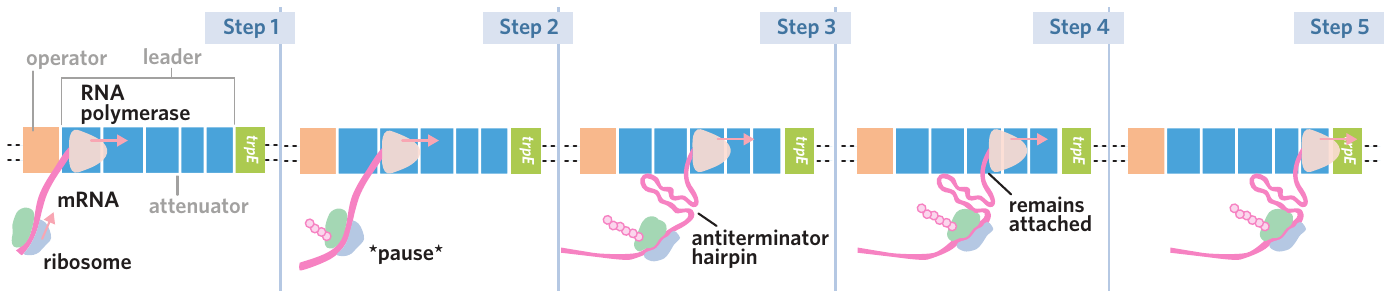
Example
Worked Example: Attenuation with Low Tryptophan
When the cell needs more tryptophan:
Step 1: Transcription and translation of the trp operon begin simultaneously
Step 2: The ribosome arrives at the two tryptophan codons in the leader region
Step 3: Because tryptophan is scarce, there are no tRNA molecules carrying tryptophan available, so the ribosome pauses at this point
Step 4: Meanwhile, RNA polymerase continues transcribing the DNA, moving ahead of the stalled ribosome
Step 5: This different timing causes the mRNA to fold into a different structure called an antiterminator hairpin loop
Step 6: The antiterminator hairpin does not cause the mRNA to separate from the DNA template
Result: RNA polymerase continues transcribing the structural genes, allowing production of the enzymes needed to synthesise tryptophan
Comparing repression and attenuation
Both repression and attenuation regulate the trp operon, but they work through different mechanisms:
Repression responds to the concentration of free tryptophan in the cell. It prevents transcription from starting by blocking RNA polymerase at the operator.
Attenuation responds to the availability of tRNA-bound tryptophan. It allows transcription to begin but can terminate it prematurely through mRNA folding.
Important
Imperfect but Beneficial Regulation
Neither mechanism is perfect. Even when tryptophan levels are high, a small amount of transcription and translation of the trp operon still occurs. This is actually beneficial because it ensures the cell is never completely without tryptophan, allowing rapid response when tryptophan levels suddenly drop.
Together, repression and attenuation allow the cell to fine-tune tryptophan production and function efficiently.
Summary
Key Points to Remember:
-
Gene regulation controls gene expression, allowing cells to conserve energy by only producing proteins when needed
-
Structural genes code for functional proteins, while regulatory genes code for proteins that control the expression of other genes
-
Operons are clusters of genes in prokaryotes that share a common promoter and operator, allowing coordinated regulation
-
The trp operon regulates tryptophan production through two mechanisms: repression (which prevents transcription from starting when tryptophan is high) and attenuation (which terminates transcription early when tryptophan is high)
-
In repression, high tryptophan levels cause the repressor to bind to the operator, blocking RNA polymerase
-
In attenuation, high tryptophan levels cause mRNA to form a terminator hairpin, stopping transcription prematurely; low levels cause an antiterminator hairpin to form, allowing transcription to continue