Planar Graphs and Euler’s Formula (VCE SSCE General Mathematics): Revision Notes
📚Revision Notes
Planar Graphs and Euler's Formula
Introduction to planar graphs
A planar graph is a graph that can be drawn on a flat surface so that no edges cross over each other, except where they meet at vertices. This is an important property in graph theory because it helps us understand the structure and relationships within networks.
What makes a graph planar?
The key characteristic of a planar graph is that when drawn properly, edges only intersect at the vertices (the points or nodes). Look at this example:
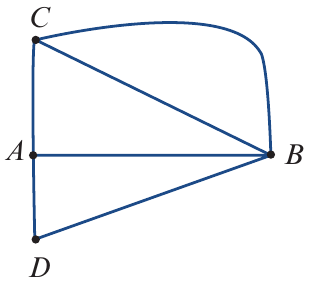
This graph is planar because we can see all four vertices (A, B, C, D) connected by edges that don't cross anywhere except at the vertices themselves.
Note
The key to identifying a planar graph is checking whether all edge intersections occur only at vertices. If edges cross anywhere else, the graph either needs to be redrawn or is non-planar.
Equivalent planar forms
Some graphs might not look planar at first glance, but they can be redrawn to show their planar nature. When two graphs have the same connections between vertices but are drawn differently, they are called equivalent or isomorphic graphs.
Consider these two graphs:
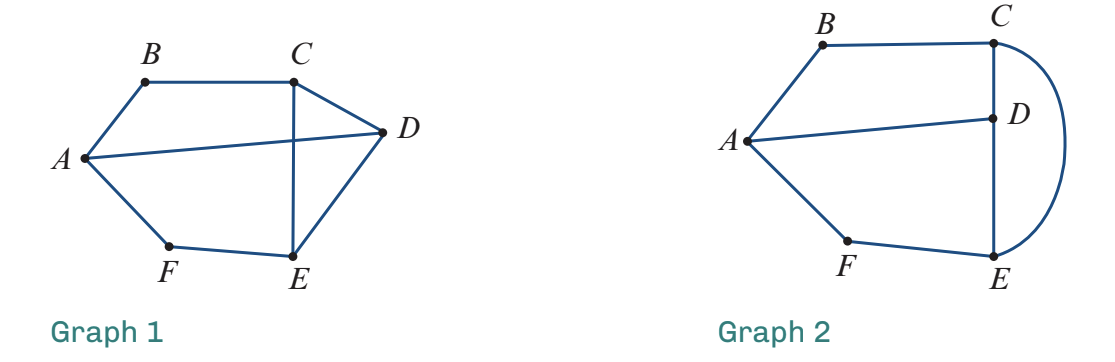
Graph 1 appears to have crossing edges, but Graph 2 shows the same graph redrawn in a way that clearly demonstrates it is planar. The connections between vertices A, B, C, D, E, and F are identical in both graphs, just arranged differently.
Note
Two graphs are equivalent (isomorphic) when they represent the same connections between vertices, even if they look different visually. The arrangement may change, but the underlying structure remains the same.
Non-planar graphs
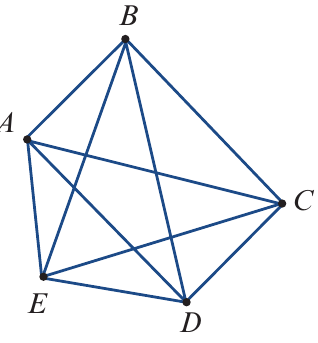
Not every graph can be redrawn in planar form. Some graphs will always have crossing edges no matter how you arrange them. Here's an example of a non-planar graph:
Important
This graph with vertices A, B, C, D, and E cannot be redrawn without edges crossing. No matter how you rearrange it, you'll always have at least one pair of edges that intersect away from the vertices. Some graphs are inherently non-planar.
Redrawing graphs in planar form
Sometimes you need to redraw a graph to reveal its planar nature. Here's a systematic approach:
Step-by-step method
Step 1: Identify which edge is causing the intersection problem and temporarily remove it.
Step 2: Redraw the remaining graph structure.
Step 3: Add back the removed edge as a curved line that avoids crossing the other edges.
Example
Worked Example: Redrawing a Graph
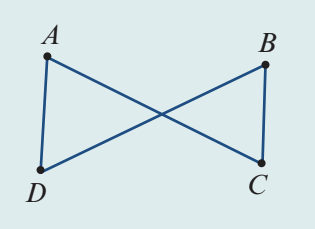
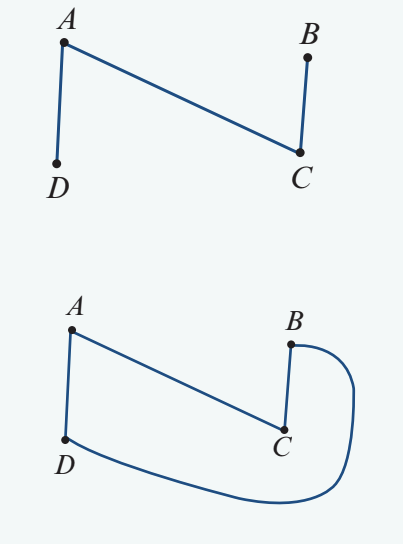
Let's redraw this graph in planar form:
Solution:
First, we identify that edge DB intersects edge AC. We remove edge DB and redraw the graph.
Then we add edge DB back as a curved line that doesn't cross any other edges. The result is an equivalent planar form where no edges intersect except at vertices.
Faces of a graph
When a planar graph is drawn, it divides the surface into distinct regions called faces.
What is a face?
A face is a region of space created by the graph. This includes:
- Areas enclosed by the edges of the graph
- The infinite region surrounding the entire graph
The surrounding region is called the infinite face and must always be counted when determining the total number of faces.
Important
Don't forget the infinite face!
When counting faces, students often forget to include the infinite region that surrounds the entire graph. This is a common mistake that will lead to incorrect results when using Euler's formula. Always count the infinite face as one of your faces.
Counting faces
Let's look at some examples to understand how to count faces.
Example with 2 faces:
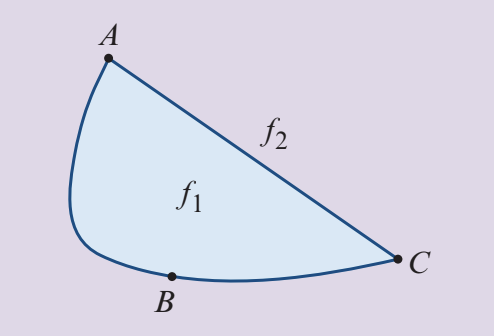
A simple triangular graph creates two faces:
- : the area inside the triangle
- : the infinite area outside the triangle
Example with 4 faces:
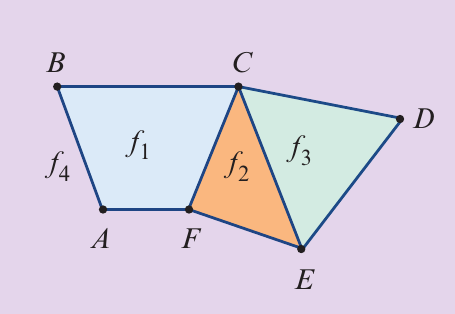
This more complex graph divides the surface into four distinct faces:
- : the blue quadrilateral region on the left
- : the orange triangular region in the centre
- : the light green triangular region on the right
- : the infinite region surrounding the entire graph
Note
Exam tip: Always mark the faces on your diagram when counting them. Use different colours or labels to distinguish each region clearly. This visual approach helps prevent counting errors and ensures you don't miss the infinite face.
Euler's formula
Euler discovered a remarkable relationship between the number of vertices, edges, and faces in any connected planar graph.
The formula
For a connected planar graph:
Where:
- = number of vertices
- = number of edges
- = number of faces
In words: number of vertices + number of faces = number of edges + 2
Note
Why is Euler's formula important?
This formula works for any connected planar graph, no matter how simple or complex. It provides a way to check your work when analyzing graphs, or to find an unknown property when you know the other two. This makes it an incredibly powerful tool in graph theory.
Understanding the formula
Let's verify the formula with a quick example. Consider a graph with:
- vertices
- edges
- faces
Verifying Euler's formula:
✓
The formula is confirmed!
Verifying Euler's formula
Let's work through some examples to practice verifying Euler's formula.
Example
Worked Example 1: Simple Verification
Consider this connected planar graph:
Step 1: Count the vertices.
There are four vertices: A, B, C, D
Therefore
Step 2: Count the edges.
The edges are: AB, AC, AD, BC (appears twice), and BD
Therefore
Step 3: Count the faces.
Mark the faces on the diagram to help count them. Remember to include the infinite face surrounding the graph.
There are four faces: , , , and (infinite face)
Therefore
Step 4: Verify Euler's formula.
✓
Therefore Euler's formula is verified.
Example
Worked Example 2: Graph Requiring Redrawing
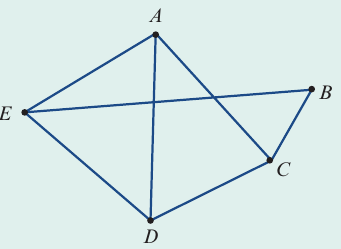
Consider this connected planar graph:
Step 1: Count the vertices.
There are five vertices: A, B, C, D, E
Therefore
Step 2: Count the edges.
The edges are: AC, AD, AE, BC, BE, CD, DE
Therefore
Step 3: Count the faces.
This graph has crossing edges, so we need to redraw it in planar form to accurately count the faces:
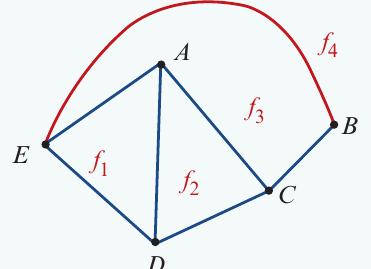
Now we can clearly see four faces: , , , and (infinite face)
Therefore
Step 4: Verify Euler's formula.
✓
Therefore Euler's formula is verified.
Using Euler's formula to find unknown properties
Euler's formula can be rearranged algebraically to find any unknown property of a planar graph when you know the other two properties.
Example
Worked Example 3a: Finding the Number of Edges
For a planar connected graph with 4 vertices and 6 faces, find the number of edges.
Step 1: Write down the known values.
,
Step 2: Write Euler's formula.
Step 3: Substitute the known values.
Step 4: Solve for .
Answer: Therefore this graph has 8 edges.
Example
Worked Example 3b: Finding the Number of Faces
For a planar connected graph with 4 vertices and 5 edges, find the number of faces.
Step 1: Write down the known values.
,
Step 2: Write Euler's formula.
Step 3: Substitute the known values.
Step 4: Solve for .
Answer: Therefore this graph has 3 faces.
Example
Worked Example 3c: Finding the Number of Vertices
For a planar connected graph with 5 faces and 8 edges, find the number of vertices.
Step 1: Write down the known values.
,
Step 2: Write Euler's formula.
Step 3: Substitute the known values.
Step 4: Solve for .
Answer: Therefore this graph has 5 vertices.
Summary
Key Points to Remember:
- A planar graph can be drawn on a flat surface with no edges crossing, except at vertices
- Some graphs that appear non-planar can be redrawn in an equivalent planar form
- A face is a region of space created by the graph, including the infinite region surrounding it
- Always count the infinite face when determining the total number of faces
- Euler's formula states: for connected planar graphs
- You can use Euler's formula to verify your graph analysis or find an unknown property
- When counting faces, it often helps to redraw the graph in clear planar form first