Precedence Tables and Activity Networks (VCE SSCE General Mathematics): Revision Notes
📚Revision Notes
Precedence Tables and Activity Networks
Introduction to project activities
Many real-world projects require multiple individual tasks to be completed before the project finishes. These include building houses, manufacturing products, or organising events like weddings. The individual tasks, called activities, often depend on each other. Some activities cannot start until other specific activities are finished.
Note
Real-world examples of project dependencies:
When organising a wedding, you must send out invitations before you can finalise seating plans (because you need to know who accepted). When building a house, you cannot start plastering walls until the house is weatherproof. These dependencies create a logical sequence that must be followed.
Immediate predecessors
When one activity must be completed before another activity can begin, we call the first activity an immediate predecessor of the second activity.
Important
Definition of Immediate Predecessor
If activity must be completed before activity can start, then activity is an immediate predecessor of activity .
Key points about immediate predecessors:
- An activity can have multiple immediate predecessors
- An activity can be an immediate predecessor for multiple other activities
- Some activities have no immediate predecessors (they can start right away)
- Some activities are not immediate predecessors for any other activities (they lead to project completion)
Precedence tables
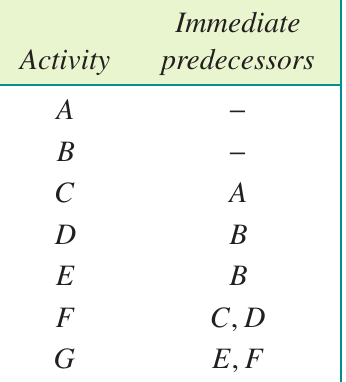
A precedence table organises information about activities and their immediate predecessors in a structured format.
Structure of a precedence table:
- First column: Lists all activities (usually labelled with letters: , , , etc.)
- Second column: Lists the immediate predecessors for each activity
- Activities with no immediate predecessors have a dash (−) in the second column
Note
Reading the precedence table:
In this example:
- Activities and can start immediately (no predecessors)
- Activity can only start after activity is complete
- Activities and can only start after activity is complete
- Activity requires both and to be complete first
- Activity requires both and to be complete first
Activity networks
An activity network is a visual diagram that shows how activities in a project flow from start to finish. It provides a graphical representation of the information contained in a precedence table.
Key characteristics of activity networks
Important
Critical Features of Activity Networks:
- Activities are represented by edges (arrows), not vertices
- Edges are labelled with activity names
- Vertices (dots/nodes) are not labelled, except for "start" and "finish"
- The network flows from a start vertex to a finish vertex
- All arrows point in the direction of project flow (from start towards finish)
Drawing activity networks from precedence tables
To construct an activity network from a precedence table, follow these principles:
Rule 1: Activities with no immediate predecessors connect directly from the start vertex.
Rule 2: Activities that are not immediate predecessors for any other activities connect directly to the finish vertex.
Rule 3: For all other activities, identify:
- Which activities must come before them (their immediate predecessors)
- Which activities come after them (activities for which they are immediate predecessors)
Worked example: Basic activity network
Example
Worked Example: Drawing an Activity Network
Let's draw an activity network for this precedence table:
Step 1: Identify activities with no predecessors
Activities and have no immediate predecessors, so they both start from the start vertex.
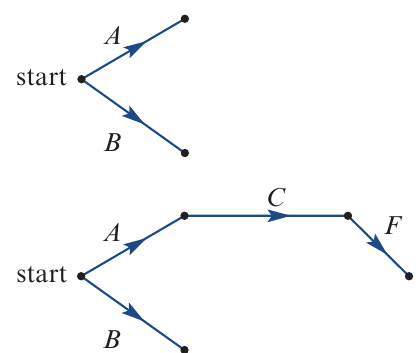
Step 2: Add activity
Activity has immediate predecessor , so follows directly after .
Step 3: Add activities and
Both and have immediate predecessor , so they both follow from .
Step 4: Add activity
Activity has immediate predecessors and , so it must follow both of these activities.
Step 5: Add activity and complete the network
Activity has immediate predecessors and . Since is not an immediate predecessor for any other activity, it leads to the finish vertex.
Another worked example: Systematic construction
Example
Worked Example: Systematic Network Construction
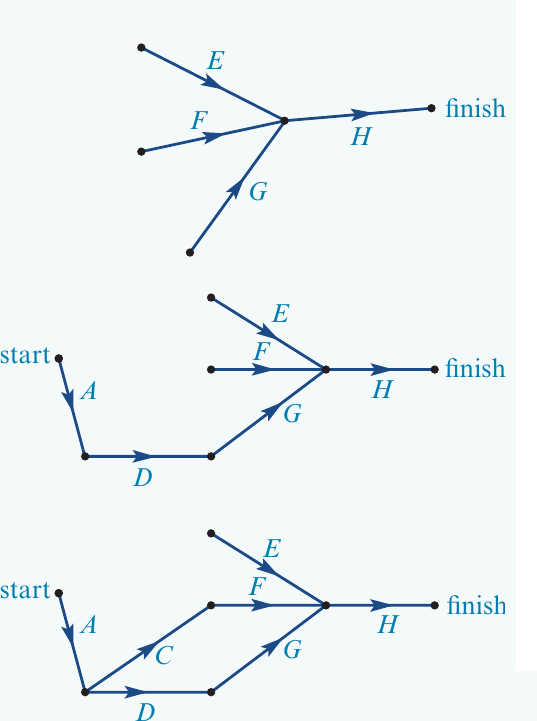
Draw an activity network from this precedence table:
| Activity | Immediate predecessors |
|---|---|
| − | |
Solution approach:
Working backwards from the finish is often helpful:
- Activity is not an immediate predecessor for anything, so it leads to the finish
- requires , , and to be complete, so these three activities converge at
- Activity requires , and requires
- Activity requires , and requires
- Activity requires , and requires
- Activity has no predecessors, so it starts from the start vertex
All three paths (, , and ) meet at activity before reaching the finish.
Dummy activities
Sometimes the structure of precedence relationships requires us to use dummy activities in our network diagrams.
When are dummy activities needed?
Important
When to Use Dummy Activities
A dummy activity is required when two activities share some, but not all, of their immediate predecessors.
Consider this precedence table:
| Activity | Immediate predecessors |
|---|---|
| − | |
| − | |
| − | |
Here's the problem:
- Activity needs both and as predecessors
- Activity needs both and as predecessors
- They share predecessor , but has unique predecessor , and has unique predecessor
How dummy activities work
A dummy activity is a fictitious activity that helps maintain correct precedence relationships. It doesn't represent real work.
Note
Representation of Dummy Activities
Dummy activities are shown as dotted lines in the network diagram. This visual distinction makes it clear they are not real activities.
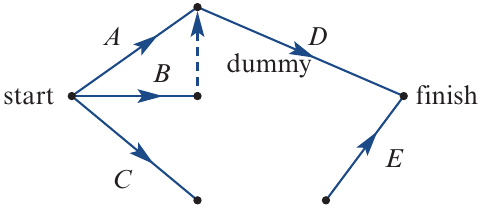
The dummy activity ensures that:
- Activity follows both and
- Activity follows both and
- The shared predecessor is correctly represented
Where to place dummy activities
Important
Rule for Dummy Activity Placement
A dummy activity extends from the end of each shared immediate predecessor to the start of the activity that has additional immediate predecessors.
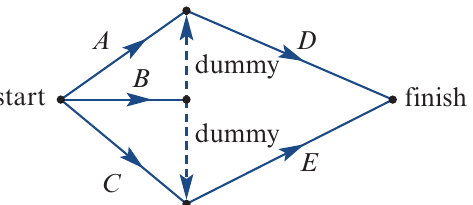
In this diagram, two dummy activities are needed:
- One dummy from to ensure depends on both and
- One dummy from to ensure depends on both and
Worked example: Including dummy activities
Example
Worked Example: Using Dummy Activities
Draw an activity network for this precedence table:
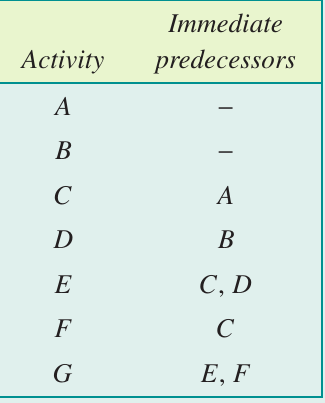
Solution:
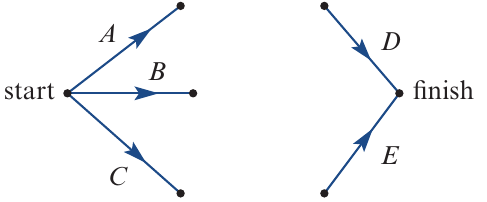
Analysis:
- Activities and start from the start vertex (no predecessors)
- Activity leads to finish (not a predecessor for anything)
- A dummy activity is needed from the end of to the start of , because:
- Both and have as a predecessor
- But also has as a predecessor, while does not
- This shared-but-not-identical predecessor situation requires a dummy
The dummy ensures that activity correctly depends on both and .
Creating precedence tables from activity networks
You may need to work backwards, creating a precedence table from a given activity network.
Method
- Create a table with one row for each activity
- For each activity, look at what arrows lead into it
- List all activities that lead directly into this activity as immediate predecessors
- Remember that dummy activities also create precedence relationships
Reading dummy activities
Note
Interpreting Dummy Activities
When you see a dummy activity connecting from activity to activity , it means activity is an immediate predecessor of activity .
Worked example: Network to table
Example
Worked Example: Converting Network to Precedence Table
Write a precedence table for this activity network:
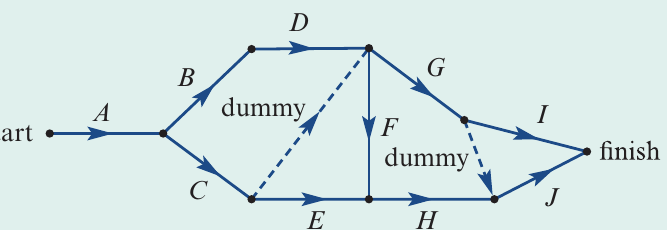
Solution:
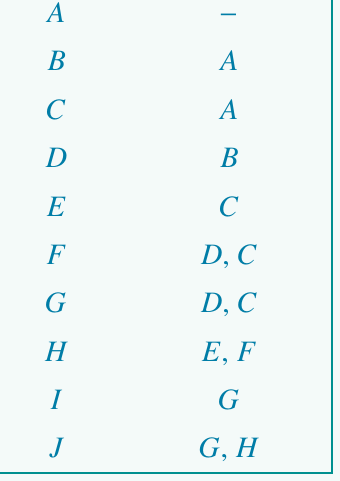
Explanation:
- Activity connects from start (no predecessors)
- Activity follows (predecessor: )
- Activity follows (predecessor: )
- Activity follows (predecessor: )
- Activity follows (predecessor: )
- Activity follows and has a dummy from (predecessors: )
- Activity follows and has a dummy from (predecessors: )
- Activity follows and (predecessors: )
- Activity follows (predecessor: )
- Activity follows and has a dummy from (predecessors: )
The dummy activities ensure the correct precedence relationships are maintained.
Summary
Key Rules and Concepts
For drawing activity networks:
- Activities with no immediate predecessors start from the start vertex
- Activities that are not immediate predecessors for others end at the finish vertex
- Edges (arrows) represent activities and must be labelled
- Vertices (dots) are not labelled except for start and finish
- Use dummy activities (dotted lines) when activities share some but not all predecessors
For creating precedence tables:
- List each activity in the first column
- For each activity, identify all arrows leading into it
- List the activities at the start of these arrows as immediate predecessors
- Include dummy activities when determining predecessors
Essential definitions:
- Immediate predecessor: An activity that must finish before another can start
- Precedence table: Shows activities and their immediate predecessors in a structured format
- Activity network: Visual diagram where edges (arrows) represent activities
- Dummy activities: Dotted lines used when activities share some but not all predecessors; they're fictitious but necessary for correct representation
- Always label edges (activities), not vertices (except start and finish)