Tangents and Normals (VCE SSCE Mathematical Methods): Revision Notes
📚Revision Notes
Tangents and Normals
What is a tangent?
The derivative of a function tells us the gradient of the curve at any given point. This gradient is identical to the gradient of the tangent line at that point. A tangent is a straight line that just touches the curve at a single point and has the same slope as the curve at that exact location.
When we know the gradient and a point on the curve, we can find the equation of the tangent line.
Note
Think of a tangent as a line that "kisses" the curve at exactly one point, matching the curve's direction at that moment. The derivative gives us this direction by providing the gradient.
Formula for the equation of a tangent
If is a point on the curve , and the function is differentiable at , then the equation of the tangent at this point is:
Where:
- is the point on the curve
- is the gradient of the tangent (found using the derivative)
- This is the point-slope form of a linear equation
Important
The Tangent Formula: This formula is essential for all tangent problems. Remember that represents the derivative evaluated at the specific point , giving you the gradient you need.
What is a normal?
The normal to a curve at a given point is the line that:
- Passes through that point
- Is perpendicular to the tangent at that point
The normal line forms a right angle (90°) with the tangent line at their point of intersection on the curve.
Perpendicular gradients
Two lines are perpendicular when the product of their gradients equals . That is, if two lines have gradients and , they are perpendicular when:
This means: If a tangent has gradient , the normal has gradient
To find the normal's gradient, take the negative reciprocal of the tangent's gradient.
Important
The Perpendicular Gradient Rule: Remember: "flip and flip the sign" - to get the normal's gradient from the tangent's gradient, take the reciprocal (flip the fraction) and then negate it (change the sign).
For example:
- If tangent gradient = , then normal gradient =
- If tangent gradient = , then normal gradient =
Worked example: Finding a tangent equation
Example
Worked Example: Finding a Tangent to a Polynomial Curve
Question: Find the equation of the tangent to the curve at the point .
Solution:
Step 1: Find the coordinates of the point.
When :
So the point is .
Step 2: Find the gradient of the tangent using the derivative.
At :
The gradient of the tangent is .
Step 3: Use the tangent equation formula.
Worked example: Finding a normal equation
Example
Worked Example: Finding a Normal to a Curve
Question: Find the equation of the normal to the curve at the point .
Solution:
The point lies on the normal.
Step 1: Find the gradient of the tangent.
At :
The gradient of the tangent is .
Step 2: Find the gradient of the normal using the perpendicular rule.
Step 3: Use the point-slope formula for the normal.
Worked example: Tangent with fractional powers
Example
Worked Example: Tangent with Fractional Indices
Question: Find the equation of the tangent to the curve at the point where .
Solution:
Step 1: Find the derivative using the power rule.
Step 2: Evaluate the function and derivative at .
When :
The point is and the gradient is .
Step 3: Write the equation of the tangent.
Using a CAS calculator
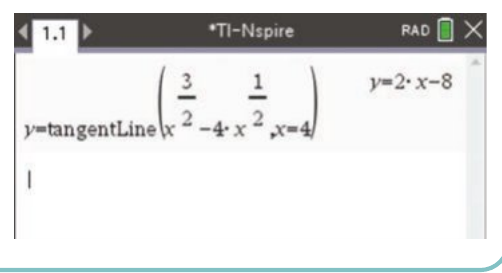
You can use technology to verify your tangent equations and save time on calculations. On a TI-Nspire calculator, use menu > Calculus > Tangent Line.
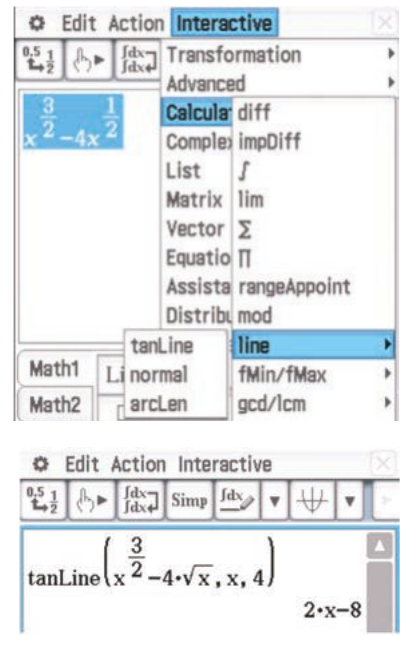
On a Casio ClassPad, enter the expression, then go to Interactive > Calculation > line > tanLine.
Note
While calculators are helpful tools for checking your work, it's important to understand the underlying process. Always practice finding tangent equations by hand first to build your understanding of the concepts.
Worked example: Tangent to a trigonometric function
Example
Worked Example: Tangent to a Sine Function
Question: Find the equation of the tangent to at the point where .
Solution:
Step 1: Find the derivative.
Step 2: Evaluate the function and derivative at .
When :
Step 3: Write the equation of the tangent.
Worked example: Tangent and normal together
Example
Worked Example: Finding Both Tangent and Normal
Question: Find the equations of both the tangent and normal to at the point .
Solution:
Step 1: Find the gradient at this point.
At :
Step 2: For the tangent:
Step 3: For the normal:
The gradient of the normal is .
Special case: Vertical tangents
Sometimes a curve has a vertical tangent at a point where the derivative is not defined. This occurs when the function is continuous at that point, but the derivative approaches infinity.
Understanding these special cases is important because they represent situations where the standard tangent formula cannot be directly applied.
Important
When Vertical Tangents Occur: A vertical tangent appears at a point where:
- The function remains continuous
- The derivative as approaches that point
At these points, the tangent line is vertical (undefined gradient), so you cannot write it in the form .
Example: Vertical tangent on a cube root function
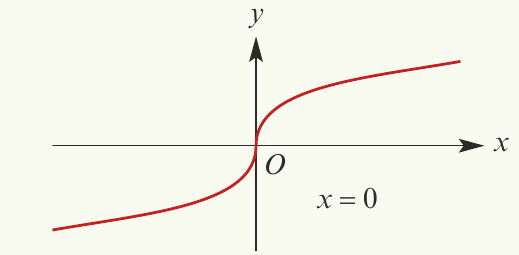
Consider at .
The derivative is not defined at .
For :
The function is continuous at , and as .
The graph has a vertical tangent at .
Note
Notice how the curve becomes increasingly steep as it approaches from both sides. The tangent line at this point would be the vertical line .
Example: Vertical tangent with a cusp
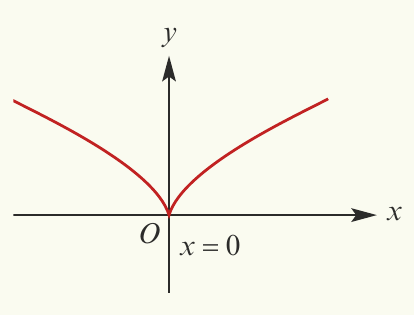
Consider at .
The derivative is not defined at .
For :
The function is continuous at . However:
- as (from the right)
- as (from the left)
This creates a cusp at . The graph has a vertical tangent at this point, but approaches from different directions.
Note
A cusp is a sharp point on the curve where the derivative approaches infinity from one side and negative infinity from the other. This creates a distinctive V-shaped or pointed feature on the graph.
Summary
Summary
Key Points to Remember:
- The equation of a tangent at point is:
- To find a normal, use gradient where is the tangent's gradient
- For perpendicular lines:
- The derivative equals the gradient of the tangent at any point on the curve
- "Flip and flip the sign" to get the normal's gradient from the tangent's gradient
- Vertical tangents occur when a function is continuous but the derivative approaches infinity
- A cusp forms when the derivative approaches from one side and from the other