Differentiating Where n is a Negative Integer (VCE SSCE Mathematical Methods): Revision Notes
📚Revision Notes
Differentiating Where n is a Negative Integer
Introduction
You've already learned how to differentiate polynomial functions with positive integer powers. In this section, we extend this skill to functions involving negative integer powers of .
When working with negative powers, remember that . This means we need to be careful about our domains, since we cannot divide by zero.
Note
Why are domains important for negative powers?
Negative powers involve division by powers of . Since division by zero is undefined, we must exclude from our domain. This is why you'll see (all real numbers except zero) throughout this section.
Functions with negative powers
Here are some examples of functions that involve negative integer powers:
The notation means all real numbers except zero. We exclude zero because negative powers involve division by powers of , and we cannot divide by zero. For example, is undefined when .
Proving the power rule from first principles
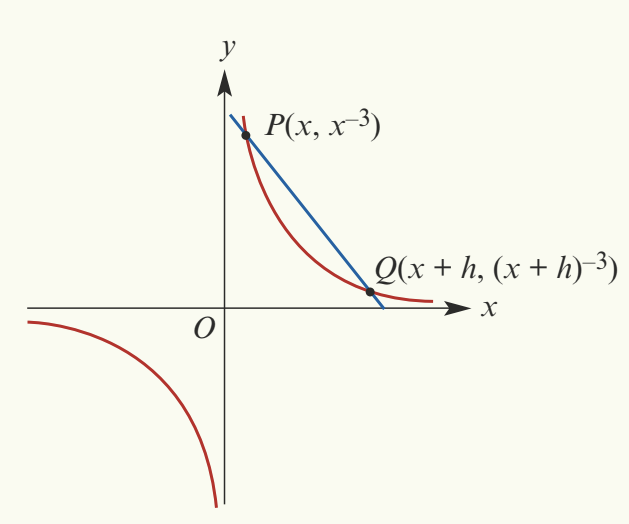
To understand why the power rule works for negative integers, let's prove it rigorously using the definition of the derivative. We'll use the function as our example.
Example
Worked Example: Finding from first principles
For , find from first principles.
Step 1: The gradient of the secant line is:
Step 2: Convert the negative powers to fractions:
Step 3: Expand using the binomial theorem:
Step 4: Simplify the numerator:
Step 5: Factor out from the numerator and cancel:
Step 6: Take the limit as :
Answer:
Notice that the power rule works exactly as it did for positive powers: we multiply by the power and reduce the power by one.
The general power rule
Based on the first principles proof above, we can state the general rule:
Important
Power Rule for Non-Zero Integers
For , we have , where is a non-zero integer.
For , we have , where is a constant.
Domain specifications
The choice of domain depends on whether the power is positive or negative:
- When n is positive, we take the domain of to be
- When n is negative, we take the domain of to be
This distinction is crucial because negative powers involve division by powers of .
Applying the rule to differentiate functions
Now let's see how to apply the power rule to various functions with negative integer powers.
Example
Worked Example: Differentiating a polynomial with negative powers
Find the derivative of , where .
Solution:
If (for )
Apply the power rule to each term:
Simplify:
Note that the derivative of the constant term 2 is 0.
Example
Worked Example: Another derivative calculation
Find the derivative of .
Solution:
Apply the power rule to each term:
Simplify:
Notice how the coefficient 3 remains and we multiply by the power 2, and similarly for the second term where is multiplied by to give .
Example
Worked Example: Finding the gradient at a point
Find the gradient of the tangent to the curve determined by the function at the point .
Solution:
Step 1: Rewrite the function using negative powers:
Step 2: Differentiate:
Step 3: Evaluate at :
Answer: The gradient of the curve at the point is 1.
Example
Worked Example: Showing a derivative is always negative
Show that the derivative of the function is always negative.
Solution:
Step 1: Differentiate:
Step 2: Consider the sign:
Since is positive for all (any number raised to an even power is positive), we have:
Conclusion: The derivative is always negative, meaning the function is always decreasing (except at where it's undefined).
Summary
Key Points to Remember:
- The power rule works for all non-zero integers, including negative integers
- When is negative, the domain must exclude zero: , because we cannot divide by zero
- Always rewrite fractions as negative powers before differentiating: , , etc.
- The derivative of a constant is always zero
- When differentiating terms with negative powers, multiply by the power (which is negative) and reduce the power by one