When Is a Function Differentiable? (VCE SSCE Mathematical Methods): Revision Notes
📚Revision Notes
When Is a Function Differentiable?
What does it mean for a function to be differentiable?
We say a function is differentiable at a point when the following limit exists:
This limit represents the derivative of the function at that point. If this limit exists, we can find the gradient of the tangent line to the function at .
Most functions you'll work with are differentiable throughout their domains. But not all functions have this property.
Note
For instance, the absolute value function is not differentiable at because the gradient is to the left of zero and to the right of zero. The limit from the left and right don't match, so the derivative doesn't exist at that point.
Piecewise functions and differentiability
Some piecewise-defined functions are differentiable everywhere, while others are not. The key factor is whether the pieces join smoothly at the boundary points.
When two pieces of a piecewise function meet at a point:
- If they join smoothly (no sharp corner), the function is differentiable at that point
- If they form a sharp corner or discontinuity, the function is not differentiable at that point
Let's look at some examples to understand this better.
Example
Worked Example: Smooth Join (Differentiable Everywhere)
For the function with the following rule, find and sketch the graph of :
Solution:
To find the derivative, we differentiate each piece separately:
For :
For :
Therefore:
Importantly, is defined and equals . This is because both pieces give the same derivative value at . The two sections of the original function join smoothly at the point .
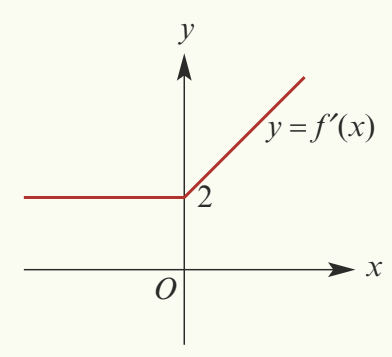
Example
Worked Example: Sharp Corner (Not Differentiable at Join)
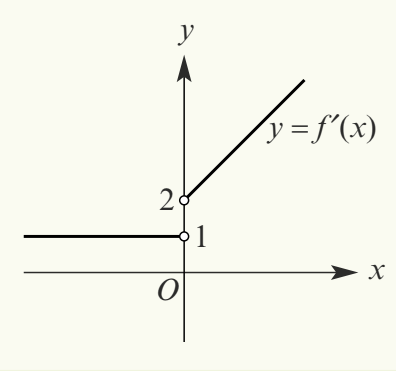
For the function with the following rule, state where the derivative is defined, find for this set of values, and sketch the graph of :
Solution:
Again, we differentiate each piece:
For :
For :
Therefore:
Here's the crucial difference: is not defined because the limits from the left and right are not equal. From the left, the gradient approaches , while from the right it approaches .
The function is differentiable for all real numbers except zero, which we write as .
Example
Worked Example: Continuous but Not Differentiable
For the function with rule , state when the derivative is defined and sketch the graph of the derivative function.
Solution:
Using the power rule for differentiation:
The derivative is not defined at because we cannot divide by zero (the power creates a zero in the denominator).
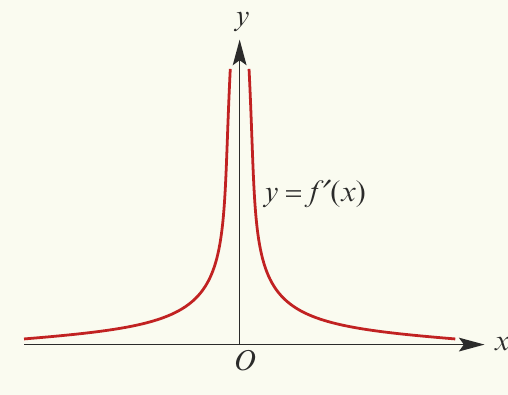
We can verify this using first principles. The derivative at would be:
As , we have . Since this limit doesn't exist, is not defined.
This example shows something important: the function is continuous everywhere (you can draw it without lifting your pen), but it's not differentiable at (the tangent line is vertical at that point).
The relationship between differentiability and continuity
Important
If a function is differentiable at a point, then it must also be continuous at that point.
However, the reverse is not true! A function can be continuous at a point but not differentiable there. The cube root function example above demonstrates this perfectly: it is continuous at , but not differentiable there.
Think of it this way:
- Differentiability is a stronger condition than continuity
- Differentiable continuous (always true)
- Continuous differentiable (not always true)
Summary
Key Points to Remember:
- A function is differentiable at if the limit exists
- For piecewise functions, check if the pieces join smoothly - if they form a sharp corner, the function is not differentiable at that point
- Differentiability implies continuity, but continuity does not imply differentiability
- A function can be continuous everywhere but still have points where it's not differentiable (like at )
- When finding derivatives of piecewise functions, check the derivative from both sides at boundary points to determine if the function is differentiable there