Antidifferentiation: Indefinite Integrals (VCE SSCE Mathematical Methods): Revision Notes
📚Revision Notes
Antidifferentiation: Indefinite Integrals
What is antidifferentiation?
Antidifferentiation is the process of finding a function from its derivative. This is essentially "undoing" differentiation.
For example, we know that the derivative of with respect to is . If we work backwards from , we can determine that the original function was . This reverse process is called antidifferentiation.
Multiple antiderivatives
An important feature of antidifferentiation is that there isn't just one answer. Consider these two functions:
Both have the same derivative: and .
This means that both and are antiderivatives of .
Why can different functions have the same derivative?
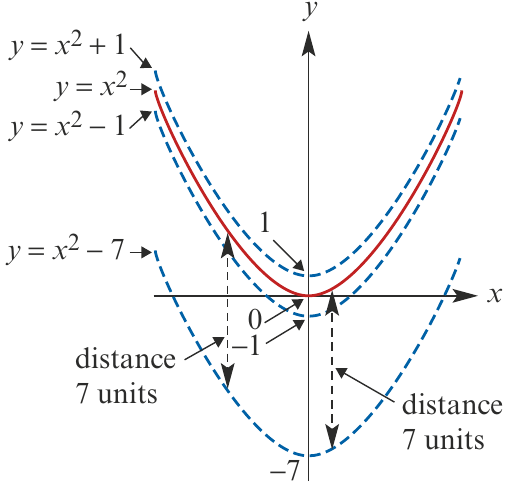
When two functions have the same derivative, they differ only by a constant. Graphically, this means one graph is a vertical shift of the other.
Note
The diagram shows several antiderivatives of . Each parabola is a vertical translation of . They all have the same shape but are shifted up or down the -axis. This visual representation demonstrates why we need the constant in our general antiderivative.
Notation for indefinite integrals
The general antiderivative of is written as , where represents any constant value. We use special notation to express this:
This is read as:
- "the general antiderivative of with respect to is equal to ", or
- "the indefinite integral of with respect to is "
Understanding the notation
- The symbol is called the integral sign
- The expression is the function we're integrating
- indicates we're integrating with respect to
- is the constant of integration (an arbitrary real number)
Important
General Formula for Indefinite Integrals
If , then:
where is an arbitrary real number.
This formula tells us that if is an antiderivative of , then the indefinite integral of gives us plus a constant.
The power rule for integration
When integrating powers of , we can use a general formula, provided the power is not equal to .
Building understanding through examples
Let's look at some differentiation results and reverse them:
- Since implies , we can reverse this:
- Since implies , we can reverse this:
- Since implies , we can reverse this:
- Since implies , we can reverse this:
We can also write:
The general power rule
From these examples, we can see a pattern:
In words: to integrate , add one to the power, then divide by the new power, and don't forget to add the constant .
Important
Critical Restriction
This rule cannot be used when (as division by zero would occur). The case of requires a different approach that will be covered later.
Domain considerations
Note
The power rule can only be applied for suitable values of depending on the value of :
- If , then must be positive ()
- If , then can be any real number except zero ()
- If , then can be any real number ()
Always consider the domain of the original function when applying integration rules.
Rules for integration
These rules follow directly from the corresponding differentiation rules:
Sum rule:
Difference rule:
Constant multiple rule:
where is a real number.
Note
These rules allow us to integrate more complex expressions by breaking them into simpler parts. You can integrate term by term and factor out constants before integrating.
Worked examples
Example
Worked Example 1: Finding the general antiderivative of
Find the general antiderivative (indefinite integral) of .
Step 1: Apply the constant multiple rule
Step 2: Apply the power rule
Step 3: Simplify
Example
Worked Example 2: Finding the general antiderivative of
Find the general antiderivative (indefinite integral) of .
Step 1: Apply the sum rule to split the integral
Step 2: Apply the power rule to each term
Step 3: Simplify
Example
Worked Example 3: Finding in terms of if
Step 1: Rewrite in power form
Step 2: Apply the power rule
Step 3: Simplify and write the solution
Example
Worked Example 4: Finding in terms of if
Step 1: Rewrite in power form
Step 2: Apply the power rule
Step 3: Simplify
Finding a specific antiderivative
When we're given additional information about a function, we can find the exact value of the constant and determine a unique antiderivative.
Example
Worked Example 5: Finding a specific function with a given condition
It is known that and . Find .
Step 1: Find the general antiderivative
Step 2: Use the condition to find
As , we have .
Step 3: Write the final answer
Example
Worked Example 6: Finding the equation of a curve
If the gradient of the tangent at a point on a curve is given by and the curve passes through the point , find the equation of the curve.
Step 1: Set up the problem
Let the curve have equation . Then .
Step 2: Find the general antiderivative
Step 3: Use the condition that the curve passes through
Since , we have:
Hence .
Step 4: Write the final answer
Summary
Key Points to Remember:
- Antidifferentiation is the reverse process of differentiation - finding a function from its derivative
- The indefinite integral represents all possible antiderivatives of
- Always include the constant of integration when finding indefinite integrals
- The power rule for integration states: (where )
- You can find a specific antiderivative when given an additional condition by solving for the constant