Finding the Area Under a Curve (VCE SSCE Mathematical Methods): Revision Notes
📚Revision Notes
Finding the Area Under a Curve
Introduction to area and definite integrals
The definite integral gives us the net signed area under a curve. This means the integral takes into account whether the curve is above or below the -axis, which affects the sign of the result.
Note
When finding areas, the sign of f(x) in your interval is crucial. This determines whether you get a positive or negative value from the integral, and affects how you calculate the actual area.
Finding the area of a region
When the function is above the x-axis
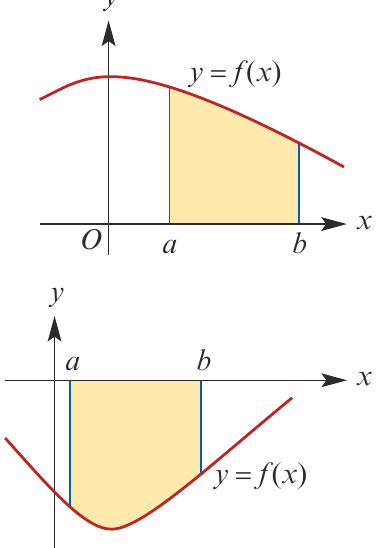
If your function satisfies for all in the interval , this means the curve stays above or on the x-axis throughout the entire region. In this case, finding the area is straightforward.
The area of the region between the curve, the -axis, and the vertical lines and is given by:
When the function is below the x-axis
If your function satisfies for all in the interval , the curve stays below or on the x-axis. Here's where we need to be careful: the definite integral will give us a negative number, but area is always positive.
Important
Why the negative sign?
When a function is below the -axis, the integral produces a negative value. However, area must always be positive. Therefore, you must take the negative of the integral to obtain the actual area.
To find the actual area , we need to use the negative of the integral:
Alternatively, you can reverse the limits of integration:
Both approaches give the same positive area value.
When the function crosses the x-axis
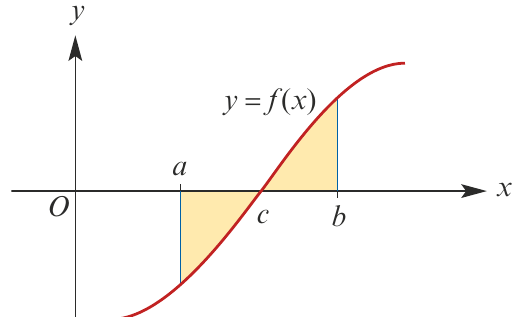
Sometimes your function crosses the -axis within the interval. Suppose the function crosses at point where , so that:
- for in the interval (above the axis)
- for in the interval (below the axis)
Important
Splitting the integral:
When the function crosses the x-axis, you cannot use a single integral. Instead, you must split your calculation at the crossing point and add the absolute values of each region together.
The area is:
The first integral is positive (above axis), and we add the negative of the second integral (which was below the axis) to get the total area.
Note
Critical factor: The sign of f(x) in your given interval is the key determining factor when calculating area under a curve. Always check whether your function is positive, negative, or crosses the axis before setting up your integral.
Worked examples
Example
Worked Example: Finding area above the x-axis
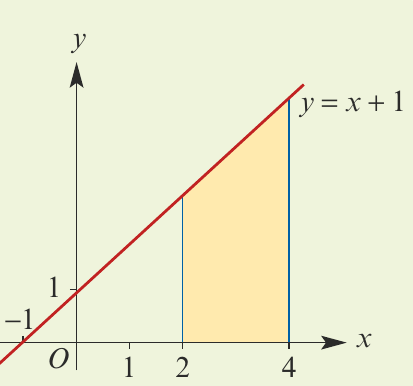
Find the area of the region between the -axis, the line and the lines and . Check your answer by calculating the area of the trapezium.
Solution:
First, notice that is positive throughout the interval from to . When , , and when , . So the curve is above the -axis.
The area of the shaded region is 8 square units.
Check: We can verify this using the trapezium area formula:
This confirms our answer.
Example
Worked Example: Finding area below the x-axis
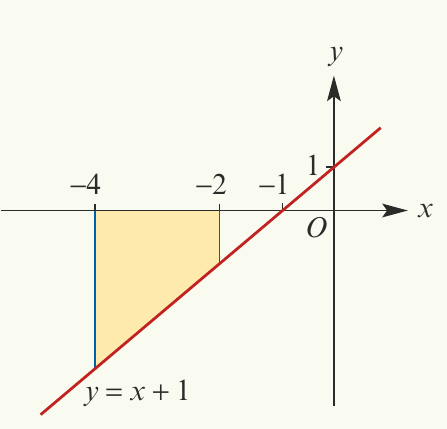
Find the area under the line between and .
Solution:
Looking at the diagram, we can see that in this interval, the line is below the x-axis. When , , and when , . Both values are negative.
Since the function is below the -axis, we need to use the negative of the integral:
The area of the shaded region is 4 square units.
Note: The negative sign is essential here because the integral gives us the signed area from to , which is negative. Taking the negative of this gives us the positive area.
Example
Worked Example: Function crossing the x-axis
Find the exact area of the shaded region.
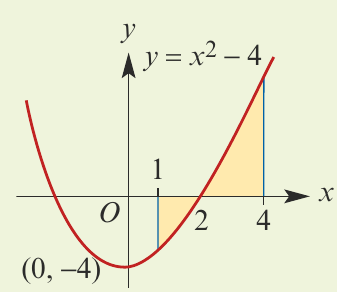
Solution:
The parabola crosses the -axis at (since gives ). Looking at the shaded region from to :
- From to : the curve is below the x-axis (since )
- From to : the curve is above the x-axis (since )
We need to split the integral at x = 2:
Calculate the first integral:
Calculate the second integral:
Add the two parts together:
The area is 37/3 square units.
Summary
Key Points to Remember:
- The definite integral gives the net signed area, taking into account whether the function is above or below the -axis
- When throughout the interval, use directly
- When throughout the interval, use to get a positive area
- When the function crosses the x-axis, split the integral at the crossing point and add the absolute values of each region
- Always check which sign your function has in the given interval - this is the critical factor in determining how to calculate the area
- You can verify your answers using geometric formulas (like the trapezium formula) when the shape is simple