Integration of Circular Functions (VCE SSCE Mathematical Methods): Revision Notes
📚Revision Notes
Integration of Circular Functions
Introduction to integrating circular functions
When we differentiate circular functions like sine and cosine, we get predictable results. This knowledge allows us to work backwards and find antiderivatives of these functions through integration.
Note
The Fundamental Relationship from Differentiation:
The key to understanding integration of circular functions lies in knowing their derivatives:
- If , then
- If , then
By reversing this process, we can determine the integral formulas for circular functions.
Key integration formulas
Important
Essential Integration Formulas for Circular Functions:
Understanding the formulas:
- The coefficient represents the frequency of the circular function
- The constant represents a phase shift (horizontal translation)
- We must divide by k because of the chain rule working in reverse
- The constant represents the constant of integration for indefinite integrals
- Notice the negative sign when integrating sine (this comes from the derivative of cosine being negative sine)
Worked example: finding antiderivatives
Example
Worked Example: Finding Antiderivatives of Circular Functions
Part a: Find an antiderivative of
Using the formula for integrating sine:
Here, and
Therefore:
Part b: Find an antiderivative of
We can take the constant factor outside the integral:
Here, and
Applying the formula:
Worked example: evaluating definite integrals
When evaluating definite integrals, we use the antiderivative and substitute the limits of integration.
Example
Worked Example: Evaluating Definite Integrals with Exact Values
Part a: Find the exact value of
First, find the antiderivative:
Now evaluate at the limits:
Part b: Find the exact value of
Split the integral into two parts:
The antiderivative is:
Evaluating at the limits:
Worked example: finding areas under curves
Finding areas under circular function curves requires careful attention to regions above and below the x-axis.
Example
Worked Example: Finding Areas Under Circular Function Curves
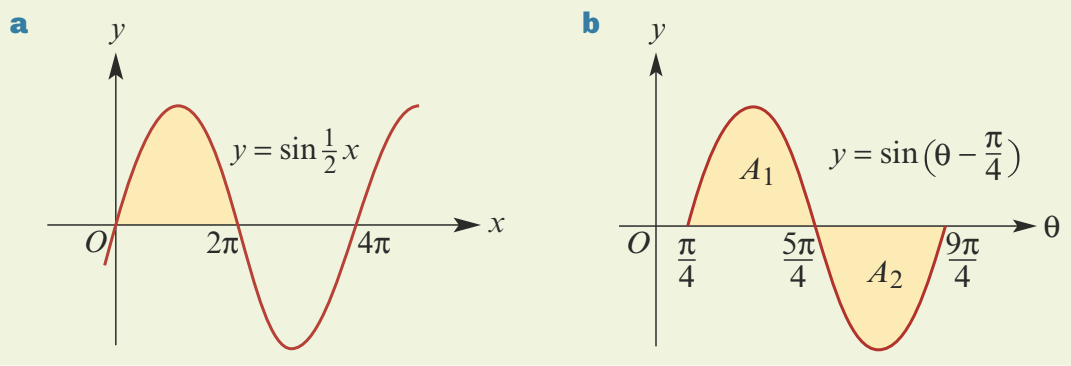
Part a: Find the exact area under one complete arch of from to
The graph shows a complete arch of the sine curve above the x-axis. Since the entire region is above the x-axis, we can integrate directly:
Therefore, the area of the shaded region is 4 square units.
Part b: Find the total area for regions and of
This graph shows two regions:
- Region : above the θ-axis from to
- Region : below the θ-axis from to
Since region is below the axis, we must treat it separately.
Finding Area :
Finding Area :
Since this region is below the axis, the integral gives a negative value. We take the negative of the integral to get the positive area:
Therefore, the total area of the shaded region is 4 square units.
Important
Critical Note About Areas Below the Axis:
When finding areas, always check whether the curve lies above or below the x-axis over your interval of integration. For regions below the axis, you must either split the integral or use the absolute value to ensure a positive area result.
Summary
Key Integration Formulas:
Important
Key Points to Remember:
- When integrating , the result is (notice the negative sign and division by k)
- When integrating , the result is (division by k)
- Always divide by the coefficient k when integrating circular functions
- For area calculations, be careful with regions below the x-axis—these require separate treatment to ensure positive area values
- When evaluating definite integrals, use exact values for common angles like , , , etc.