The Area of a Region Between Two Curves (VCE SSCE Mathematical Methods): Revision Notes
📚Revision Notes
The Area of a Region Between Two Curves
Understanding the basic concept
When we need to find the area of a region trapped between two curves, we use integration. The key idea is to subtract the area under the lower curve from the area under the upper curve.
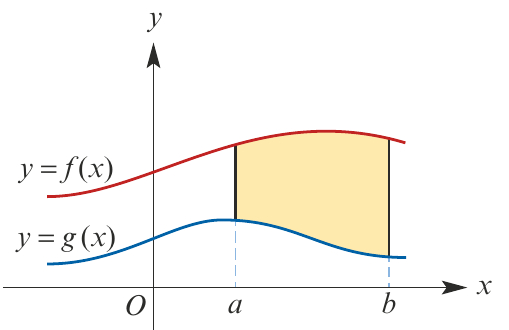
Consider two continuous functions and defined on the interval . If for all values of in the interval , then the area enclosed by these two curves and the vertical lines and can be calculated using:
This formula tells us to integrate the difference between the upper function and the lower function over the interval.
Note
The shaded region in the diagram shows the area we calculate using this method. The function is above the function throughout the interval from to .
When one curve is always above the other
If one curve sits entirely above another curve over a given interval, we simply apply the formula above. The crucial step is identifying which function is the upper one and which is the lower one.
Example
Worked Example: Parabola and straight line
Find the area of the region bounded by the parabola and the line .
Solution:
First, we need to find where these curves intersect by setting them equal:
Therefore or
The coordinates of point are (2, 4).
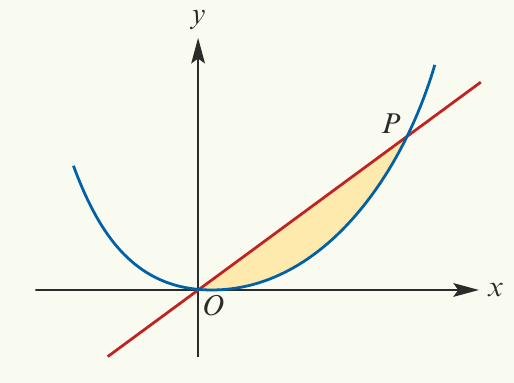
From the graph, we can see that the line is above the parabola in the interval from to . Therefore we integrate (line - parabola):
Required area
The area is square units.
Example
Worked Example: Region with vertical boundaries
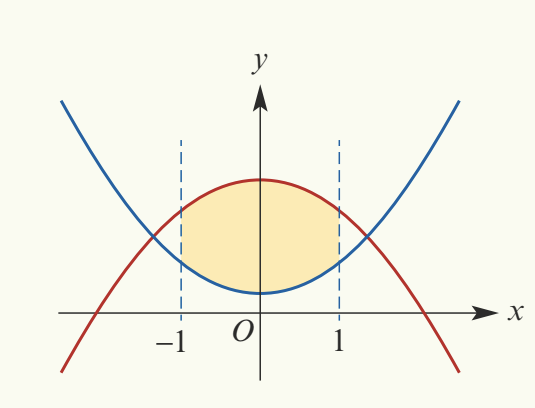
Calculate the area of the region enclosed by the curves and between the vertical lines and .
Solution:
We need to determine which curve is above the other in the interval . Notice that will be greater than when:
This is true for between and .
Required area
The area is square units.
When curves cross each other
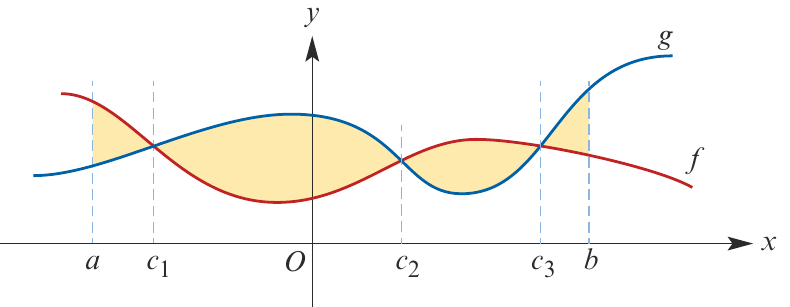
What happens if the two curves intersect at points between the boundaries? In this case, we need to be more careful because the upper and lower functions swap positions.
Important
To find the area of the shaded region when curves cross, we must split the calculation into separate intervals. At each interval, we identify which function is on top and integrate (upper - lower).
The total shaded area becomes:
Notice how we switch the order of subtraction depending on which curve is above the other in each interval.
Example
Worked Example: Cubic and linear functions
Find the area of the region enclosed by the graphs of and .
Solution:
First, find where the curves intersect by setting them equal:
Therefore or
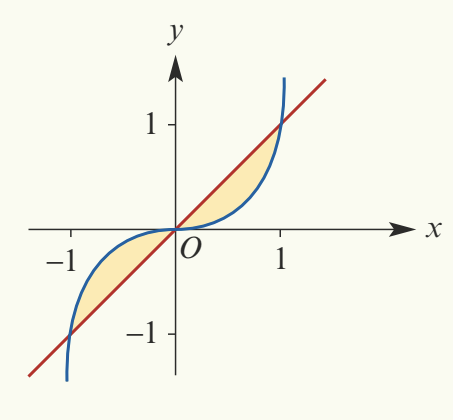
Now we need to determine which function is above the other in each interval:
- For : (the cubic is above the line)
- For : (the line is above the cubic)
The area is given by:
The area is square unit.
Working with trigonometric functions
The same principles apply when working with trigonometric functions. We still need to find intersection points and determine which function is above the other.
Example
Worked Example: Sine and cosine
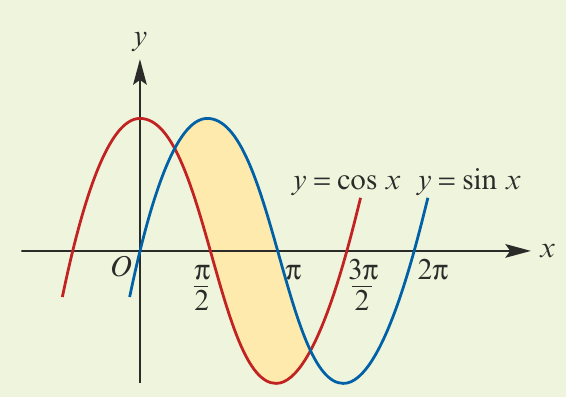
Find the area of the shaded region between and from to .
Solution:
First, find where :
If , then
Therefore or in the interval
From the graph, we can see that between and .
Area
The area is square units.
Working with exponential and logarithmic functions
We can also apply these techniques to exponential and logarithmic functions, sometimes using clever geometric approaches to simplify our calculations.
Example
Worked Example: Logarithmic and exponential functions
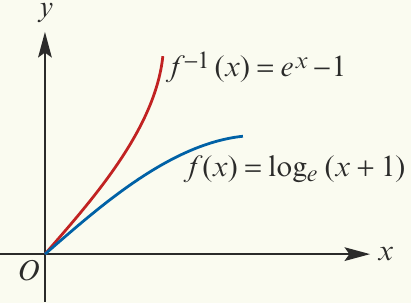
For the function , where :
a) Find and sketch both functions on the same axes.
Solution:
Let . Then:
Hence the inverse function is:
, where
b) Find the exact value of .
Solution:
c) Find the exact value of .
Solution:
We can use a geometric approach here. Looking at the diagram below:
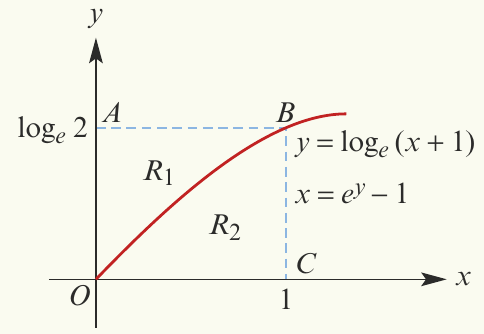
The area of rectangle (width 1, height )
The area of region (from part b)
The area of region = area of rectangle - area of region
Therefore
Summary
Summary
Key Formula:
To find the area of a region bounded by two curves and vertical lines and :
where and are continuous functions on such that for all .
When curves intersect:
If the curves intersect within the interval, split the calculation into separate intervals and always integrate (upper function - lower function) in each interval.
Summary
Key Points to Remember:
- Top minus bottom: Always integrate the upper function minus the lower function
- Find intersections first: Set the two functions equal to find where they meet
- Split at crossings: When curves intersect, divide the region into separate intervals where one function stays above the other
- Check which is above: In each interval, determine which function is the upper one (you can test a value or sketch the curves)
- Keep boundaries clear: Pay attention to whether the region is bounded by vertical lines or just by the intersection points