Families of Cubic Polynomial Functions (VCE SSCE Mathematical Methods): Revision Notes
📚Revision Notes
Families of Cubic Polynomial Functions
What are families of cubic polynomial functions?
Just as we can group straight lines or quadratic functions by shared characteristics, we can also group cubic polynomial functions into families. A family of cubic functions is a set of cubic graphs that share a common form or property.
Note
In these families, we use letters like , , , , and as parameters - these are values that can vary to create different members of the same family.
Types of cubic function families
Different families of cubic functions are defined by their form and properties. Here are the main families you need to know:
Key families include:
-
Vertical dilation form: where represents all cubic graphs that are vertical dilations of the basic cubic
-
Translation form: where represents all cubic graphs that are translations (shifts) of
-
Factored form: where represents all cubic graphs with specific x-axis intercepts (in this case, , , and )
-
Origin-passing form: where represents all cubic graphs that pass through the origin (notice there's no constant term)
Finding rules for cubic polynomial functions
The method you use to find the equation of a cubic function depends on what information you're given. Here are the main scenarios:
When the point of inflection is known
If you know the cubic has the form and you're given the point of inflection , you only need one additional point to find the value of .
Example
Worked Example: Finding a when the point of inflection is known
A cubic function has rule of the form . The point is on the graph. Find the value of .
Solution:
The point of inflection tells us that and .
Substitute the point into the equation:
Therefore, the rule is .
When x-axis intercepts are known
If you know three -axis intercepts, you can write the cubic in factored form. Then use one additional point to find .
Example
Worked Example: Finding a when x-axis intercepts are known
A cubic function has rule of the form . The point is on the graph. Find the value of .
Solution:
The -axis intercepts are , , and (from the factors).
Substitute the point :
Therefore, the rule is .
When multiple points are known
If you have a general cubic form with multiple unknown parameters, you need enough points to create a system of equations.
Example
Worked Example: Finding parameters using simultaneous equations
A cubic function has rule of the form . The points and are on the graph. Find the values of and .
Solution:
Since there are two unknowns ( and ), we need two equations.
Using :
Using :
Multiply equation (1) by :
Subtract equation (3) from equation (2):
Substitute back into equation (1):
Therefore, and .
Finding rules from graphs
When working with graphs, you need to identify key features to determine the appropriate form of the equation.
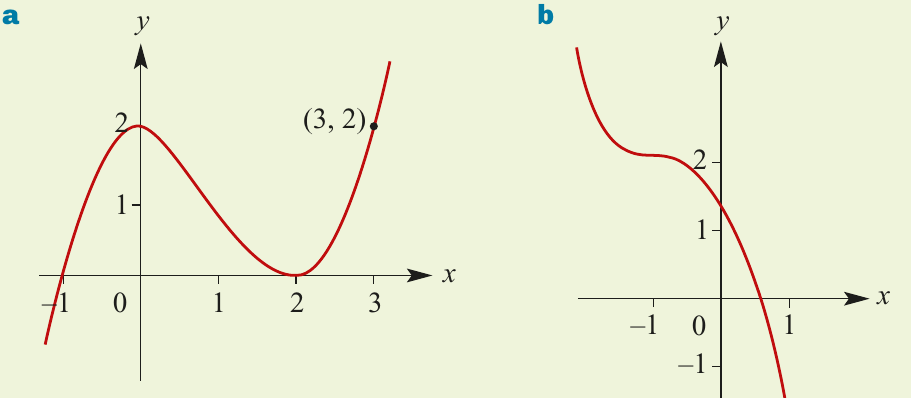
Example
Worked Example: Finding the rule from a graph with a repeated root
For graph (a) above: The -axis intercepts are and . Notice that the graph touches the -axis at rather than crossing it. This means is a repeated factor.
The form of the rule is:
Using the point :
Therefore, the rule is .
Important
Repeated Factors: When a graph touches (rather than crosses) the -axis at a point, that factor is repeated. This is a critical observation for writing the correct factored form.
Example
Worked Example: Finding the rule from a translated cubic
For graph (b) above: This graph has the characteristic S-shape of a translated cubic. The point of inflection appears to be at .
The form of the rule is:
Using the point :
Therefore, the rule is :.
Key information needed to determine a cubic rule
You can determine the rule of a cubic function if you know:
-
Four points on the graph - this gives you four equations to solve for four unknowns in the general form
-
The factored form with values of and (including one repeated root), plus one additional point
-
The translation form with the inflection point , plus one additional point
Note
The key is to match the information given to you with the most appropriate form of the cubic equation. This will minimize the number of unknowns and make solving much easier.
Exam tips
Important
Essential Exam Strategies:
-
Always identify the form first: Look at what information you're given to determine which form to use
-
Repeated factors: If a graph touches (rather than crosses) the -axis, that root is repeated
-
Point of inflection: For the form , the point of inflection is always at
-
Check your answer: Substitute your values back into the original equation to verify they work
Remember!
Summary
Key Points to Remember:
-
Different families of cubic functions are defined by their form and share common properties
-
The parameters , , , , and determine specific members within each family
-
To find a cubic rule, match the given information to the appropriate form
-
A point of inflection and one other point are sufficient for translation form cubics
-
Three x-axis intercepts and one other point are sufficient for factored form cubics
-
Watch for repeated factors when a graph touches (but doesn't cross) the -axis